Recommended Free Tools
Fomalhaut is a bright, nearby star surrounded by a vast system of dusty belts—and its once-famous planet candidate, Fomalhaut b, is now best explained as a dispersing cloud of collision debris. Observations from Hubble and the James Webb Space Telescope have made this system a valuable way to study the raw material and structure of planetary systems.
What is Fomalhaut?
Fomalhaut is the brightest star in the southern constellation Piscis Austrinus, or the Southern Fish, and it can be seen without a telescope. NASA gives its distance as about 25 light-years from Earth. Its brightness and relative proximity make it possible for astronomers to study the dusty material around it in detail. NASA’s Webb overview describes it as the brightest naked-eye star in the constellation.
As an Amazon Associate I earn from qualifying purchases.
How did astronomers discover its dusty belts?
The story began with infrared observations. In 1983, NASA’s Infrared Astronomical Satellite (IRAS) detected the dust ring’s infrared signature. In 2004, Hubble’s Advanced Camera for Surveys resolved the outer belt in visible light for the first time. That image showed a sharp inner edge and an offset ring—features that helped prompt the idea that an unseen planet might be shaping the belt. NASA’s Hubble feature includes an updated note on how the interpretation of Fomalhaut b changed.
What did Webb discover around Fomalhaut?
In 2023, the James Webb Space Telescope’s Mid-Infrared Instrument (MIRI) revealed three nested belts, including inner structures that had not previously been resolved. The imaged system extends about 14 billion miles (23 billion kilometers) from the star, roughly 150 times the Earth–Sun distance. Its outermost belt is roughly twice the scale of our Solar System’s Kuiper Belt. NASA’s Webb report describes the observations.
#1 Best Overall
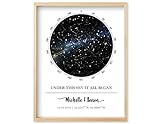
- Best Quality: printed on premium luster paper using the highest high-definition ink quality from state-of-the-art printers. Completely eye catching, unframed, ready for the frame of your choice (not included).
- United States all the way: designed, printed, proofed, and expertly packaged right here in our studio in Florida.
- 100% Accurate: star software that pulls the most detailed of skies possible for any date (past, present, or future) and any location.
- Fully Customizable: 3 size options, 4 font choices, any title, date & location! Created for one name, two names, or more.
Hubble’s 2004 image showed the outer belt in visible light; Webb’s MIRI observations revealed additional structure using infrared emission. The belts themselves are observed features. NASA says their shapes are most likely carved by the gravity of unseen planets, but Webb did not directly image planets in the gaps. That explanation is an inference based on how planets shape debris structures in our own Solar System.
Why are the belts important?
The belts contain dust produced by collisions among larger bodies, analogous to asteroids and comets. Studying that debris gives astronomers clues about the larger objects that are otherwise difficult to observe and about how material is organized in a planetary system. András Gáspár, lead author of the Webb study at the University of Arizona, called Fomalhaut “the archetype of debris disks found elsewhere in our galaxy,” noting that it has components similar to those in our own planetary system. NASA’s report includes his description.
Rank #2

- NAVIGATE THE NIGHT SKY WITH EASE: This planisphere is a comprehensive sky map for northern hemisphere stargazers located between the equator and latitude 60° north that makes it easy to identify what constellations and major celestial objects are up in your night sky based on the date and time.
- INNOVATIVE DOUBLE-SIDED DESIGN: This night sky guide, which features maps crafted by noted celestial cartographer Wil Tirion, uses a double-sided design to minimize the distortion that is inherent to any polar-centered projection. This design choice means observers can see truer representations of the constellations located outside the equator (noted by a green line) by simply flipping the planisphere over.
- IDENTIFIES MULTIPLE TYPES OF CELESTIAL OBJECTS: In addition to showcasing constellations, this planisphere indicates the location of notable variable stars, open clusters, nebulae and galaxies. Other features include a line representing the ecliptic, a faint blue band for the Milky Way and a magnitude scale that indicates the brightness of the stars that are shown.
- EXCELLENT CRAFTSMANSHIP AND CLEAR INSTRUCTIONS: Made in the USA, this astronomy planisphere is made of durable plastic that easily wipes clean, and the rotating components are secured with sturdy brass rivets for smooth manipulation. Guidance for using your sky map is printed on the device for quick reference.
- TRUSTED CUSTOMER SUPPORT: This product comes with reliable after-sales support from our team based in Springdale, Arkansas. If you have any questions about how to use your planisphere, we are ready to help!
Is Fomalhaut b a planet?
Fomalhaut b was announced in 2008 as a candidate planet, but it is no longer best described as a planet. Hubble observations showed that the source faded and spread out over time. A 2020 peer-reviewed analysis by András Gáspár and George H. Rieke found its changing appearance and motion consistent with a dispersing dust cloud from a catastrophic collision between large planetesimals. That is the best-supported interpretation, though it does not establish every detail of the collision. The 2020 analysis in PNAS reports the findings; NASA’s historical feature carries an editor’s note reflecting the later interpretation.
What is the “great dust cloud” Webb saw?
NASA also reported a separate feature called the “great dust cloud,” which may be evidence of a collision in Fomalhaut’s outer belt. It is not Fomalhaut b: Webb’s feature is distinct from the candidate source Hubble first detected inside the outer ring. NASA distinguishes the two features in its Webb report.
Quick Recap
Best Value
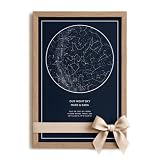
- GIVE THEM THE STARS ✦ Delight someone special with this one of a kind personalized star map gift - a truly unforgettable and meaningful way to remember a special anniversary, wedding, engagement, birthday, adoption, graduation or just because.
- CUSTOMIZABLE FEATURES ✦ Celestory star maps come in multiple sizes, color styles, and unframed / framed print and canvas options to suit any aesthetic - making each custom star map as unique as the moment it captures.
- GUARANTEED ACCURATE ✦ Each star chart is mapped with NASA-backed astronomical data of the constellations, stars, moon, planets, and Milky Way for any date and location of your choosing.
- QUALITY TO LAST A LIFETIME ✦ Professionally printed in the USA on premium fine art paper or gallery wrapped canvas with giclée archival inks - your star map is a heirloom quality keepsake that will stand the test of time.
- CUSTOM MADE ✦ Simply click on "Customize now" to design your custom star map with your personal message and specific date and location. You may then choose your star map display size: 8x10, 11x14, 16x20, 18x24, 24x30, or 30x40 and the color of your made-to-order wood frame.
Rank #4
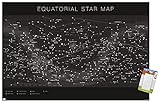
- THIS TRENDS ASTROLOGY - EQUATORIAL STAR MAP WALL POSTER uses high-resolution artwork and is printed on PhotoArt Gloss Poster Paper which enhances colors with a high-quality look and feel
- INCLUDES 16 STICKY POSTUPS TABS that secure the art print to the wall without any holes
- ADHESIVE POSTER MOUNTS don't damage your walls like nails, thumb tacks, or push pins
- PERFECT SIZE for any room; poster is 22.375" x 34"
- EASILY DECORATE any space to create the perfect decor for a party, bedroom, bathroom, kids room, living room, office, dorm, and more
Rank #3

- Best Quality: printed on premium luster paper using the highest high-definition ink quality from state-of-the-art printers. Completely eye catching, unframed, ready for the frame of your choice (not included).
- United States all the way: designed, printed, proofed, and expertly packaged right here in our studio in Florida.
- 100% Accurate: star software that pulls the most detailed of skies possible for any date (past, present, or future) and any location.
- Fully Customizable: 3 size options, 4 font choices, any title, date & location! Created for one name, two names, or more.
Fomalhaut observations at a glance
- 1983: IRAS detects the dust ring’s infrared signature.
- 2004: Hubble resolves the outer belt in visible light.
- 2008: Fomalhaut b is announced as a candidate planet.
- 2020: A peer-reviewed analysis finds that Fomalhaut b’s fading and expansion fit a collision-produced dust cloud.
- 2023: Webb MIRI reveals three nested belts and reports the separate “great dust cloud.”
Product prices and availability are accurate as of the date/time indicated and are subject to change. Any price and availability information displayed on Amazon at the time of purchase will apply.




