Eco Mode saves power while an Epson projector is actively projecting; Sleep Mode is for inactivity. They apply to different states, so neither is a universal winner. The exact energy difference depends on your projector model, how its Sleep Mode works, communication settings, and how long it spends in each state. Epson’s published standby figures should not be treated as Sleep Mode figures unless that model’s documentation confirms they describe the same state.
What Eco Mode and Sleep Mode do
Eco Mode reduces power during projection
Eco Mode is a lower-brightness setting for an image that is still being projected. Epson’s specifications for the S17/X17/W17 describe it as operating at a lower brightness setting. Epson’s PowerLite X12 brochure says its ECO setting reduces lamp brightness and fan noise while saving power and lamp life. The trade-off is a dimmer image, which may or may not suit your room and content.
As an Amazon Associate I earn from qualifying purchases.
For two examples, Epson lists the PowerLite 1750 at 322 W in normal mode and 212 W in ECO mode, and the Home Cinema 1060 at 315 W in normal mode and 228 W in ECO mode. These are manufacturer-published specifications for those models, not measurements of every Epson projector or tests of your setup. See Epson’s PowerLite 1750 product page and Home Cinema 1060 product page.
Recommended Free Tools
Sleep Mode is for inactivity
Sleep Mode addresses periods when the projector is inactive rather than when it is actively displaying an image in Eco Mode. Its exact behavior and trigger depend on the model. For example, Epson’s PowerLite 1750 listing describes a timer adjustable from 1 to 30 minutes when the A/V mute slide is closed or no signal is detected. The PowerLite X12 brochure describes a no-signal timer, while Epson’s S17/X17/W17 specifications identify Sleep Mode as “Sleep Mode (A/V Mute).” These examples do not establish that every Epson projector uses the same controls or behavior.
#1 Best Overall

- Display Stunning Images up to 300" — Widescreen picture four times larger than a 75" flat panel delivers an immersive experience for business presentations, home viewing and beyond
- Compact Design — Sleek, lightweight design easily fits in backpacks for easy portability on the go
- Ultra Bright Images — 3,000 lumens of color and white brightness (1) deliver outstanding-quality images in a variety of lighting conditions
- Best-in-Class Color Brightness (2) — Advanced 3-chip 3LCD technology displays 100% of the RGB color signal for every frame, allowing for outstanding color accuracy while maintaining excellent color brightness without any distracting “rainbowing” or “color brightness” issues seen with other projection technologies
- Compatible with Streaming — Connect your preferred streaming solution, such as an Apple TV, Roku, Amazon Fire TV or Android TV (3), to the built-in HDMI port to start streaming your favorite content—easy.
Consult the manual for your model to learn what its Sleep Mode does and what event starts it. The X12 brochure is available from Epson’s PowerLite X12 brochure; the S17/X17/W17 specifications are in Epson’s product specifications.
Why the published standby figures do not settle the comparison
Epson lists separate standby power figures for the two example models, with different values depending on whether communications are on or off:
Rank #2
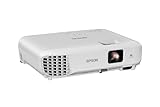
- EXTRA-LARGE SCREEN DISPLAY — Image size reaches up to 300 in, 4x the size of a 75 in flat panel; Color projector with speaker allows you to level up your Zoom video conferencing experience with stunning widescreen WXGA resolution
- ULTRA BRIGHTNESS — 4,000 Lumens of Color Brightness (IDMS rated) and 4,000 Lumens of White Brightness (ISO Rated)¹; Wall projector allows you to display group presentations, spreadsheets and videos, even in well-lit rooms
- CRISP IMAGE QUALITY — Advanced 3-Chip 3LCD technology displays 100% of RGB color signal for every frame, providing precision color accuracy while maintaining vivid color brightness, without distracting "rainbowing" or "color brightness" issues
- VERSATILE CONNECTIVITY — Epson video projector features two HDMI ports so you can easily connect laptops and streaming devices², including Amazon Fire, Apple TV, Roku and Chromecast; Connect laptops for seamless video conferencing and more
- QUICK AND SIMPLE SETUP — The built-in speaker means you can start using this business projector immediately; Easy setup for video and audio right out of the box; Portable projector can also be easily repositioned
| Model | Normal projection | ECO projection | Standby, communication on | Standby, communication off |
|---|---|---|---|---|
| PowerLite 1750 | 322 W | 212 W | 7.4 W | 0.38 W |
| Home Cinema 1060 | 315 W | 228 W | 2.0 W | 0.2 W |
All figures are the specifications Epson publishes on the respective product pages; publication years are not stated there. Epson labels the lower figures as standby, not as Sleep Mode consumption. Without confirmation in the specific model’s manual, it would be inaccurate to equate those states. The figures also show why the model and communication setting matter: even listed standby use differs between models and settings.
What’s actually slowing this PC down?
Pick the symptom - the matching free tool is one click away.
Quick Recap
Rank #4
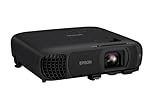
- EXTRA-LARGE SCREEN DISPLAY — Image size reaches up to 300 in, 4x the size of a 75 in flat panel; Color projector with speaker allows you to level up your Zoom video conferencing experience with stunning Full HD 1080p resolution
- ULTRA BRIGHTNESS — 4,100 Lumens of Color Brightness (IDMS rated) and 4,100 Lumens of White Brightness (ISO Rated)¹; Wall projector allows you to display group presentations, spreadsheets and videos, even in well-lit rooms
- CRISP IMAGE QUALITY — Advanced 3-Chip 3LCD technology displays 100% of RGB color signal for every frame, providing precision color accuracy while maintaining vivid color brightness, without distracting "rainbowing" or "color brightness" issues
- WORKS WITH APPLE AIRPLAY — Epson projector with wifi allows you to wirelessly stream videos, music, photos and presentations to your projector from your iPhone, iPad, or Mac², plus screen mirroring with Miracast to stream from your Windows PC³
- VERSATILE CONNECTIVITY — Features two HDMI ports and a USB port that functions as a power source for streaming devices⁴; Easily connect laptops and devices including Fire TV, Apple TV, Roku, and Chromecast; Seamless video conferencing and more
Rank #3
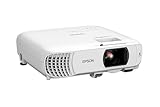
- HOME THEATER PROJECTOR — Bring your entertainment experience to the next level; With detailed 1080p images and fast data processing, the Epson Home Cinema projector is optimized for fast-action sports and more; Also an exciting casual gaming projector
- ULTRA BRIGHT IMAGES — 4,000 Lumens of Color Brightness (IDMS rated) and 4,000 Lumens of White Brightness (ISO Rated)¹; Wall projector for tv and movies delivers clear and crisp images in a variety of lighting conditions
- VIVID AND PRECISE COLOR — Advanced 3LCD technology displays 100% of RGB color signal for every frame, providing precision color accuracy while maintaining vivid color brightness, without distracting "rainbowing" or "color brightness" issues
- VERSATILE CONNECTIVITY — Streaming projector features two HDMI ports and a USB port that functions as a power source for streaming devices²; Connect laptops and devices, including Fire TV, Apple TV, Roku, and Chromecast; Seamless video conferencing
- QUICK AND SIMPLE SETUP — The built-in speaker means you can start using this projector immediately; Easy setup for video and audio right out of the box; Portable projector with speaker can also be easily repositioned
How to estimate which setting saves more in your setup
- Identify your model. Find its manual or specifications on Epson’s support site and check how Eco, Sleep, A/V mute, and standby are defined.
- Compare like with like. Use the Eco figure for active projection and a Sleep or standby figure only if Epson identifies it as the state you are measuring. Check whether communications are enabled.
- Account for time. Your total use depends on how many hours the projector spends projecting in Eco and how many hours it spends inactive. A long viewing session and a short idle interval contribute differently from extended inactivity.
- Check image suitability. Eco saves power while projecting by lowering brightness, so use it only if the resulting image remains clear enough for the room and content.
- Measure if you need a direct answer. An electricity usage monitor can show the draw of your particular projector in the states you use. Allow the projector to enter the intended state and verify it has done so before comparing readings.
Which should you use?
- While watching or presenting: use Eco Mode if its lower brightness is acceptable. Epson’s cited examples list lower power in ECO than in normal projection.
- When the projector is inactive: use its Sleep Mode or inactivity timer as described in that model’s manual. Do not assume its listed standby wattage is the Sleep Mode wattage.
- For a numeric winner: compare the actual model’s power in the relevant states and the time spent in each. The available Epson examples do not establish a universal Sleep-versus-Eco wattage comparison.
Product prices and availability are accurate as of the date/time indicated and are subject to change. Any price and availability information displayed on Amazon at the time of purchase will apply.




