Document understanding usually means interpreting documents—identifying what they contain and extracting useful information. Intelligent document processing (IDP) usually describes the wider workflow that takes documents from intake through digitization, classification, extraction and validation, then sends usable data to another system or process. The terms overlap, and vendors do not use them consistently, so compare the capabilities and workflow rather than relying on the label.
What does document understanding mean?
In practical terms, document understanding is the interpretive part of document automation. Software analyzes a document’s content and structure so it can recognize a document type, find relevant information, and produce structured fields or tables.


As an Amazon Associate I earn from qualifying purchases.
For example, a system might identify an invoice, locate its invoice number and total, and return those values as structured data. It may also interpret layout or context to determine where information belongs. The exact capabilities depend on the product: Oracle’s Document Understanding service, for instance, lists OCR, text extraction, key-value extraction, table extraction and document classification (Oracle Cloud Infrastructure documentation).
“Document understanding” can also be a vendor’s name for a product or framework, not just a general capability. UiPath’s documentation uses the term for a set of document-automation capabilities that includes digitization, classification, extraction and validation (UiPath documentation). That usage overlaps with what other vendors call IDP.
#1 Best Overall
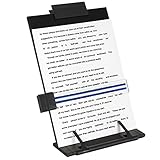
- Great for Body Health: The document holder is adjustable with 7 position at the backstand to adjust height and angle to make you easily reading without straining your back, shoulders or neck, then you can enjoy reading books while promoting a proper posture and even improve the spinal health.
- HIGH PRACTICAL: Design with Highlighting Line Guide makes you're easier to see where you left off and keep your track while typing, reading or transcribing. Comes with page holder clip to ensure documents do not slide. Help you work more efficiently.
- Really Sturdy & Stable: The bottom is designed with a page support clip to keep the book open on the page you need to read. The metal backplate, easily supports your documents. Very sturdy and can withstand multiple sizes of papers, recipes, books, magazines, textbooks and catalogs.
- Premium Material: The Book Stand is made of high-quality metal and ABS, with a polished and baked-on finish, it's durable, smooth, not easily broken, easy to clean and looks stylish, and has rounded corners to protect hands from injury or scratches.
- Foldable & Compact: 13.9" x 8.3" (35.5cm x 21cm). Fold quickly and store easily. Portable and lightweight, easy to carry to library, home, office and outdoor. Great gift for colleague, children, friend and family.
What does intelligent document processing mean?
IDP usually refers to a broader operational process for turning incoming documents into information that a business can use. Depending on the product and setup, that process can include:
- Receiving documents from scans, uploads, email or other sources.
- Digitizing paper or image-based documents when needed.
- Classifying documents and separating mixed packets.
- Extracting text, fields, tables or other structured information.
- Validating results, handling exceptions and sending uncertain cases for human review.
- Routing the resulting data into a business application, database, storage service or subsequent workflow.
Microsoft describes IDP as workflow automation that scans, reads, extracts, categorizes and organizes information, contrasting it with processing focused mainly on digitizing and indexing paper documents (Microsoft’s IDP explanation). That is Microsoft’s framing, not a universal standards definition. Databricks likewise presents IDP as an end-to-end process spanning ingestion and orchestration, parsing, extraction, classification and downstream use (Databricks documentation).
Rank #2

- WHATS INCLUDED - The binder comes with a starter set of 17 templates now included, 3 main dividers, 18 sub-dividers, 25 regular plastic sleeves, 2 zipper plastic sleeves and 40 tab labels. Dividers enable you to easily categorize & organize everything into relevant sections for quick access. Zipper sleeves keep various documents and receipts safe and in one place.
- ALL IN ONE HOME ORGANIZATION - The holistic home binder enables you to store & organize your whole home, from house plans, building projects and ownership documents to vehicle info, home appliance warranties, passwords, food logs, invoices, important dates and much more! Keep everything in one convenient location, so you never have to fumble around for important documents or information. A perfect family binder to organize your household!
- WHAT CAN YOU USE IT FOR? - You can use it as a home maintenance log, home building planner, home organization planner, auto mileage log, emergency binder, password keeper book, organizing pantry and frozen food, storing important contacts, vehicle and firearm ownership and maintenance, storing invoices and insurance info. You can use it for a specific purpose or for everything above and more. It's an ever evolving binder with new templates being added based on your feedback.
- STANDARD SIZE & DURABLE DESIGN - The binder is designed for standard US Letter size paper making it compatible with most important documents, the laminated cover is thick and durable, the dividers are made from thick cardboard to avoid tattering and curling, the rings of the binder are gap-free and rust-resistant. Its a binder that is designed to last for years to come.
- PERFECT GIFT FOR NEW HOMEOWNERS - Whether your friends or family members have owned their house for years or they have just purchased their first home, this binder will come in handy in every household, it also makes for a perfect housewarming gift alongside bread and wine. Help your loved ones create and maintain a beautiful & organized home.
How OCR, classification and extraction fit in
OCR and digitization
Optical character recognition (OCR) converts text in an image or scanned page into machine-readable text. It is an important part of digitizing paper or image-based documents, but digitization may involve more than OCR, such as handling files and preserving useful document structure. Native PDFs may already contain machine-readable text, so they may not need the same OCR step as a scan. UiPath explicitly treats OCR as part of digitization rather than as the whole process (UiPath documentation).
Free tools Windows power users keep installed
One-click scans. No signup required.
Classification and splitting
Classification assigns a document or page to a type or category—for example, distinguishing an invoice from a purchase order. Splitting separates a combined file or packet into individual documents when a workflow needs to process them independently. Google Cloud’s Document AI overview includes classification and splitting among the capabilities used to turn document content into structured data (Google Cloud documentation).
Extraction and validation
Extraction turns document content into usable output, such as text, key-value pairs, tables or custom fields. Validation checks whether the extracted results are suitable for the next step. It may involve rules, confidence handling or a person reviewing uncertain results; automation does not mean human review is always removed. UiPath includes validation in its capability model, while Google Cloud describes extraction of text and layout as well as key-value pairs and tables (UiPath documentation; Google Cloud documentation).
Independent reader supportYour contribution helps us test, update, and keep practical guides available for everyone.The practical difference
| Question | Document understanding | Intelligent document processing |
|---|---|---|
| Main emphasis | Interpreting document type, layout, context and content; extracting relevant information. | Managing a broader document-to-process workflow. |
| Typical scope | Classification and extraction, sometimes with digitization or validation depending on the product. | May include intake, digitization, classification, extraction, validation, exception handling and downstream routing. |
| Typical result | Recognized content or structured fields and tables. | Data delivered to another system or used in a business process. |
| Boundary between terms | Not standardized. Vendors may use “document understanding” for capabilities that another vendor groups under IDP. | |
This distinction is a useful way to discuss scope, not a rule that every product follows. Google Cloud describes Document AI as transforming unstructured document content into structured data, with capabilities and integrations that can support a wider workflow (Google Cloud documentation). A feature set called “Document Understanding” can therefore overlap substantially with one marketed as IDP.
Rank #4
How to compare document automation tools
Start with the documents and process you need to handle. Compare actual inputs, outputs and operating requirements—not just whether a product page uses “understanding,” “processing” or “AI.”
- Inputs: Check support for scanned images, native PDFs, office files and mixed document packets. Consider the image quality and file variations you expect.
- Tasks: Verify the specific capabilities you need: OCR, document classification, packet splitting, key-value extraction, table extraction, custom fields or layout-aware outputs.
- Quality controls: Find out how the system handles confidence, validation, human review, exceptions and corrections. Determine what happens when a field is missing or uncertain.
- Outputs and integrations: Confirm the structured formats available and whether the product connects to your storage, databases, search tools, RPA or business applications.
- Operations and governance: Check deployment geography, access controls, data governance, expected volume, model customization and ongoing maintenance.
- Workflow coverage: Establish whether the product handles only parsing and extraction or also orchestration and downstream process actions.
These questions help distinguish an extraction component from a broader workflow platform without assuming that one category is inherently more accurate, faster or less expensive. Product configurations and results vary; the vendor descriptions cited here do not establish a general performance ranking.
Do you need a document scanner?
Only if paper originals need to enter your workflow and you do not already have a suitable way to scan them. A scanner can create image files for later digitization and OCR, but it is not the central requirement for processing digital-native PDFs or other files that already enter the workflow electronically.
Quick Recap
Product prices and availability are accurate as of the date/time indicated and are subject to change. Any price and availability information displayed on Amazon at the time of purchase will apply.




