Do these 3 things before closing this tab:
1Scan for outdated or missing drivers - takes under a minute2Repair Windows errors before they cause bigger problems3Fix the driver behind crashes, sound loss and screen glitchesMost agentic AI systems need both: GPUs for model inference and CPUs for orchestration, retrieval, tool execution, state management, and other work between model calls. Add CPU cores when concurrent sessions are saturating CPU-side work; add GPU capacity when inference latency, throughput, or GPU memory is the constraint. There is no generally valid CPU-to-GPU ratio, so size each tier against a representative end-to-end workflow.
Why agents use both CPUs and GPUs
An agentic system is a workflow, not a single model call. It may route a request, retrieve information, assemble context, invoke a model, run tools, validate results, update state, and call the model again. Those stages have different resource demands.
As an Amazon Associate I earn from qualifying purchases.
CPU work between model calls
CPU capacity commonly supports orchestration, routing, retrieval, vector search, context assembly, guardrails, tool execution, sandboxing, memory management, logging, and response validation. Some of this work is memory-, storage-, or network-bound rather than limited by core count alone. AWS describes CPUs as handling these workflow stages and says CPUs and GPUs are complementary, not competing choices: AWS CPU inference and orchestration guidance.
GPU work during inference
GPUs commonly run larger or latency-sensitive model inference, where parallel computation can help meet response-time or throughput objectives. A GPU does not automatically speed up tool calls, database queries, or business logic that run elsewhere. Conversely, adding CPU cores does not substitute for the accelerator capacity needed to serve a demanding model at a tight latency target.
#1 Best Overall
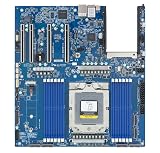
- Rigorously Tested for Perfect Performance Every product is 100% tested before shipping to ensure stable operation and flawless performance, so you can start using it immediately without any concerns.
When to add CPU cores
More CPU cores can help when many concurrent agents are doing substantial CPU-side work at once—for example, running sandbox tasks, processing data, or handling tool calls. AMD’s guidance similarly notes that core density can matter for concurrent sandbox tasks, API calls, or database queries. It is vendor guidance, not a guarantee that a particular core count will fit a workload: AMD’s overview of agentic AI workflows.
Check more than total cores. Per-core performance, memory capacity and bandwidth, storage I/O, networking, and the actual amount of parallel work can all constrain the CPU tier. For a host feeding GPUs, stronger per-core performance, frequency, memory bandwidth, I/O, or networking may matter more than maximizing core count; AMD notes that some workloads may need fewer cores than a simplistic “more cores” approach suggests.
When to add GPU capacity
GPU capacity is the more direct lever when larger-model inference or a latency-sensitive generation stage is missing its target, or when the inference tier cannot sustain required throughput. AWS offers example starting points—not universal thresholds—associating CPU deployments with quantized 1–8B small language models, embeddings, classifiers, orchestration, retrieval, ETL, and batch scoring. Its guidance associates GPU or Trainium with larger or latency-sensitive online inference, fine-tuning, and training. The same AWS table gives example ranges of p95 latency at 100–500 ms for CPU-oriented cases versus below 50 ms for GPU-oriented cases, and fewer than 100 requests per second per endpoint versus more than 100 sustained. These are AWS decision aids, not cross-provider benchmarks or performance guarantees: AWS’s CPU and accelerator guidance.
Free tools Windows power users keep installed
One-click scans. No signup required.
Rank #2

- [ Maximum AI Compute Power ] Dominate complex workloads with the ASUS ESC8000A-E13. This 4U rack server is a powerhouse engineered for mass-scale AI, machine learning, and deep training. Featuring support for dual AMD EPYC 9005/9004 processors and up to eight dual-slot GPUs, it delivers the raw computational muscle required to train LLMs and run complex simulations effortlessly. Accelerate your data science pipeline and transform raw data into actionable intelligence faster than ever.
- [ Advanced Thermal Efficiency ] High performance demands elite cooling. The ESC8000A-E13 features a cutting-edge aerodynamic design with independent CPU and GPU airflow tunnels. Equipped with redundant hot-swap fans and optimized for liquid cooling integrations, this 4U server ensures maximum uptime under heavy, sustained workloads. Keep your data center running cool, quiet, and highly efficient while preventing thermal throttling during mission-critical enterprise operations.
- [ Scale with Flexible Storage ] Future-proof your infrastructure with unmatched storage and expansion flexibility. This offers comprehensive front-panel drive bays supporting Gen5 NVMe, SAS, or SATA drives alongside multiple PCIe 5.0 slots. Designed as a high-density 4U server capable of housing eight dual-slot GPUs: NVD H200, RTX PRO 6000 Blackwell, RTX PRO 4500 Blackwell or AMD Instinct MI350P PCIe Card, each supporting up to 600 watts.
- [ Enterprise-Grade Reliability ] Minimize downtime and secure your ecosystem with server-grade redundancy. The ESC8000A-E13 is built for 24/7 continuous operation, boasting 2+2 redundant (3200W total) 80 PLUS Titanium power supplies and integrated ASUS ASMB11-iKVM for comprehensive out-of-band management. Ideal for cloud service providers, rendering farms, and large enterprise infrastructure, it combines robust physical hardware with smart remote monitoring to safeguard your digital assets.
- [Reliability Guaranteed] Shop with total peace of mind knowing that every new computer component we sell is backed by our EPC 3-year warranty. Whether you are investing in high-speed DDR5 RAM or a powerhouse GPU, we protect your build against defects and performance failures. We stand firmly behind the quality of our hardware, ensuring that your setup remains fast, stable, and secure for years to come.
GPU memory can be a separate limit from compute throughput. Longer contexts and concurrent sessions can increase memory pressure. NVIDIA describes agent sessions as potentially lasting minutes to hours, with repeated model calls, growing context, and idle intervals while tools run. Its guidance notes that key-value (KV) cache stores intermediate context computations on the GPU so generation does not have to reprocess the full context; that cache can constrain concurrency. NVIDIA estimates approximately 16–32 GB of KV cache for a 128K-token context with a 70B model, depending on model and serving configuration. This is an NVIDIA estimate, not a universal requirement: NVIDIA’s agentic inference guidance.
Why request rate alone can mislead
An agent request may trigger many sequential model calls and tool operations rather than one short, independent inference. NVIDIA characterizes a single task as potentially involving 50–500 sequential model invocations and cites 30K–120K+ tokens as common context windows in its comparison. Those are NVIDIA’s vendor claims, not universal measured constants. The practical implication is to measure complete task duration, context growth, concurrency, and time spent waiting on tools—not just incoming requests per second.
A 2026 arXiv preprint, From LLM Inference to Agentic Workloads: Characterization and Implications for Serving Systems, found non-LLM components dominated latency in 5 of 10 applications in its studied set. It also reported sandbox working-set memory peaking at 28 GB per session, resource affinities ranging from GPU-bound inference to memory-bound retrieval and CPU-bound sandboxes, and task-latency divergence up to 32x. Those results describe the paper’s applications and experiments, not a general production guarantee: Read the 2026 preprint.
Rank #3

- Processor: Single32c/64t, 2.0GHz (3.0GHz boost)
- Cache: 64MB L3 per socket
- I/O: Integrated 128 lanes PCIe 3, no chipset needed
- Memory: 8 channels with 2 DIMMs ea, up to 2TB DDR4-2666 MHz
- Amplify application performance with smart resource balancing and consistent feature sets
Choose a deployment shape that matches the workflow
CPU-heavy deployment
Consider CPU-first serving for smaller quantized models, embeddings, classifiers, retrieval, orchestration, and batch work when the measured latency objective is acceptable. This can avoid paying for accelerator capacity on stages that do not benefit from it. Validate the particular model, quantization, context size, thread count, and concurrency before choosing this approach.
Outdated Drivers Are Slowing You Down
One free scan finds every outdated or missing driver and matches the right update for your exact hardware.Free scan · exact hardware matchPC Slower Than It Used to Be?
A free scan shows the junk files, broken settings and background clutter dragging Windows down - then fixes them in one click.Free scan · Windows 10 & 11GPU-heavy inference with CPU agent runtime
For larger or latency-sensitive generation, a common split is GPU-accelerated inference plus general-purpose CPU instances for the agent runtime. AWS describes this division for hybrid-cloud deployments: inference and completion generation use GPU-accelerated compute, while the runtime managing tool calls, conversation state, and business logic is primarily CPU-bound. The article is AWS-specific and was published June 22, 2026: AWS’s hybrid-cloud agent architecture.
CPU routing and retrieval with GPU escalation
A split design can use a small language model and routing layer on CPU for constrained tasks, escalating complex requests to a GPU-hosted larger model. Another variation runs retrieval and embedding generation on CPU while a GPU-hosted model performs final generation. These are architectural options described in AWS guidance; whether they reduce cost or meet latency goals depends on the actual models, traffic, and handoff overhead.
Rank #4
- Condition&Quality :100% New and High Quality.
How to size the tiers without guessing
- Define the unit of success. Choose the task outcome to optimize, such as cost per successfully completed task, rather than comparing hardware by theoretical capacity alone.
- Capture a representative workflow. Use the actual model, prompt and context lengths, tool mix, retrieval path, sandbox behavior, and expected concurrency. Include long-running sessions and bursts if they occur in production.
- Set service targets. Record throughput and p50/p95 latency targets for the complete task as well as the inference stage. Include CPU and GPU memory pressure, deployment geography, data requirements, and operational complexity in the decision.
- Benchmark candidate tiers consistently. AWS recommends testing candidate CPU families and GPU with the same model, quantization, context size, and thread count. Compare cost per 1,000 queries at the target p95 latency. AWS’s thresholds are starting points; its guidance is to benchmark actual traffic.
- Scale the tier that is limiting the target. If the CPU tier is saturated by concurrent tool or sandbox work, test more CPU capacity or improve the constrained CPU-side stage. If inference latency remains too high at target concurrency, test GPU capacity. If GPU memory limits concurrent sessions, examine context and KV-cache pressure as well as accelerator count.
Do not assume a fixed core-to-GPU ratio. Benchmarking should reveal whether the limiting stage is compute, memory, I/O, networking, or a handoff between stages; then compare cost per successful task for the candidate design.
What published performance figures can—and cannot—tell you
NVIDIA’s agentic inference page cites “up to 15x more tokens at inference” and a “5–15x GPU overhead multiplier” for multi-agent deployments versus single-agent equivalents. It also reports that its Dynamo mechanisms improve GPU utilization from 40–55% to 75–85% and allow 2–3x more concurrent sessions per GPU node. These are NVIDIA’s vendor claims and reported outcomes, not independent guarantees or capacity-planning constants. They illustrate why agentic workloads may change accelerator utilization and session capacity; they do not determine the right hardware mix for another system.
The 2026 arXiv preprint reports design-exploration results including 29–40% lower latency from task-aware serving, up to 4.5x improvement from communication-aware placement, 4.6x lower memory use from state offloading, and removal of 35.2% of redundant search calls with 19.3% lower aggregate search latency from tool-result caching. These are outcomes in the paper’s experiments and traces, not expected gains for every deployment. The paper is available at arXiv.
Quick Recap
Product prices and availability are accurate as of the date/time indicated and are subject to change. Any price and availability information displayed on Amazon at the time of purchase will apply.




