The Tool Desk
Outbyte PC Repair FREERepair Windows errors before they cause bigger problemsFix Now →Outbyte Driver Updater FREEFix the driver behind crashes, sound loss and screen glitchesFind Drivers →Julius Caesar is said to have used a letter-substitution code for confidential correspondence, but the surviving account does not say that he used it for military messages. The key description comes from the Roman biographer Suetonius, writing well after Caesar’s lifetime. The familiar name “Caesar cipher” is modern, and the simple method is not secure by today’s standards.
What the ancient account actually says
In Life of Julius Caesar 56, Suetonius says Caesar used a cipher when writing confidential matter to Cicero and other intimates. He describes changing the order of the alphabet’s letters and explains how to reverse the substitution: a reader should replace A with D, “the fourth letter of the alphabet,” and do likewise for the others. Read Suetonius’s account in the translation by J. C. Rolfe.


As an Amazon Associate I earn from qualifying purchases.
This is evidence for coded private correspondence, not specifically for ciphered military dispatches. The passage also comes from Suetonius, a later biographer, rather than from a surviving account written by Caesar himself. Caesar’s surviving works do not explain the cipher. The University of York course material dates Suetonius’s account to around AD 121, roughly two centuries after Caesar’s lifetime. University of York course material on the Caesar cipher.
How the Caesar cipher works
In the conventional English-alphabet demonstration, each plaintext letter is replaced by the letter three places later. A becomes D, B becomes E, and letters near the end wrap around to the start. For example, CODE becomes FRGH. That English example is a modern teaching illustration; Suetonius gives the substitution rule, not this example.
#1 Best Overall
The apparent difference between “D for A” and a shift of three comes from direction. Suetonius describes how to decipher: replace the encoded letter with the letter three positions after it in the alphabet. The usual modern explanation of encryption runs the mapping in reverse, shifting the original message forward three places. The University of York course shows the modern worked example.
Why the name is modern
“Caesar cipher” is the later name for the method, not a term shown in Caesar’s surviving writing. A University of Bristol dissertation discusses Suetonius’s account alongside references in Aulus Gellius and Cassius Dio, and notes the distinction between ancient descriptions and the modern label. University of Bristol dissertation, Myths and Histories of the Spartan Scytale.
Nor does Suetonius establish that Caesar invented alphabet substitution. The University of Wisconsin–Madison’s historical notes point out that other substitution ciphers were used earlier. The surviving evidence supports the narrower claim that Caesar used a substitution method, as Suetonius reports; it does not establish who first devised such methods. University of Wisconsin–Madison handout on the Caesar cipher.
Do these 3 things before closing this tab:
1Clear out junk files and repair common Windows errors2Fix the driver behind crashes, sound loss and screen glitches3Repair Windows errors before they cause bigger problemsWas it secure?
The sources cited here do not establish how difficult Caesar’s method was for his contemporaries to break. A lack of evidence about contemporary cryptanalysis is not proof that the cipher was secure.
By modern standards, a fixed letter-for-letter substitution is weak. In the English alphabet there are only 25 nontrivial shifts to test, and substitution ciphers can also be attacked by looking at letter frequencies. The MIT Press Reader explains these basic weaknesses and why frequency analysis works. MIT Press Reader, “A History of Cryptography From the Spartans to the FBI”.
Independent reader supportYour contribution helps us test, update, and keep practical guides available for everyone.Keep the dispatch story separate
Suetonius’s discussion of coded correspondence should not be conflated with a separate scholarly dispute over his description of letters to the Senate being arranged into pages or a memorial book. C. H. Roberts examined that textual issue in a 1933 article; it is not the source of the cipher claim. C. H. Roberts, “A Note on Suetonius, Divus Julius 56, 6,” Journal of Roman Studies.
Quick Recap
Rank #4
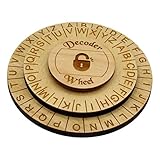
- Authentic escape room puzzle & prop: Elevate your adventures with this 4.4" wooden Caesar cipher wheel. Perfect for DIY escape rooms, spy game missions, or as a key piece in detective kits. Unlock secrets and engage players of all ages
- Educational STEM learning tool: Make learning fun! This decoder introduces cryptography concepts and the classic Caesar cipher. An ideal hands-on, Montessori-inspired resource for classrooms, homeschoolers, and critical thinking development. "Where escape rooms meet education."
- Handmade USA quality for lasting fun: Expertly crafted in our Spring Hill, FL workshop from durable Baltic Birch (1/4" wheels, 1/8" cap) with precision laser-engraved symbols. A reliable, tactile addition to any spy or detective kit.
- Easy to use intuitive design: This 4.4-inch cipher disk is straightforward for everyone. Smooth-turning wheels and clear markings allow for easy message encoding and decoding, enhancing any spy, detective, or escape room game experience.
- Unique gift for clever minds: Delight puzzle enthusiasts, aspiring spies, teachers, or escape room fans with this unique brain teaser. A thoughtful present that combines engaging play with educational value for any occasion.
Product prices and availability are accurate as of the date/time indicated and are subject to change. Any price and availability information displayed on Amazon at the time of purchase will apply.




