What’s actually slowing this PC down?
Pick the symptom - the matching free tool is one click away.
An MPEG-2 transport stream (MPEG-TS, or simply TS) is a systems-layer multiplexing format that packages compressed audio, video and related data into fixed-size packets, along with the signaling a receiver needs to find each program and its components. It is defined in ISO/IEC 13818-1, also published as ITU-T H.222.0, and it is built to keep working when a transmission channel drops or corrupts data.
A container layer, not a codec
The most common misunderstanding is to treat MPEG-2 transport stream as a video compression method. It is not. ISO/IEC 13818-1 covers the systems layer: how separately compressed streams are combined, synchronized, buffered and signaled. The actual video and audio coding are specified in other parts of the MPEG-2 family. A transport stream therefore carries an MPEG-2 video stream, an MPEG-2 or other audio stream, or other permitted data, without changing how those components were encoded.
| # | Preview | Product | Price | |
|---|---|---|---|---|
| 1 |
|
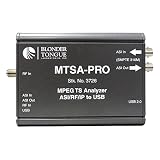
MTSA-PRO, Blonder Tongue MPEG Transport Stream Analyzer | $3,995.00 | Buy on Amazon |
As an Amazon Associate I earn from qualifying purchases.
The standard describes the systems layer as supporting several jobs at once: keeping multiple compressed streams in sync during decoding, interleaving them, providing startup buffering, managing buffers continuously, identifying time, and multiplexing and signaling the components of a program.
Do these 3 things before closing this tab:
1Repair Windows errors before they cause bigger problems2Fix the driver behind crashes, sound loss and screen glitches3Clear out junk files and repair common Windows errorsThe 188-byte packet
A transport stream is a sequence of transport packets, and each packet is 188 bytes long. The IETF’s glossary in RFC 4326 defines a TS packet as a fixed-length 188-byte unit (RFC 4326). That figure describes the size of one packet, not a limit on the size of a stream or recording. A file or broadcast can contain millions of these packets back to back.
#1 Best Overall
- Real time analysis via RF/ASI/IP input & TS file
- Single DVB-ASI input and single DVB-ASI output adapter for USB (half duplex)
- Subtitle support
- Real-time A/V decoding
Fixed packet length is what makes the format robust. A receiver that loses sync can search for the next packet boundary and resume decoding, and a damaged packet affects only the payload it carries rather than the whole multiplex.
How a receiver finds programs
Program content does not arrive as a single labeled stream. The usual model has three layers, each handled by a different part of the system.
Elementary streams and PES packets
Each encoded component, such as a video elementary stream or an audio elementary stream, is first organized into Packetized Elementary Stream (PES) packets. Transport packets then carry portions of those PES packets, together with the system information needed to route them.
Windows Errors? Fix Them Before They Spread
Repair common Windows errors and clear accumulated junk for a smoother, more stable PC - no reinstall needed.Free scan · no reinstallOutdated Drivers Are Slowing You Down
One free scan finds every outdated or missing driver and matches the right update for your exact hardware.Free scan · exact hardware matchThe Program Association Table (PAT)
The PAT is the entry point. It lists the programs carried in the multiplex and tells the receiver where to find the Program Map Table for each one. ETSI’s DVB reference, TS 102 034, identifies MPEG PSI, including the PAT and PMT, as information carried in an MPEG transport stream (ETSI TS 102 034).
The Program Map Table (PMT)
Each PMT describes one program: which packet identifiers carry its video, audio and other components. A receiver that has read the PAT and the relevant PMT knows which packets to decode for a chosen program and can ignore the rest. This is why one transport stream can carry several programs side by side.
Not every transport stream carries the same set of optional service-information tables. What exists depends on the broadcast system or application profile, so a receiver built for one environment may expect tables that another environment omits.
Independent reader supportYour contribution helps us test, update, and keep practical guides available for everyone.Transport stream versus program stream
MPEG-2 defines two multiplex forms. The table below reflects how ISO/IEC 13818-1 characterizes them.
Recommended Free Tools
| Axis | Transport stream | Program stream |
|---|---|---|
| Number of programs | Can multiplex several programs with independent time bases | Built around one program with a common time base |
| Intended transmission conditions | Designed for environments where errors are likely | Generally more appropriate for almost error-free environments |
| Basic unit | Fixed 188-byte transport packets | Variable-length packets carrying PES data |
The distinctions above are stated in the ISO abstract. They describe what the format is designed for, not a rule that every file must be one or the other. Choosing between them depends on the application and the profile in use.
Which edition to cite
At the time of checking, ISO’s catalogue listed the current edition as ISO/IEC 13818-1:2025, Edition 10, published in August 2025, under the title “Information technology — Generic coding of moving pictures and associated audio information — Part 1: Systems” (ISO listing for ISO/IEC 13818-1:2025). Check the ISO page for any later revision before citing it.
Deployed equipment often follows earlier revisions or application specifications. When you discuss conformance or the exact meaning of a table field, name the edition and the specification you are relying on.
The packet size of 188 bytes is the figure most often quoted for transport packets, and it is documented in the IETF glossary of 2009. It is a protocol packet size, not a market statistic.
Searches often phrase the topic as “What is an MPEG-2 transport stream?” or “What is the size of an MPEG-2 transport-stream packet?” Both questions are answered above.
Quick Recap
- Transport stream: systems-layer container, not a codec.
- Multiplexes several programs, each with its own time base.
- Built from 188-byte packets that tolerate transmission errors.
- PAT and PMT tables let a receiver locate programs and their components.
- The base standard is ISO/IEC 13818-1, which application profiles may extend.
“
Product prices and availability are accurate as of the date/time indicated and are subject to change. Any price and availability information displayed on Amazon at the time of purchase will apply.




