The Tool Desk
Outbyte PC Repair FREERepair Windows errors before they cause bigger problemsFix Now →Outbyte Driver Updater FREEFix the driver behind crashes, sound loss and screen glitchesFind Drivers →Claude Code runs on your computer, but its standard model inference is not cloud-independent. It reads repository files locally, then sends portions needed for the current task to Anthropic’s API to get a response. That distinction matters for privacy and GDPR decisions: local execution, model-training settings, and data-location controls do not by themselves establish that a particular deployment is GDPR-compliant.
What “local” means in Claude Code
Claude Code is a terminal agent that can read a repository, edit files, and run commands. Anthropic’s Help Center says: “Claude Code runs on your machine. Source files are read locally, and only the portions needed for the current task are sent to the API to generate a response.” (Anthropic Claude Code user FAQ, August 7, 2026.)


As an Amazon Associate I earn from qualifying purchases.
In other words, the CLI and its access to the repository run locally, while the documented standard path uses an Anthropic-hosted API for model responses. “Only the portions needed” describes the documented data flow; it is not a promise that no code or task context leaves the computer. Treat content sent for inference as disclosed to the service, and assess what the agent may need to read for the task.
Does Anthropic train on Claude Code sessions?
The answer depends on the account and applicable settings or terms. Anthropic’s Claude Code FAQ says Team and Enterprise organizational terms do not use code and conversations to train models. That statement should not be generalized to consumer accounts; check the current terms for the specific account and deployment.
#1 Best Overall

- Pre-installed Linux OS & Ultimate Performance: Powered by the cutting-edge AMD Ryzen Max+ 395 processor with 16 cores and boost clock speeds up to 5.1GHz, this laptop delivers exceptional processing power. Pre-loaded with Linux, it offers a seamless, highly customizable, and secure environment out of the box—ideal for developers, power users, and tech enthusiasts.
- Discrete-Level Graphics Power: Featuring Radeon 8060S with 40 RDNA 3.5 CUs, delivering performance that rivals high-end discrete GPUs. Experience stutter-free 4K video playback and fluid 3D rendering in Blender or Unreal Engine.
- Flight-Ready Endurance: The 99Wh battery hits the maximum limit for air travel. Stay productive for 8+ hours during long-haul flights or remote sessions, supported by a 230W adapter for rapid power replenishment anywhere.
- The Ultimate Developer Engine: 8000MT/s blazing bandwidth paired with a 256-bit bus allows you to run dozens of Docker containers, VMs, and massive IDE compilations simultaneously. Say goodbye to system lag caused by memory bottlenecks.
- Private AI Lab on Your Desk: With 128GB LPDDR5X RAM and 126 TOPS total compute, fine-tune 70B LLMs (like Llama 3) locally. Eliminate costly cloud subscriptions while ensuring 100% data privacy for your proprietary algorithms.
For consumer use, Anthropic’s Privacy Center says chats and coding sessions may be used to improve models if the user chooses to allow it, if a conversation is flagged for safety review, or if the user otherwise explicitly opts in. This may include the entire related conversation. It also says Incognito chats are not used to improve Claude, even when Model Improvement is enabled. (Anthropic Privacy Center: Is my data used for model training?, March 16, 2026.)
What geography and residency controls do—and do not—cover
Hosted inference and storage geography are separate from local execution. Anthropic’s commercial-products information says customer traffic may be routed by default to selected countries in the US, Europe, Asia, and Australia, unless otherwise agreed or instructed. It also says data is stored in the US and internal processes can occur in countries where Anthropic or its affiliates operate. The page distinguishes commercial products from consumer plans using Claude Code. (Anthropic Privacy Center: server locations, June 15, 2026.)
Rank #2
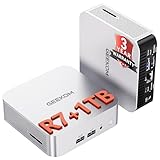
- [Ryzen 7 8745HS & Agentic AI Workstation] Powered by the AMD Ryzen 7 8745HS processor (8 Cores, 16 Threads, up to 4.9GHz), the GEEKOM A8 delivers fast, responsive performance for 4K video editing, graphic design, and heavy coding. It doubles as a cloud-native Agentic PC—seamlessly hosting cloud AI tasks, automating office workflows, and handling intelligent document summarization without complex local deployment. Built for creators, engineers, and professionals who need reliable workstation-class productivity.
- [Upgradeable DDR5 Memory & PCIe 4.0 Storage] Stay productive with 16GB DDR5 memory and a 1TB PCIe 4.0 NVMe SSD for fast boot times, instant responsiveness, and smooth multitasking. Unlike compact PCs with soldered memory, the GEEKOM A8 supports upgrades up to 128GB DDR5 and 4TB SSD storage, making it ideal for large creative projects, virtual machines, business databases, and future performance upgrades.
- [Radeon 780M Graphics for Visual Creativity] Powered by AMD Radeon 780M graphics based on the latest RDNA 3 architecture, the GEEKOM A8 delivers exceptional integrated graphics performance for demanding visual workloads. Edit 4K videos, create complex digital artwork, and enjoy smooth multi-monitor productivity—all without requiring a dedicated graphics card.
- [0.5L Ultra-Compact Design with VESA Mount] Free up valuable desk space without sacrificing performance. The GEEKOM A8 packs workstation-level capability into a sleek 0.5-liter aluminum chassis that fits neatly into home offices, creative studios, and business environments. Mount it behind your monitor with the included VESA bracket for a cleaner, more organized workspace.
- [Efficient Cooling & 24/7 Cloud AI Hosting] Stay productive during extended workloads with an advanced cooling system featuring dual heat pipes, a high-efficiency fan, and optimized airflow. Whether exporting large videos, compiling huge codebases, or executing 7x24 unattended cloud AI-agent tasks, the GEEKOM A8 maintains consistent performance and rock-solid stability while operating quietly.
For the platform, Anthropic distinguishes inference geography—the location where a supported model request runs—from workspace geography, which covers data storage and certain endpoint processing. Its live documentation describes global inference as the default, a US option for supported models, and US as the only workspace geography currently listed. These are controls over hosted services, not on-device inference or a guarantee that data stays on a developer’s computer. Verify the available settings for the model and account in use. (Anthropic Claude Platform Docs: Data residency, accessed October 7, 2026.)
Can Claude Code be called GDPR-compliant?
Not categorically on the basis of local execution, a no-training statement, or geography controls. GDPR compliance depends on the actual processing, the data involved, the parties’ roles, applicable terms and safeguards, and any international transfers. If a provider processes personal data on an organization’s behalf, Article 28 addresses the required processor contract or legal act and its particulars. Article 44 requires third-country transfers to comply with GDPR Chapter V; Article 46 addresses appropriate safeguards where there is no adequacy decision. The regulation does not decide whether a particular Claude Code deployment satisfies those requirements. (Regulation (EU) 2016/679, Articles 28, 44, and 46.)
Independent reader supportYour contribution helps us test, update, and keep practical guides available for everyone.Checklist for evaluating a team deployment
- Identify the data. Determine whether repositories, prompts, logs, or outputs contain personal data, confidential material, or regulated information.
- Map the flow. Establish what repository content and task context may be sent to the API, and who can access those materials.
- Confirm account terms. Check whether the account is consumer or organizational, which model-improvement rules apply, and what current contractual terms say.
- Review processing arrangements. Where personal data is processed on the organization’s behalf, assess the processor relationship and Article 28 documentation.
- Check retention and geography separately. Confirm applicable retention options, inference location, storage location, and subprocessors for the exact configuration; a residency setting does not answer every one of these questions.
- Assess transfers and safeguards. If personal data may be transferred to a third country, determine the relevant Chapter V basis and safeguards.
- Set project rules. Define which repositories and data categories are permitted, and ensure developers understand that a locally running agent can still transmit task-required content to a hosted model.
Organizations handling personal or regulated data should have their privacy or legal team assess the intended use and the specific account terms and configuration before relying on Claude Code for code review.
Quick Recap
Product prices and availability are accurate as of the date/time indicated and are subject to change. Any price and availability information displayed on Amazon at the time of purchase will apply.




