Short answer: makeup can change how well some face-matching systems perform under particular test conditions, but there is no evidence that an ordinary makeup tutorial reliably defeats facial recognition across cameras, algorithms or real-world deployments. The specific steps attributed to Richa Chadha could not be verified from the available source material, so claims about what her tutorial gets right or wrong would be speculation.
What “beat facial recognition” can mean
The phrase covers several different outcomes. Makeup might cause a false non-match when a system compares a person with a stored reference image. It might reduce identification accuracy when software searches a watchlist or database. It could also be intended to defeat a particular camera, model or commercial API. Those are different tasks, metrics and threat models.
As an Amazon Associate I earn from qualifying purchases.
The U.S. Government Accountability Office describes the technology this way: “Facial recognition technology can verify or identify an individual from a facial image.” One-to-one verification (is this person the account holder?) is not the same as one-to-many identification (which person in a database is this?). A result from one setup cannot be transferred automatically to the other.
What studies have actually found
Early evidence that cosmetics alter matching
A 2012 IEEE conference paper, Can facial cosmetics affect the matching accuracy of face recognition systems?, compared subjects photographed with and without makeup in two databases. The authors reported that cosmetics could compromise matching accuracy, while explicitly describing the findings as early. The work establishes that makeup is a source of image variation; it does not establish a repeatable consumer method for evading deployed systems.
#1 Best Overall
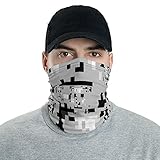
- Fabric weight: 6.19 oz/yd² (210 g/m²)
- Breathable fabric, washable and reusable
- Printed on one side, reverse side is left blank
- MADE TO ORDER
- Inspired by the art project Project Hyperface (no affiliation). WE DO NOT GUARANTEE the effectiveness of this pattern against artificial intelligence algorithms.
Makeup and expression can interact
A 2020 study examined full makeup together with changes in mood and facial expression. Using the Radboud Faces database and the Psychological Image Collection at Stirling (PICS), the researchers calculated similarity scores with dlib, Verilook and VGGFace. In that experiment, the combined condition produced an equal error rate (EER) of 4.68%, while each factor considered separately produced an EER below 1%.
EER is the point at which false-match and false-non-match rates are equal. The 4.68% figure is therefore a result for that study’s images, algorithms and protocol—not a probability that makeup will fool a facial-recognition system in public. The study indicates that multiple sources of variation can compound one another, not that any particular shade, contour or application technique is dependable.
| Finding | What was tested | What it does not prove |
|---|---|---|
| 2012 IEEE study | Subjects with and without makeup in two databases | That a tutorial defeats modern systems or every camera |
| 2020 experiment | Full makeup plus expression changes; dlib, Verilook and VGGFace scores on Radboud Faces and PICS | That a 4.68% EER is a real-world evasion rate |
| 2023 CLIP2Protect paper | Text-guided adversarial makeup evaluated against black-box models and online commercial APIs | That ordinary cosmetics provide the same effect |
Ordinary makeup versus adversarial makeup
Researchers have also designed adversarial makeup: patterns optimized to interfere with a chosen recognition model. The 2023 CVPR paper CLIP2Protect treats text-guided adversarial makeup as part of a facial-privacy approach and evaluates it against black-box models and online APIs. This is a technical research direction. Optimization for a target model, controlled images and measured attack success are fundamentally different from following a short beauty tutorial.
IDIAP’s AIM dataset further shows that makeup-based presentation attacks remain an active research area. Its grayscale release dates to 2019, and an RGB version was added in 2024. A dataset’s existence supports experimentation; it is not evidence that consumers can reliably avoid identification.
Why results vary from one system to another
- Task: verification and identification use different decision processes and error measures.
- Makeup: light, full and deliberately optimized adversarial cosmetics are not interchangeable conditions.
- Capture conditions: lighting, pose, camera quality, resolution, occlusion and expression can matter as much as cosmetics.
- System: algorithms, enrollment images, thresholds and API implementations differ.
- Metric: false non-match, false match, EER and identification accuracy measure different failures.
Percentages should be compared only when these axes align. The available sources contain no population-level statistic showing how often makeup defeats facial-recognition systems in everyday use.
Rank #2

- Material: Natural cotton fleece.Size: About 2.1 * 2.3 cm/ 0.8 * 0.9 inch(L*W). Apply on any skin type.
- The facial mask is a dry compressed facial mask and no facial products are embedded in the paper, apply for DIY skin care. You need add additional facial product (such as beauty liquid,eggs, milk, honey) when you use, according to personal needs.
- Absorbent and skin-friendly, disposable, having facial skin care by yourself or beauty salon.
- Natural non-woven fiber-- No chemical composition. non-irritating, Natural, no stimulation mask sheet,safe, comfortable for facial application . Suitable for all people, easy compressed disposable Facial for home DIY facial skin care.
- 100pcs in one package. Each mask sheet is individually packaged, easy to carry; meet international health standards, great for travel.
What can be said about Richa Chadha’s tutorial
The specific tutorial, its demonstration conditions and any statements attributed to Chadha were not verifiable in the source material available for this article. It would therefore be misleading to say that a particular contour, color, product or sequence “works,” or to identify an individual step as wrong. At most, a tutorial could illustrate the general principle that changing visible facial features may alter a matcher’s input. That illustration would still fall far short of proving reliable evasion.
The wider privacy and accuracy context
Makeup is only one possible source of variation. The GAO’s 2020 review discusses demographic performance differences found in NIST testing and privacy concerns including loss of anonymity and use without consent. A 2016 study of human perception—not biometric software—found that people recognized no-makeup and light-makeup faces more accurately than heavily made-up faces in its experiments. Human recognition results should not be treated as a benchmark for automated systems.
Even if cosmetics reduce a match in one image, cameras may capture additional views, systems may use multiple frames or other data, and an unsuccessful match is not the same as anonymity. Makeup should not be presented as privacy protection or as a guaranteed way to prevent surveillance.
How to read a claim that makeup defeats recognition
- Identify whether the claim concerns verification or one-to-many identification.
- Ask what makeup condition was used: everyday, full-face or model-optimized adversarial makeup.
- Check the camera, lighting, pose, image quality, algorithm and dataset.
- Look for the actual metric and baseline, rather than a single dramatic example.
- Check whether the result was replicated across systems and uncontrolled conditions.
Without those details, “beat” is usually an overstatement. The defensible conclusion from current evidence is narrower: cosmetics can affect measured performance under tested conditions, while reliable, cross-system evasion has not been demonstrated.
Quick Recap
Product prices and availability are accurate as of the date/time indicated and are subject to change. Any price and availability information displayed on Amazon at the time of purchase will apply.




