Yes—but only in the sense that pencil graphite can form part of an experimental gas sensor. Published designs use pencil marks as conductive paths or electrodes, and some rely on added materials such as carbon nanotubes, palladium nanoparticles, or a specialized framework to produce or improve the response to a particular gas. A pencil mark alone is not a proven gas alarm.
How a pencil-on-paper gas sensor works
A chemiresistive sensor measures a change in electrical resistance as a gas interacts with a conductive sensing network. In a pencil-based design, graphite can provide that network or serve as an electrode. Other materials may supply much of the gas-specific interaction, so the construction and results vary from one device to another.
As an Amazon Associate I earn from qualifying purchases.
In a 2012 research highlight, Timothy Swager and colleagues at MIT used a pencil-like tool to abrade a packed pellet of single-walled carbon nanotubes onto paper, forming an electrical circuit. Exposure to ammonia produced measurable conductivity changes in the nanotube layers. This was a prototype description, not a complete build guide. Nature’s 2012 research highlight describes the demonstration.
The Tool Desk
Outbyte PC Repair FREEClear out junk files and repair common Windows errorsFree Scan →Outbyte Driver Updater FREEFix the driver behind crashes, sound loss and screen glitchesFind Drivers →Later studies explored different approaches: 9B pencil graphite as a sensing network, palladium nanoparticles added to pencil-mark circuits for hydrogen detection, and pencil-drawn graphite electrodes combined with a specialized framework and carbon nanotubes for toluene sensing. These are distinct experimental designs, not interchangeable recipes.
#1 Best Overall

- MQ-2 gas sensor sensitive material used in the clean air low conductivity tin oxide (SnO2). When there is the environment in which the combustible gas sensor, conductivity sensor with increasing concentration of combustible gases in air increases.
- Quick response and recovery characteristics
- The dual signal output (analog output and TTL output)
- The analog output and increased with the increase of concentration, the higher the concentration higher voltage
- Has a very high sensitivity to sulfide, benzene vapor, smoke and other harmful gases
What different studies reported
The figures below describe separate experiments. Detection limits, ranges, response times, and recovery times are different measurements; the results should not be treated as a head-to-head ranking.
| Target gas and study | Materials and role of pencil graphite | Reported result | Test context |
|---|---|---|---|
| Nitrogen dioxide (NO₂), Shukla and colleagues, 2021 | Commercially available 9B pencil graphite formed the conductive sensing network. | Detection limit: 100 ppb. Response time: approximately 30 seconds. | Reported sensing at ambient temperature and pressure. New Journal of Chemistry paper. |
| Ammonia (NH₃), Shukla and colleagues, 2021 | Commercially available 9B pencil graphite formed the conductive sensing network. | Detection limit: 500 ppb. Response time: approximately 50 seconds. | Reported sensing at ambient temperature and pressure. New Journal of Chemistry paper. |
| Hydrogen, Nahm and colleagues, 2019 | Palladium nanoparticles were added to pencil-mark circuits. | Detection limit: as low as 1 ppm. Reaction time: approximately 50 seconds. Recovery: 32 seconds at 1 ppm and 78 seconds at 1000 ppm. | Study-specific experimental conditions. 2019 paper. |
| Toluene, Zhao and colleagues, published online in 2024 | MWCNT-templated nickel porphyrin covalent organic framework paired with pencil-drawn graphite interdigitated electrodes. | Reported detection range: 1–500 ppm. Detection limit: 30 ppb. Response: 32 seconds; recovery: 116 seconds. | Study-specific experimental conditions. ACS Sensors paper and PubMed record. |
For their 2021 paper, Shukla, Saxena, Madhwal, Bhardwaj, and Jain describe the operating principle as “The principal of operation of the chemiresistive gas sensor is based on the variation in the electrical resistance due to the selective interaction between the pencil graphite network and the specific gaseous analyte in a two-pole format.” That statement describes their device; it does not establish that every pencil-based sensor has the same selectivity or performance.
Rank #2
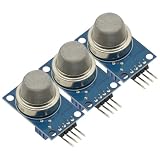
- 3Pcs MQ-135 MQ135 Air Quality Sensor Hazardous Gas Detection Module Gas sensor DC 5V For Arduino Sensors
- Double-sided panel design, with power supply indication and TTL signal output indication;
- With DO switching signal (TTL) output and AO analog signal output;
- The effective signal of TTL output is low level. (When the output low level signal light, can be directly connected to the microcontroller or relay module)
- Analog output voltage, the higher the concentration of the higher voltage.
Why the materials and test conditions matter
Graphite can conduct electricity, but a working sensor needs a design in which the target gas causes a measurable, interpretable change. In the examples above, the sensing layer ranges from pencil graphite to nanotubes, palladium-decorated pencil marks, or a functional framework paired with graphite electrodes. The pencil is therefore not necessarily the material doing most of the gas recognition.
Free tools Windows power users keep installed
One-click scans. No signup required.
- The target gas differs: the studies address ammonia, nitrogen dioxide, hydrogen, and toluene. A result for one gas does not establish detection of another.
- The reported metrics differ: a detection limit is not a detection range, and response time is not recovery time. Figures also depend on each study’s device and test setup.
- Selectivity and real-world performance require their own evidence: laboratory exposure results alone do not demonstrate reliable operation amid mixtures, humidity, changing temperatures, or other conditions found outside a controlled test.
The 2021 study explicitly reports ambient temperature and pressure. The other figures listed here are presented as the particular studies’ reported results; they should not be generalized beyond those experimental contexts.
Rank #3
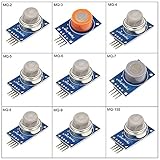
- Working voltage: DC 5V; With signal output indicator light;
- With a long service life and reliable stability;Quick response and recovery characteristics;
- The analog output and increased with the increase of concentration, the higher the concentration higher voltage
- For harmful gas family, environment detection device, is suitable for the detection of the ammonia, aromatic compounds, sulfide, benzene vapor, smoke and other harmful gas, gas sensitive element concentration range: 10 to 1000ppm provides reference cases.
- Package Includes: MQ-2 Smoke Sensor,MQ-3 Alcohol Sensor,MQ-4 Methane Sensor,MQ-5 LPG Natural Gas City Gas Sensor,MQ-6 isobutane propane sensor,MQ-7 Carbon Monoxide Sensor Module,MQ-8 hydrogen sensor,MQ-9 Carbon Monoxide Combustible Gas Sensor,MQ-135 air quality detection sensor
Can you make a reliable gas alarm with a pencil?
The published demonstrations establish research approaches, not a consumer-ready alarm. They do not show that drawing a graphite line on paper and connecting it to a meter will reliably warn of hazardous gas. The evidence cited here does not establish these prototypes as certified gas alarms, so they should not be used for safety-critical detection or as a replacement for a properly certified detector.
A 9B pencil is a material used in one reported design, but the pencil is only one component. Reproducing a sensor requires the specific design, any added sensing materials, electrical measurement, and a way to test it against controlled gas exposures. A household pencil mark is not a substitute for those elements.
Quick Recap
Best Value

- MQ-8 module for hydrogen h2: SnO2 sensing element heated inside a metal mesh cap
- Analog output AO rises with gas concentration; digital output DO switches at a level you set
- 5V DC supply, 4-pin 2.54 mm header (VCC / GND / DO / AO), power and signal LEDs
- Onboard LM393 comparator and threshold potentiometer, so DO can drive a buzzer or LED with no extra code
- Two modules per pack; needs warm-up and your own calibration - a prototyping module, not a certified detector
Rank #4

- High Precision Performance - CO₂ accuracy of ±(40 ppm + 5% MV) and humidity accuracy of ±6%RH (typical) ensure reliable environmental data.
- Low Power Operation - Averages <0.4 mA at 5V with 1 measurement every 5 minutes, ideal for battery-powered or long-term monitoring applications.
- SCD41 CO2 Carbon Dioxide Gas Sensor Module Dual-Function Sensing - Simultaneously measures CO₂ (400–5000 ppm), temperature, and humidity for comprehensive indoor air quality monitoring.
- SCD41 CO2 Carbon Dioxide Gas Sensor Module Integrated I2C Interface - 2.54mm pitch pin interface (GND, VDD, SCL, SDA) enables easy connection to microcontrollers and development boards.
- SCD41 CO2 Carbon Dioxide Gas Sensor Gas Detect Module Temperature Humidity Sensor I2C Communication 2.4-5.5 V for Air Quality Monitoring
Product prices and availability are accurate as of the date/time indicated and are subject to change. Any price and availability information displayed on Amazon at the time of purchase will apply.




