Do these 3 things before closing this tab:
1Clear out junk files and repair common Windows errors2Scan for outdated or missing drivers - takes under a minute3Repair Windows errors before they cause bigger problemsBefore you buy an AI tool, answer one question: what specific piece of work is this supposed to improve, and how would you know it had improved? If the answer begins with a feature rather than a problem, the workflow is not ready for a tool yet. This checklist covers what to establish, in what order, and how to turn those answers into a go, defer, or stop decision.
Start with the work as it runs today
A tool can only be judged against the process it will change. Before you look at vendors, document the current process as it actually happens, not as the process manual describes it.

As an Amazon Associate I earn from qualifying purchases.
- Write the workflow as-is. List each step, who performs it, how often it runs, and what triggers it.
- Mark where the friction is, with evidence. Record delays, rework, error rates, handoff gaps, and cost, using logs, timestamps, or complaint records where they exist. Estimates are acceptable if you label them as estimates.
- State the problem in one sentence that names no product. For example: “Claims intake takes an average of three days because staff re-key data from scanned forms.” A sentence that begins with “We need an AI that…” is a solution, not a problem.
- Test whether a non-AI fix would solve it. A revised form, a clearer approval rule, an extra validation step, or an existing tool your organization already licenses may be enough. If one of these works, AI is not needed for this problem.
The ACT-IAC AI Playbook, written for U.S. federal agencies, makes the same ordering point: its assessment phase should generally come before organizational readiness work, so that business relevance and use-case selection are settled first. Its readiness checklist asks two plain questions, whether the use case and problem statement are clearly defined and whether AI is actually the right approach.
Crashes, No Sound, or Screen Glitches?
Random freezes, missing sound and display glitches usually trace back to one bad driver. Find and replace yours safely.Free scan · under a minutePC Slower Than It Used to Be?
A free scan shows the junk files, broken settings and background clutter dragging Windows down - then fixes them in one click.Free scan · Windows 10 & 11Why a tool demo cannot answer these questions
A demonstration shows the tool working on inputs the vendor selected. It does not show what happens with your data, your users, your error tolerance, or your exceptions. The NIST AI Risk Management Framework (AI RMF) Core addresses this gap in its Map function, which calls for documenting intended purpose, context, users, business value, organizational risk tolerance, and requirements. NIST states that the information gathered through Map can inform an initial decision about whether an AI solution is appropriate or needed at all. A demo cannot supply that information; only your own workflow analysis can.
The checklist, stage by stage
Work through these stages in order. Each one either produces a clear answer or shows you what you still need to find out before spending money.
Stage 1: Workflow and problem
- What work is done now, by which roles, and how often?
- Where are the delays, errors, handoffs, and costs, and how are they measured today?
- Is the problem stated specifically enough that a non-AI fix could be tested against it?
Stage 2: Outcome and alternatives
- What measurable result would make the change worthwhile, and what is the baseline it must beat?
- Could a process change, a template, or an existing tool produce that result?
- If the answer is yes for any of these, record why AI would still be the better choice, or stop here.
Stage 3: Use case, users, and boundaries
- What task would the system support, and what is explicitly outside its scope?
- Who will use the output, and who could be affected by it, including people who never touch the tool?
- What settings and user expectations apply? NIST’s Map function asks teams to document intended purposes, the settings of use, task and method, and the system’s known limits. Write these down before you evaluate products, so you can test each product against the same boundaries.
Stage 4: Data and dependencies
- Is the data needed for the task available, suitable, accurate enough, and usable under the rights you hold?
- What third-party data, models, or software does the workflow depend on?
- The ACT-IAC checklist names data availability, content, quality, and rights as readiness items. NIST’s framework includes component and third-party risks, so a dependency that you cannot audit belongs on the risk list.
Stage 5: People, ownership, and authority
- Who owns the workflow and its outcome?
- Who leads the effort, and who can approve changes to policy, process, or technology?
- Who has the domain knowledge and the technical skill to operate the system and review its output, either internally or through a contracted expert?
Stage 6: Costs, acquisition, and portability
- What does the project cost beyond the license: integration, training, maintenance, and staff time?
- What is the cost of an error, or of a limitation the tool cannot overcome?
- Can you move your data and process to another provider? Who owns the intellectual property in outputs, configurations, and any custom work? ACT-IAC lists portability and intellectual property among acquisition considerations, and so should your contract review.
- Do not assert a payback period without evidence from your own workflow. A vendor’s estimate is a claim to test, not a baseline.
Stage 7: Impacts, risks, and oversight
- What positive and negative impacts are plausible, and for whom?
- Which legal and policy requirements apply to this use?
- Where are the privacy and security concerns, and what is your organization’s risk tolerance?
- Where will a person review the output, and what triggers escalation? NIST asks organizations to document how outputs may be used and overseen, so name the reviewer and the point at which review is mandatory.
Stage 8: Pilot bounds and stop criteria
- Is the pilot limited to one team, one process, or one data set?
- Is there a recorded baseline, agreed success measures, and a named person responsible for the review?
- What result would cause you to expand the pilot, and what result would cause you to stop?
ACT-IAC explicitly asks about prototypes and pilots and how success will be measured. NIST describes the Map outcomes as the basis for an initial go or no-go decision, so the pilot should begin only after that decision is made.
Rank #2
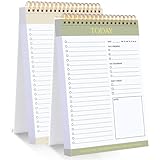
- 【Undated Daily To Do List Notepad】This to do list is non dated, which can help you plan daily planner or appointment without causing waste of pages. 2 pack to do list notepad totally 208 pages can meet your daily needs. The product is made of FSC-certified paper.
- 【100GSM Paper & Protective Cover】The planner has a plastic protective cover that protects the inner pages from getting wet, dirty or damaged. The inner pages are made of 100gsm paper, easy to write down and suitable for many types of pens.
- 【Spiral Binding To Do Notebook】The to do list notepad is bound in spirals, which is convenient for turning used pages to make plans again.
- 【Perforated Pages】The to do list pad is perforated designed, you can tear off used pages with ease, measuring 8.27x5.5'', which is very suitable for carrying around and tracking the completion of the to-do list at any time.
- 【Wide Applications】The to do list notepad allowing you to prioritize and stay organized, help you track important daily events and develop daily habits. It is a home school office essential for men and women to plan their life.
Compare options against the same criteria
If you are weighing two or more solution paths, such as a new AI system, an upgrade to an existing tool, or a process change, score each one against identical questions. Use the table below to keep the comparison consistent. The sources do not set weights or pass marks, so the weighting is yours to define and record before you see vendor pricing.
What’s actually slowing this PC down?
Pick the symptom - the matching free tool is one click away.
| Criterion | Question to answer for each option | Where the standard comes from |
|---|---|---|
| Expected outcome | How does the measured result compare with the current baseline? | NIST Map: benefits and costs |
| Data and integration fit | Can the option use your data and connect to your systems with the rights you hold? | ACT-IAC data readiness; NIST third-party risk |
| Reliability for this task | What are the known limitations, and do they fall inside your error tolerance? | NIST: documented system limits |
| Privacy, security, and legal | Which requirements apply, and what third-party risk does the option add? | NIST Govern and Map functions |
| Human oversight | Who reviews output, and how are exceptions escalated? | NIST: documented oversight |
| Portability and ownership | Can you exit, and who owns the outputs and any custom work? | ACT-IAC acquisition considerations |
| Total cost and staff capability | What is the full cost, and does your staff have the skill to run and review it? | ACT-IAC budget and expertise items |
Decide: go, defer, or stop
After the eight stages, the answer should fall into one of three outcomes.
Rank #3

- Find Your Perfect Match for Any Occasion: With 8 options ranging from minimalist to stylish aesthetics, there's always a notepad that perfectly aligns with your style. Whether for work, home or school, sure to find your match
- Effortless Daily To-Do List: Stay organized with sections for Top Priorities, For Tomorrow, Don’t Forget, and Notes. Capture tasks, track your day, and stay on top of everything—stress-free and productive
- Maximize Productivity with Ample Space: Jot down notes, set goals, make lists, plan tasks, and schedule appointments with ease in the generous space provided. By prioritizing what matters most and planning your day in advance, you'll see your productivity skyrocket
- High-Quality For Extended Lifespan: With a front cover and robust cardboard back cover, our notebook lays flat for smooth writing and is easy to carry without damaging the pages. The compact size ensures it fits perfectly in your bag, making it your ideal companion as you navigate through your busy day
- Superior 100GSM Paper: Experience superior, smooth writing without any bleed-through with our ink-friendly paper. Offers 42 Sheets, for almost 3 month of managing your to-do lists. Ideal for organizing home, office, and school tasks
- Go to a bounded pilot when the problem is specific, a non-AI fix has been ruled out, the data and ownership questions have answers, the risks have named reviewers, and the pilot has a baseline and stop criteria.
- Defer when the problem is real but one of the readiness items is missing, such as unclear data rights, no accountable owner, or no baseline. Fix the gap and return to the checklist.
- Stop when a simpler process change or existing tool meets the need, or when the required oversight costs more than the expected benefit.
NIST’s wording on the Map outcome is direct: “After completing the map function, Framework users should have sufficient contextual knowledge about AI system impacts to inform an initial go/no-go decision about whether to design, develop, or deploy an AI system.” That decision is a starting point, not the end of risk work. If you proceed, continue measuring and managing risk as the pilot runs, since NIST treats its framework functions as applicable according to your needs, resources, and capabilities rather than as a fixed sequence.
Independent reader supportYour contribution helps us test, update, and keep practical guides available for everyone.Currency and scope of the guidance
- NIST AI RMF 1.0 was released January 26, 2023. The Generative AI Profile was released July 26, 2024. NIST’s overview states that AI RMF 1.0 is being revised, so confirm the current version on NIST’s official site before citing version-specific requirements in a procurement file.
- NIST AI RMF Playbook offers suggested actions aligned to the framework and states that it is neither a checklist nor a set of steps to follow in its entirety.
- ACT-IAC AI Playbook is framed for the U.S. federal government. Its readiness questions are useful prompts for any organization, but it is not a universal legal or procurement requirement.
- OECD guidance (2026) is aimed at enterprises applying responsible business conduct and AI principles. It describes practical examples and says they are not an exhaustive checklist and do not suit every situation.
Before any procurement, check the rules that apply in your jurisdiction and sector. The frameworks above inform the analysis; they do not replace legal, privacy, or procurement review.
Quick Recap
Best Value

- BOOST PRODUCTIVITY | Harness our to do list notebook for an organized and efficient workspace.
- DESIGNED FOR YOU | Our notebook for work organization aesthetically incorporates to-do checklist, dot grid, and notes sections.
- SMART NAVIGATION | With perforated corner tabs in our work notebook, effortlessly track and return to your active page.
- LUXURIOUS WRITING | Our checklist notebook boasts 100 pages of 120 gsm extra-thick paper, providing a premium, bleed-proof writing experience.
- ON-THE-GO PLANNING | Our to do notebook offers full-page perforation for easy and portable planning on the move.
Rank #4

- SIMPLE, ATTRACTIVE DESIGN - The notepad flaunts a design that's both stylish and fun, making it the perfect backdrop for your daily tasks.
- 8.5" X 11": LETTER SIZE - With ample space for jotting down your to-dos, appointments, and reminders, this notepad ensures you never miss a beat. The larger size offers room to breathe and encourages creative planning.
- DOUBLE-WIRE SPIRAL BINDING - Tear off sheets as needed or keep them intact to be able to look back on your prior tasks. Whether you're at your desk, in a meeting, or on the go, your notepad is ready for you to use as you see fit.
- 50 SHEETS - Created so you can pack all your tasks onto one sheet in order to set and achieve goals, plan and complete projects, and stay organized no matter how you use your notepad.
- VERSATILE FOR TRACKING ALL YOUR TASKS - Whether you're a busy professional, a student managing coursework, or a parent juggling household chores, this notepad can help you organize. It's perfect for daily/weekly planning, making lists, setting priorities, and tracking progress.
Product prices and availability are accurate as of the date/time indicated and are subject to change. Any price and availability information displayed on Amazon at the time of purchase will apply.




