Not especially. Rare-earth elements are relatively abundant in Earth’s crust, but deposits concentrated enough to mine economically are much less common. They come from several kinds of mineral deposits and clays, and the supply chain involves more than simply finding or digging up ore.
What counts as a rare-earth element?
The name refers to a defined group of 17 chemical elements: the 15 lanthanides, plus scandium and yttrium. It does not mean every scarce mineral or metal. The elements also differ in abundance: the U.S. Geological Survey (USGS) gives cerium a crustal abundance of about 60 parts per million, while thulium and lutetium are each about 0.5 parts per million. These are estimates of how much is present in Earth’s crust, not measurements of mineable material.
As an Amazon Associate I earn from qualifying purchases.
The key distinction is between an element’s presence in the crust and a deposit where it is concentrated in a form that can be recovered economically. As the USGS put it in its 2017 overview, “Although REEs are not rare in terms of average crustal abundance, the concentrated deposits of REEs are limited in number.”
Free tools Windows power users keep installed
One-click scans. No signup required.
Where rare earths come from
There is no single rare-earth ore. The principal economic sources identified by the USGS include the minerals bastnasite, monazite, and loparite, as well as lateritic ion-adsorption clays. These occur in different geological settings; an occurrence of a rare-earth-bearing mineral is not automatically a mineable deposit.
#1 Best Overall

- Assorted Multi‑Size Magnet Set for DIY & Craft Projects: This kit comes with a nice variety of magnet sizes to meet your different hobby‑project needs. Multiple sizes in one pack, convenient for crafts, handmade ornaments, 3D‑print accessories and small DIY modifications. Ideal choice if you need assorted small‑size magnets for light‑duty work
- Comes with Handy Storage Organizer Case: All magnets are stored in a reusable plastic case for easy classification and storage. Keep different‑size magnets organized, reduce unintended violent snapping‑together between magnets, help prevent chipping and loss during storage
- Good Performance for Light‑Weight Applications: Magnets attract strongly to each other. Suitable for holding paper, photos and lightweight decorations on ordinary steel metal surfaces. Note: magnet‑to‑metal holding power is weaker than magnet‑to‑magnet attraction. NOT for heavy‑duty hanging jobs
- Economical Value Pack for Hobby Users: Cost‑effective assorted magnet pack with sufficient quantity. Perfect for casual crafters, makers, science‑experiment use and household light‑duty use. Please note these are small‑dimension magnets; refer to product images and size chart for exact dimensions before purchasing
- Important Usage Reminder: Neodymium magnets are brittle. Do NOT allow magnets of different sizes to snap violently together, as impact may cause chipping or cracking. Keep away from pacemakers and electronic screens. Not suitable for small children without adult supervision. Not recommended for stainless‑steel / glass refrigerator doors.The magnetic flux of our product is below 50 kG²/mm²
Minerals and deposit types
Rare earths can be concentrated in carbonatites and other alkaline igneous rocks, as well as in iron-oxide deposits, iron-oxide-copper-gold deposits, phosphate-rich sedimentary rocks, veins, and placer deposits. Placer deposits form when natural processes concentrate resistant minerals in sediments; monazite and xenotime can occur in them.
Carbonatite-hosted deposits have historically been important sources of light rare earths. Ion-adsorption clays in southern China are a key source of heavy rare earths. Which elements are enriched, how readily they can be recovered, and the costs of mining and processing all affect a deposit’s value.
Rank #2

- 【Stronger Magnetic Force】Compared with individual NdFeB countersunk magnets, cup magnets have the advantage of being smaller in size and stronger in magnetic force, the magnetic force is 5 times stronger than normal rare earth magnets.Per strong magnet can up to 150 pound holding power.
- 【Nice Design】The round countersunk hole magnet cup design increases the beauty of the product, the steel shell concentrates the strong magnetic force on one side only, the other three sides are almost non-magnetic, well greatly increase the holding power.
- 【Sturable】Neodymium magnets are very brittle, and the steel shell protects magnets so that strong magnets are not easily broken. The magnetic force is permanent and the service life is super long.
- 【Wide Application】Due to its excellent performance, strong cup magnets are widely used in home or industry, such as clips in automation equipment, door closers, tool holders, fixtures, providing magnetic base mounting for lamps, clocks, machines, mirrors and so on. Heavy duty also comes with 6 stainless steel screws to increase the range of product usage.
- 【Precautions】As the neodymium magnet is very fragile and strong magnetic, when you use it you must remove it in a flat position, and after removing it, it is forbidden to collide it with other metal objects (including another magnet) to avoid injury! We are a magnet supplier with professional strength. You can certainly find strong cup magnets with holes you want in my shop!
Examples of known deposits
The USGS names Mountain Pass in California as a major carbonatite-hosted deposit. It also identifies Bayan Obo in Inner Mongolia and deposits in Sichuan and Anhui, China. These examples illustrate different geological sources; they are not, by themselves, a current ranking of countries by production.
What’s actually slowing this PC down?
Pick the symptom - the matching free tool is one click away.
Why supply is concentrated
Rare-earth elements occur in many places, but commercially useful concentrations are limited. A project’s prospects depend on more than the presence of rare earths: the deposit’s grade, the elements it contains, the ability to recover them, processing costs, and commodity prices all matter. Mining is also only one stage of supply. Separation and refining capacity are distinct parts of the chain, so a country’s mine output alone does not show where all processing takes place.
Rank #3

- SUPER POWERFUL - This fishing magnet has a diameter of 2 inches (50 millimeters). Please note that when the contact surface between the magnet and the object being attracted is smooth, the maximum pulling force can reach 350 pounds.
- HIGH QUALITY - The powerful magnetic force is only concentrated at the bottom, The other three sides are Protected by steel cups that almost no magnetic force and magnetic force equivalent to 10 times the volume of the same magnet. force permanent, long service life. Made under ISO 9001 Quality Systems. 60 Days Money Back Guaranteed!
- BEST COATING - Ni+Cu+Ni Triple Layer Coated. The Best Coating Available, which Provides a Shiny and Rust Resistant Coated steel cup provides protection for the magnet and helps to prevent chipping or cracking.
- MULTI USE - Unique design with Countersunk Hole and Eyebolt Great for salvaged of various iron-containning nickel material underwater and Good idea for magnet fishing, lifting, hanging, retrieving applications. Have fun to searching items like eyebolt, screws, hooks, fasteners and so on in your warehouse garage or yard.
- PERMANENT STRENGTH - Neodymium is a kind of rare earth metal, it's suitable for making permanent & powerful magnets. This fishing magnet has permanent magnetism, it will be the same powerful even decades after.
The USGS’s Mineral Commodity Summaries 2026 estimates world rare-earth production at 390,000 metric tons in 2025. That figure is estimated production for one year—not the amount of rare earths in the crust, a reserve estimate, or a measure of how much material is readily available to manufacturers. The cited summary does not establish a comparable current country-by-country split across mining, separation, and refining.
Historical figures should not be mistaken for today’s shares. A USGS report published in 2019 says China accounted for approximately 84 percent of world rare-earth production between 2011 and 2017; it also says U.S. production from Mountain Pass provided about 4 percent of world supply during the period described in that report. Neither number is a current production share.
Rank #4
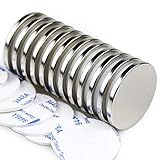
- Magnets Coated - Ni+Cu+Ni Triple Layer Coated. The Best Coating Available, which Provides a Shiny and Rust Resistant Protection for the Magnets.
- Strong Rare Earth Magnets - Made from Strong Magnetic Material, these magnets offer concentrated and durable magnetic force. Perfect for securing photos, lists, and tools—ideal for home displays, workspace organization, and creative projects.
- Magnets Dimensions - Diameter 32mm x Thick 3mm (approx. 1.26" x 0.126" ). Tolerances: 0.2mm x 0.2mm.
- Diy Projects & Science Experiments - Refrigerator Magnets, Shower Door, Work or Office, Scientific Purposes, Arts and Crafts or School Classroom.
- Multi Use - This super strong neodymium disc magnet with Epoxy Coating is made of rare earth materials, which has the powerful ability to attract all kinds of iron materials. With our free double-sided adhesive tape, it can be applied to almost all kinds of scenes in life,example for Refrigerator Magnets, DIY,Shower Door, Work or Office, Scientific Purposes, Arts and Crafts or School Classroom,etc.
Does “critical” mean rare?
No. In this context, “critical” concerns the importance of a material and the risk or potential economic consequences of a supply disruption; it is not a synonym for geologically scarce. The USGS’s explanation of its 2025 critical-minerals list describes a supply-chain risk assessment and identifies samarium, lutetium, terbium, dysprosium, gadolinium, and yttrium among the highest-risk commodity chains under its methodology. Rare earths are chemical elements; criticality is assessed individually rather than applying equally to the group.
The Tool Desk
Outbyte PC Repair FREEClear out junk files and repair common Windows errorsFree Scan →Outbyte Driver Updater FREEScan for outdated or missing drivers - takes under a minuteDriver Scan →How to judge claims about a new rare-earth source
A deposit announcement or map showing rare-earth occurrences does not by itself demonstrate a dependable supply. To compare a mine or proposed project, check:
Best Value

- 【Product Size】: 0.47 x 1.69 inches; Package: 4 pack; Pull Power: 17 pounds. The gold testing magnet is the perfect size and strength for identifying fake silver and gold jewelry!
- 【Small & Convenient Tools】: The magnetic design can easily hang some small objects on metal surfaces such as refrigerators, metal doors, tables, chairs, etc. Easy to place and find, and save space. Free your hands and only need a magnetic keychain to adsorption the tools and accessories needed for work
- 【Practical Magnetic Keychain】: The magnetic keychain is small, light in weight, and easy to carry. You can put it in your pocket or wallet directly when you go out, you don’t need to find the key in your pocket or wallet anymore and you will never lose them again
- 【Multi Use Jewelry Magnet】: The magnet keychain provides you with an incredibly versatile multi-functional tool. It can make your daily work more organized and convenient, suitable for all your indoor and outdoor uses
- 【Exquisite Packaging & Special Gifts】: Exquisite package with plastic case, avoid damage and loss of magnets during transportation, It can be given as a gift to relatives or friends
- Which elements are present: Light and heavy rare earths are not interchangeable descriptions of a deposit’s mix.
- Host and deposit type: The minerals or clays holding the elements affect how they can be recovered.
- Grade and recoverability: The amount present and the share that can be extracted matter more than occurrence alone.
- Processing capacity: Mining, separation, and refining are different stages and should not be conflated.
- Economic and environmental constraints: Costs and practical development conditions help determine whether a resource can become production.
The USGS’s 2019 review of rare-earth deposits in the United States discusses the range of deposit types and the economic factors involved. A geological resource or occurrence should not be described as an economic reserve unless that status is established.
Quick Recap
Sources and further reading
- USGS: Rare Earths Statistics and Information
- USGS: Rare-earth elements, December 19, 2017
- USGS: Mineral Commodity Summaries 2026
- USGS: About the 2025 List of Critical Minerals
- USGS: Rare earth element mineral deposits in the United States, April 11, 2019
Product prices and availability are accurate as of the date/time indicated and are subject to change. Any price and availability information displayed on Amazon at the time of purchase will apply.




