Freedom251 › AI Video Summarizers
YouTubeTLDR
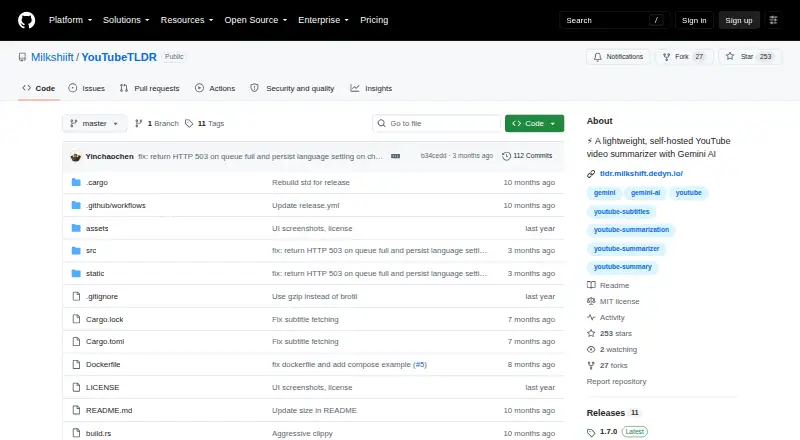
What YouTubeTLDR is
YouTubeTLDR is a free, self-hosted YouTube video summarizer built around Gemini AI. Enter a YouTube video URL to generate a summary, choose any available Gemini model, and customize the instructions that guide the output format. The application also exposes the complete raw transcript. Summary history is stored locally in the browser so it can be revisited later. YouTubeTLDR runs a Rust server on your own machine, with a vanilla HTML and JavaScript interface. You provide your own Google Gemini API key, which the project says is used directly without proxies or data collection, while your data remains yours. The documented deployment is a single executable of about 0.3 MB, without a database, Tokio, or frameworks. Start it by running the executable and opening localhost:8000 in a browser. TLDR_IP, TLDR_PORT, and TLDR_WORKERS environment variables can change the server address, port, and worker count. The project supports Linux, macOS, Windows, web, and self-hosted use, and its repository identifies an MIT license. It accepts YouTube URLs only; video uploads and chapter generation are not supported. The server is optimized for personal use rather than hundreds of simultaneous users.
Who it suits
YouTubeTLDR suits individuals who want local control over YouTube summaries and are comfortable running a small self-hosted executable. It fits users who have a Gemini API key and want model choice, custom prompts, transcripts, and browser-based history.
What it does well
- Free and MIT-licensed
- Runs locally as a roughly 0.3 MB single binary
- Supports custom instructions and selectable Gemini models
- Provides full raw video transcripts
- Stores summaries locally in the browser
- Supports Linux, macOS, Windows, web, and self-hosting
What to know first
- Requires your own Google Gemini API key
- Accepts YouTube URLs but not video uploads
- Not designed for hundreds of concurrent users
- Does not generate chapters
Limits
Use requires a Google Gemini API key. The server is intended for personal use and is not designed to support hundreds of concurrent users; it accepts YouTube URLs rather than video uploads and has no chapter generation.
Getting started
- Download the executable from the project releases
- Run the executable on a supported system
- Open localhost:8000 in a browser
- Provide your Google Gemini API key
- Enter a YouTube video URL
- Optionally set TLDR_IP, TLDR_PORT, or TLDR_WORKERS
Verdict
Pick YouTubeTLDR for a lightweight, local YouTube summarizer with customizable Gemini instructions and transcript access. Consider another tool if you need uploaded videos, automatic chapters, or a service designed for large concurrent usage.
Questions
Is YouTubeTLDR free?
Yes. It has a free plan and the repository identifies an MIT license.
What does YouTubeTLDR summarize?
It summarizes YouTube videos supplied as video URLs and also provides the full raw transcript.
Do I need a Gemini API key?
Yes. Running the app requires your own Google Gemini API key, used directly by the application.
Where does YouTubeTLDR run?
It supports Linux, macOS, Windows, web, and self-hosted use through a Rust server running on your machine.
Can it process uploaded videos or create chapters?
No. Its input is YouTube video URLs, and chapter generation is not supported.
How are summaries saved?
Summaries are saved locally in the user's browser for future reference.
Facts from YouTubeTLDR's own pages
- Concurrency limit
- The server is optimized for personal use and is not designed to support hundreds of concurrent users. · github.com, 8 Oct 2026
- Configuration
- The server IP, port, and worker count can be changed with the TLDR_IP, TLDR_PORT, and TLDR_WORKERS environment variables. · github.com, 7 Oct 2026
- Custom prompts
- Users can customize prompts to get summaries in their preferred format. · github.com, 8 Oct 2026
- Dependency footprint
- The project describes the application as a roughly 0.3 MB single binary with no database, Tokio, or frameworks. · github.com, 7 Oct 2026
- Deployment
- The project describes itself as a single binary of about 0.3 MB, with no database, Tokio, or frameworks. · github.com, 8 Oct 2026
- Gemini API
- Users provide their own Google Gemini API key, which the app uses directly without proxies or data collection, according to the project. · github.com, 7 Oct 2026
- Gemini models
- Users can choose any available Gemini model. · github.com, 8 Oct 2026
- Gemini model selection
- Users can choose any available Gemini model. · github.com, 7 Oct 2026
- History
- Summaries are saved locally in the user’s browser for future reference. · github.com, 7 Oct 2026
- Interface
- The app uses a Rust server with a vanilla HTML and JavaScript interface. · github.com, 7 Oct 2026
- License
- The repository lists an MIT license. · github.com, 8 Oct 2026
- Privacy
- The README says the app runs on the user's own machine and uses their Gemini API key directly, with no proxies or data collection. · github.com, 8 Oct 2026
- Purpose
- YouTubeTLDR is a lightweight, self-hosted YouTube video summarizer that uses Gemini AI. · github.com, 8 Oct 2026
- Release
- The releases page lists version 1.7.0 as the latest release and says it fixed caption fetching. · github.com, 8 Oct 2026
- Requirements
- Running the app requires a Google Gemini API key; the README describes Gemini's free tier as having generous limits. · github.com, 8 Oct 2026
- Setup
- The README instructs users to run the executable and open http://localhost:8000 in a browser. · github.com, 8 Oct 2026
- Summary history
- Summaries are saved locally in the user's browser for future reference. · github.com, 8 Oct 2026
- Transcript
- The app provides access to the full raw video transcript. · github.com, 8 Oct 2026
Where YouTubeTLDR stands on Freedom251
- AI Video Summarizers#23 of 25