Freedom251 › AI Video Summarizers
Video Summarizer
What Video Summarizer is
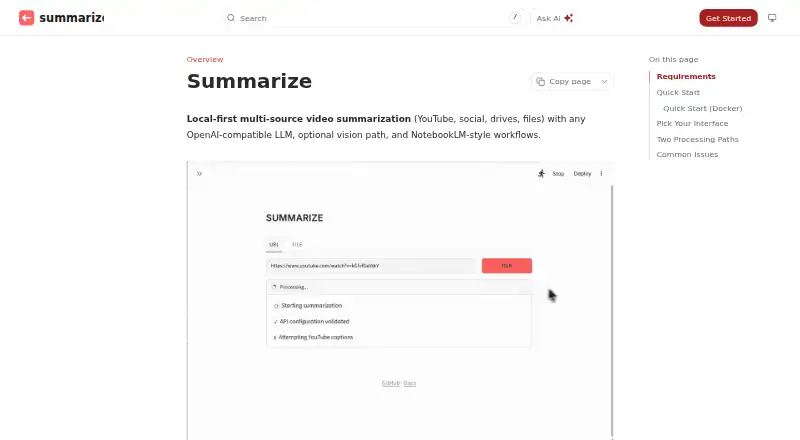
Video Summarizer is an open-source tool that turns videos into reusable notes. It accepts links or files from YouTube, Instagram, TikTok, Twitter/X, Reddit, Facebook, Google Drive, and Dropbox, as well as local files. In its default workflow, it uses available captions or transcribes audio with Whisper before summarizing the transcript with an LLM. A separate visual mode sends video, including its visible content and audio, to a video-capable model without first transcribing it. Users can choose formats such as Q&A, distillation, fact-checking, tutorials, Mermaid diagrams, and essays, or add custom styles through prompts.json. Interfaces and deployment options include a Streamlit GUI, CLI, optional HTTP API, Docker, Raycast extension, and agent skill. The project describes itself as local-first, but users must provide at least one LLM API key in a local .env file; requirements also include Python 3.7 or later and ffmpeg on PATH. Transcript caching supports reruns with other styles or providers. The webapp can publish summaries as public Tinypaste pages. The default visual-mode limits are 120 seconds per request and 100 MB per file.
Who it suits
It suits people who want to condense podcasts, lectures, conference talks, or social videos into notes, and are comfortable supplying an LLM API key. Its interfaces and deployment options serve both command-line and webapp workflows.
What it does well
- Accepts links from major video and social platforms
- Offers transcript and direct visual processing modes
- Includes GUI, CLI, optional API, and Docker deployment
- Transcript caching supports reruns without transcribing again
What to know first
- Requires users to provide an LLM API key
- Requires Python 3.7 or later and ffmpeg
- Shared summaries are public pages
- Webapp history is lost on refresh by default
Limits
Visual mode defaults to a maximum of 120 seconds per request and 100 MB per file. The webapp keeps its last 10 summaries in memory by default, and that history is lost on page refresh unless disk persistence is configured.
Getting started
- Open https://summarize.martino.im/ or choose a listed deployment route such as Docker.
- Install Python 3.7 or later and ensure ffmpeg is on PATH.
- Add at least one LLM API key to a local .env file.
- Configure settings in summarizer.yaml and choose a supported source.
- Run a summary using a style, or configure a custom style in prompts.json.
Verdict
Video Summarizer offers multiple input sources, processing modes, and interfaces in a free open-source project. Users should configure their own provider key and note that shared pages are public.
Questions
How much does Video Summarizer cost?
It is free and open source.
Does it have a free plan or trial?
A free plan is listed, and no free trial is offered.
Which platforms and interfaces does it support?
Listed platforms are API, Linux, macOS, self-hosted, web, and Windows. Interfaces include a Streamlit GUI, CLI, optional HTTP API, Docker deployment, Raycast extension, and agent skill.
Which video sources can I use?
Supported sources include YouTube, Instagram, TikTok, Twitter/X, Reddit, Facebook, Google Drive, Dropbox, and local files.
Do I need an API key?
Yes. Users supply at least one LLM API key in a local .env file.
Can I share a summary privately?
The webapp can publish a summary through Tinypaste without an account or token, but shared summaries are public pages.
Facts from Video Summarizer's own pages
- Bring your own key
- Users supply at least one LLM API key in a local .env file; configuration is stored in summarizer.yaml and .env. · summarize.martino.im, 9 Oct 2026
- Caching
- Transcript caching lets users rerun a video with different styles or providers without transcribing it again. · summarize.martino.im, 8 Oct 2026
- Input sources
- It supports YouTube, Instagram, TikTok, Twitter/X, Reddit, Facebook, Google Drive, Dropbox, and local files. · summarize.martino.im, 8 Oct 2026
- Integration
- The Raycast extension can send a video URL to the local Summarize API for summarization. · summarize.martino.im, 9 Oct 2026
- Interfaces
- The maker documents a CLI, Streamlit GUI, HTTP API, Docker deployment, Raycast extension, and agent skill. · summarize.martino.im, 9 Oct 2026
- LLM integrations
- It works with OpenAI-compatible endpoints, with examples including OpenAI, Groq, Gemini, Ollama, OpenRouter, NVIDIA, and Perplexity. · summarize.martino.im, 8 Oct 2026
- LLM providers
- The maker lists OpenAI, Groq, Gemini, Ollama, OpenRouter, NVIDIA, Perplexity, LiteLLM, and any OpenAI-compatible endpoint. · summarize.martino.im, 9 Oct 2026
- Maker
- The maker's personal site identifies Martino Piaggi as a computer science engineer who primarily writes open-source code. · martino.im, 9 Oct 2026
- Notable sharing limit
- Shared summaries are public pages, according to the sharing documentation. · summarize.martino.im, 8 Oct 2026
- Prefiltering
- Optional JEV prefiltering selects transcript passages for inclusion or exclusion before sending text to the summary model. · summarize.martino.im, 9 Oct 2026
- Processing modes
- It offers transcript based summarization and a visual mode that sends video directly to a vision-capable model without transcription. · summarize.martino.im, 9 Oct 2026
- Requirements
- The documented requirements include Python 3.7 or later, ffmpeg on PATH, and at least one LLM API key. · summarize.martino.im, 9 Oct 2026
- Security and compliance
- The maker describes the project as self-hosted and local-first and instructs users to keep API keys in .env; the opened maker pages state no security certification or compliance standard. · summarize.martino.im, 9 Oct 2026
- Security and data handling
- The project describes itself as local-first, and users configure provider API keys in a local .env file. · summarize.martino.im, 8 Oct 2026
- Sharing
- The webapp can publish a summary as a public rendered page through Tinypaste without an account or token. · summarize.martino.im, 8 Oct 2026
- Summary formats
- Available summary styles include Q&A, distillation, fact-checking, tutorials, Mermaid diagrams, and essays, with custom styles added through prompts.json. · summarize.martino.im, 8 Oct 2026
- Summary styles
- Built-in styles include Q&A, distillation, fact-checking, tutorials, Mermaid diagrams, and essays, with custom prompts supported through prompts.json. · summarize.martino.im, 9 Oct 2026
- Supported sources
- The maker lists YouTube, Instagram, TikTok, Twitter/X, Reddit, Facebook, Google Drive, Dropbox, and local files as supported sources. · summarize.martino.im, 9 Oct 2026
- Transcript cache
- A transcript cache allows rerunning the same source with different styles, providers, or languages without transcribing it again; disk persistence can be enabled. · summarize.martino.im, 9 Oct 2026
- Transcript workflow
- The default workflow uses captions when available or transcribes audio with Whisper, then summarizes the transcript with an LLM. · summarize.martino.im, 8 Oct 2026
- Visual mode
- Visual mode sends video, including visible content and audio, to a video-capable model without transcribing first. · summarize.martino.im, 8 Oct 2026
- Visual mode limits
- The documented default visual limits are 120 seconds per request and 100 MB per file, with MP4, MPEG, MOV, and WEBM listed as supported formats. · summarize.martino.im, 8 Oct 2026
- Webapp history
- The webapp keeps the last 10 summaries in memory by default, and that history is lost on page refresh unless disk persistence is configured. · summarize.martino.im, 9 Oct 2026
- What it does
- Summarize is a local-first, self-hosted tool for summarizing videos and other sources with an OpenAI-compatible LLM. · summarize.martino.im, 9 Oct 2026
Where Video Summarizer stands on Freedom251
- AI Video Summarizers#22 of 25