Freedom251 › AI Video Summarizers
tldw
What tldw is
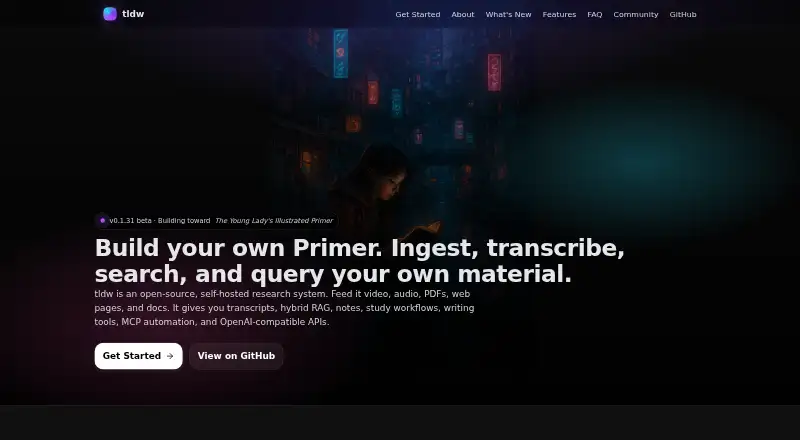
tldw is a free, open-source research system that users can self-host to collect, transcribe, search, and query source material. It accepts video, audio, PDFs, web pages, EPUB, DOCX, Markdown, XML, and other inputs, turning recordings into searchable text for quoting or summarizing. Hybrid search combines full-text retrieval, vectors, and reranking across transcripts, notes, and documents. Users can run local models, connect hosted model APIs, or use both through one interface. The project offers OpenAI-compatible Chat, Audio, Embeddings, and Evals APIs. Notes, prompts, chats, artifacts, and source material can share a workspace, alongside study packs, flashcard templates, study suggestions, and evaluation workflows. Integrations include hosted providers such as OpenAI, Anthropic, Google, Cohere, Groq, Mistral, and OpenRouter, plus local options including Ollama, vLLM, and llama.cpp. The project says data stays on infrastructure users control, with no telemetry, analytics, or phone-home behavior. It is labeled beta at v0.1.31; PyPI installation is not generally available, and setup is through a repository checkout.
Who it suits
It suits researchers and learners who want to organize and query varied source material while keeping it on infrastructure they control. It is aimed at people comfortable using a beta project and setting it up from a repository checkout.
What it does well
- Accepts video, audio, documents, and web pages.
- Searches transcripts, notes, and documents with hybrid retrieval.
- Supports local models, hosted APIs, or both.
- Data remains on infrastructure users control, according to the project.
- Includes study packs, flashcards, and evaluation workflows.
What to know first
- The project is labeled beta.
- PyPI installation is not generally available.
- Installation is directed through a repository checkout.
Limits
The current release is v0.1.31 beta. PyPI installation is not generally available, so the project directs users to a repository checkout.
Getting started
- Open the tldw website
- Choose Docker single-user, Docker multi-user with Postgres, or local single-user deployment
- Install from a repository checkout
- Run the self-hosted system on infrastructure you control
- Add source material such as YouTube URLs, local videos, documents, or web pages
Verdict
tldw brings transcription, retrieval, model connections, and study tools into a self-hosted research workspace. Its beta status and repository-based installation make it a better fit for users comfortable with early-stage software setup.
Questions
Is tldw free?
Yes. tldw is free and open source.
Where can tldw run?
The listed platforms are API, self-hosted, and web. Deployment paths include Docker single-user, Docker multi-user with Postgres, and local single-user setup.
What can tldw ingest?
It accepts video, audio, PDFs, web pages, EPUB, DOCX, Markdown, XML, YouTube URLs, local video files, and other inputs.
Which model providers work with tldw?
Hosted options listed include OpenAI, Anthropic, Google, Cohere, DeepSeek, Groq, Mistral, OpenRouter, HuggingFace, and Qwen. Local options include Ollama, vLLM, and llama.cpp.
Does tldw provide an API?
Yes. It provides OpenAI-compatible Chat, Audio, Embeddings, and Evals APIs.
How does tldw handle data?
The site says data remains on infrastructure users control, with no telemetry, analytics, or phone-home behavior.
Facts from tldw's own pages
- API
- The project provides OpenAI-compatible Chat, Audio, Embeddings, and Evals APIs. · tldwproject.com, 7 Oct 2026
- APIs and automation
- The project provides OpenAI-compatible Chat, Audio, Embeddings, and Evals APIs, plus MCP tool execution and metrics. · tldwproject.com, 7 Oct 2026
- Automation
- MCP automation includes workspace-bounded command execution, policy-aware discovery, and approval gates. · tldwproject.com, 7 Oct 2026
- Availability
- The project is labeled beta, and the site says PyPI installation is not generally available yet. · tldwproject.com, 7 Oct 2026
- Community support
- The site directs users to Discord, Zulip, and GitHub for discussion, help, and contribution. · tldwproject.com, 7 Oct 2026
- Data handling
- The site says users keep data on infrastructure they control, with no telemetry, analytics, or phone-home behavior. · tldwproject.com, 7 Oct 2026
- Deployment
- The site documents Docker single-user, Docker multi-user with Postgres, and local single-user setup paths. · tldwproject.com, 7 Oct 2026
- Installation limit
- The site says PyPI installation is not generally available yet and directs users to install from a repository checkout. · tldwproject.com, 7 Oct 2026
- Integrations
- The site lists hosted model providers including OpenAI, Anthropic, Google, Cohere, DeepSeek, Groq, Mistral, OpenRouter, HuggingFace, and Qwen, plus local options including Ollama, vLLM, and llama.cpp. · tldwproject.com, 7 Oct 2026
- Model integrations
- It supports hosted model providers including OpenAI, Anthropic, Google, Cohere, Groq, Mistral, and OpenRouter, as well as local options such as Ollama, llama.cpp, and vLLM. · tldwproject.com, 7 Oct 2026
- Models
- It supports local inference, hosted model APIs, or both through one interface. · tldwproject.com, 7 Oct 2026
- Privacy
- The site says data stays on infrastructure users control and that tldw has no telemetry, analytics, or phone-home behavior. · tldwproject.com, 7 Oct 2026
- Project status
- The site labels the current release v0.1.31 beta and says it is usable now for people comfortable with a beta project. · tldwproject.com, 7 Oct 2026
- Purpose
- tldw is an open-source, self-hosted research system for ingesting, transcribing, searching, and querying source material. · tldwproject.com, 7 Oct 2026
- Search
- Hybrid retrieval searches across transcripts, notes, and documents using full-text search, vectors, and reranking. · tldwproject.com, 7 Oct 2026
- Security
- The v0.1.31 release notes describe hardening for authentication and authorization, outbound scraping policy, audit durability, and workspace-bounded MCP command execution. · tldwproject.com, 7 Oct 2026
- Study tools
- The v0.1.31 beta includes Study Packs, flashcard templates, study suggestions, and a recipe-based evaluation framework. · tldwproject.com, 7 Oct 2026
- Support and community
- The site directs users to Discord and Zulip for community discussion and help. · tldwproject.com, 7 Oct 2026
- Supported content
- It accepts video, audio, PDFs, web pages, EPUB, DOCX, Markdown, XML, and other inputs. · tldwproject.com, 7 Oct 2026
- Supported inputs
- It accepts video, audio, PDFs, web pages, EPUB, DOCX, Markdown, XML, and other formats. · tldwproject.com, 7 Oct 2026
- Transcription
- It converts recordings into searchable text that can be quoted, summarized, and reused. · tldwproject.com, 7 Oct 2026
- Transcription and retrieval
- It turns recordings into searchable text and uses hybrid retrieval across transcripts, notes, and documents. · tldwproject.com, 7 Oct 2026
- Workspace
- Notes, prompts, chats, artifacts, and source material can live in the same system. · tldwproject.com, 7 Oct 2026
- Workspace features
- It includes notes, prompts, chatbooks, study packs, flashcard templates, study suggestions, and evaluation workflows. · tldwproject.com, 7 Oct 2026
Where tldw stands on Freedom251
- AI Video Summarizers#25 of 25