Freedom251 › Distribution Accounting
webERP
What webERP is
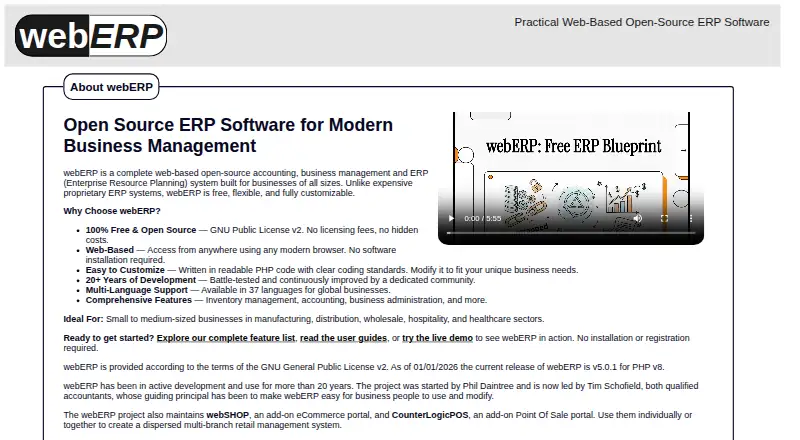
webERP is a free, open-source, self-hosted accounting and ERP system for businesses of all sizes. It combines accounts receivable and payable, general ledger, bank accounts, inventory and purchasing with order management and support for multiple entities. Manufacturing tools include multi-level bills of materials, work orders and material requirements planning; capacity requirements planning and MRP II are not available. The maker identifies small and medium-sized businesses in manufacturing, distribution, wholesale, hospitality and healthcare as ideal users. webERP is available in 37 languages and runs on a PHP-capable web server; its manual names Apache, IIS, Hiawatha and Nginx. It is operating-system independent, but works only with MySQL or MariaDB database servers. Security features described include role-based access, optional SSL, transaction audit trails and account lockout after three incorrect passwords. An XML-RPC API lets external programs retrieve and update data, but can access only one company per installation. The project also maintains webSHOP and CounterLogicPOS portals. The current release listed as of January 1, 2026 is webERP v5.0.1 for PHP v8.
Who it suits
webERP suits small and medium-sized businesses in manufacturing, distribution, wholesale, hospitality or healthcare that can self-host an ERP system. It is also an option for organizations needing finance, inventory and order tools alongside manufacturing functions.
What it does well
- Free and open source under GNU General Public License v2.
- Includes finance, inventory, purchasing and manufacturing features.
- Available in 37 languages.
- Supports role-based access and transaction audit trails.
What to know first
- Requires a MySQL or MariaDB database.
- Capacity requirements planning and MRP II are unavailable.
- API access is limited to one company per installation.
Plans
| Plan | Billed and limits | Price |
|---|---|---|
| webERP | Free and open source under GNU General Public License v2; self-hosted | Free |
As weberp.org lists them, read 10 Oct 2026. The maker's own page has the final word.
Getting started
- Visit the webERP website.
- Prepare a PHP-capable web server and a MySQL or MariaDB database server.
- Deploy webERP on-premise or in your own self-hosted environment.
- Use the project’s GitHub Discussions, issue reporting, or SourceForge mailing lists for community support.
Overview
webERP is a web-based, open-source accounting and ERP system for businesses that want to run finance and operations on their own server. It is most compelling for small and medium-sized organizations in manufacturing, distribution, wholesale, hospitality or healthcare that have the technical capacity to maintain that setup. Its breadth is substantial for a free system, though the database requirement and limits in advanced manufacturing planning rule out some needs.
Key features
Finance tools cover accounts receivable and payable, the general ledger and bank accounts, alongside inventory, purchasing and order management. Keeping these functions in one system can help wholesalers and distributors coordinate stock, orders and finances without a software subscription. Multi-entity support is useful to organizations managing several companies, but it comes with an important integration caveat: the XML-RPC API can access only one company per installation.
Manufacturing capabilities include multi-level bills of materials, work orders and material requirements planning. That is a credible base for production workflows, but the absence of capacity requirements planning and MRP II makes webERP a poor fit for manufacturers who need those controls to schedule or manage production.
The XML-RPC API lets external programs retrieve and update data; the maker recommends it to help preserve data integrity. The project also maintains webSHOP, an e-commerce portal, and CounterLogicPOS, a point-of-sale portal. These companion projects may be relevant to businesses considering those channels, while the API's one-company limit matters for integrations spanning multiple entities.
Security features include role-based access, account lockout after three incorrect passwords, optional SSL encryption, transaction audit trails, and protections against SQL injection and cross-site scripting. The system is available in 37 languages, a practical advantage for organizations serving users across language groups.
Pricing
webERP costs nothing. The free and open-source software is licensed under GNU General Public License v2 and is self-hosted; there is no free trial because the plan is already free. This suits organizations that want to avoid a software fee and can take responsibility for hosting and maintenance. The trade-off is that the price does not remove the technical requirements: webERP needs a PHP-capable web server and supports only MySQL or MariaDB database servers.
Platforms
webERP is self-hosted and described as operating-system independent. It runs on a PHP-capable web server, with Apache, IIS, Hiawatha and Nginx among the named options, but it works only with MySQL or MariaDB. That combination offers flexibility in server operating system and web-server choice while imposing a firm database constraint. The current release is webERP v5.0.1 for PHP v8.
Who it's for
Small and medium-sized businesses in manufacturing, distribution, wholesale, hospitality and healthcare are the maker's target users. The strongest case is for a business in one of those sectors that needs accounting, inventory, orders and, where applicable, core manufacturing tools together, and can run its own server. Organizations without the capacity to manage self-hosting, or manufacturers dependent on capacity requirements planning or MRP II, should look elsewhere.
Support routes include GitHub Discussions, issue reporting, and user and developer mailing lists on SourceForge. This gives technically capable users community channels to consult, but webERP remains a self-hosted system whose operation depends on the organization managing its environment.
Pros and cons
- Pros: Free, open-source licensing avoids a software charge while covering accounting, inventory, purchasing and orders.
- Pros: Multi-entity support and 37 languages suit organizations with multiple companies or language needs.
- Pros: Role-based access, audit trails, account lockout and optional SSL provide a set of security controls.
- Cons: Self-hosting and the MySQL-or-MariaDB requirement demand compatible infrastructure and ongoing technical ownership.
- Cons: No capacity requirements planning or MRP II leaves gaps for manufacturers needing advanced planning.
- Cons: The API's one-company limit constrains integrations in multi-entity installations.
Alternatives
Choose Odoo CRM if you want a free single-app option with unlimited users on Odoo Online, or prefer its freemium model and broader platform coverage, including Android and iOS. Its free offer is for one app, unlike webERP's self-hosted ERP system.
Katana is worth considering if you want a permanent free tier with no expiry date, unlimited users, integrations and inventory locations, and can work within its 30-SKU cap. Its platform is web-based.
For paid ERP alternatives, Global Shop Solutions ERP, Trimble Viewpoint Vista, abas ERP and Epicor Kinetic are options to compare if a paid system better suits your requirements; their pricing is tailored or requires contacting sales. JOBPOWER and TimeSuite are also paid alternatives.
Browse ERP Software for more systems, or Cost Accounting Software if cost accounting is your priority.
Verdict
webERP is a strong fit for technically capable small and medium-sized businesses that want a broad, free, self-hosted system for accounting and core operations. Its main reason to choose it is the range of included business functions without a software charge; its main reasons to look elsewhere are the MySQL-or-MariaDB constraint, the work of self-hosting, and the manufacturing-planning gaps. Before adopting it, confirm that the database requirement, API limit and production tools match how your organization operates.
Verdict
webERP offers a broad set of business functions at no software charge, but it requires self-hosting and a compatible database. Check the manufacturing limitations and one-company API restriction against your needs.
Questions
Does webERP have a free plan?
Yes. webERP is free and open-source under GNU General Public License v2, and its listed plan is free.
Where can webERP run?
It is self-hosted for on-premise deployment, runs on a PHP-capable web server, and works with MySQL or MariaDB. The project describes it as operating-system independent.
What business functions does it include?
Its listed functions include accounts receivable and payable, general ledger, bank accounts, inventory, purchasing, order management, and manufacturing tools.
Does it support manufacturing planning?
It includes multi-level bills of materials, work orders, and material requirements planning. Capacity requirements planning and MRP II are unavailable.
Can external programs connect to webERP?
Yes. The XML-RPC API can retrieve and update data, and the maker recommends using it to preserve data integrity. The API can access only one company per installation.
Who makes webERP, and where can users get community support?
The webERP project provides GitHub Discussions, issue reporting, and user or developer mailing lists on SourceForge.
Facts from webERP's own pages
- Accounting and inventory
- Features include accounts receivable and payable, general ledger, bank accounts, inventory, and purchasing. · weberp.org, 10 Oct 2026
- Add-ons
- The project also maintains webSHOP, an e-commerce portal, and CounterLogicPOS, a point-of-sale portal. · weberp.org, 10 Oct 2026
- API limitation
- The API can access only one company in a webERP installation, according to its tutorial. · weberp.org, 10 Oct 2026
- Current release
- The homepage states that as of January 1, 2026, the current release is webERP v5.0.1 for PHP v8. · weberp.org, 10 Oct 2026
- Database requirement
- The getting-started manual says webERP works only with MySQL or MariaDB database servers. · weberp.org, 10 Oct 2026
- Deployment
- on-premise · weberp.org, 20 Sept 2026
- Finance module
- Yes · weberp.org, 20 Sept 2026
- Free plan
- Yes · weberp.org, 20 Sept 2026
- Hosting and platforms
- webERP runs on a PHP-capable web server and is described as operating-system independent; the manual names Apache, IIS, Hiawatha, and Nginx as web-server options. · weberp.org, 10 Oct 2026
- Integration
- The maker provides an XML-RPC API for external programs to retrieve and update data, and says it should be used to preserve data integrity. · weberp.org, 10 Oct 2026
- Inventory management
- Yes · weberp.org, 20 Sept 2026
- Languages
- The site says webERP is available in 37 languages. · weberp.org, 10 Oct 2026
- Manufacturing
- Manufacturing features include multi-level bills of materials, work orders, and material requirements planning; the page says capacity requirements planning and MRP II are not available. · weberp.org, 10 Oct 2026
- Multi-entity support
- Yes · weberp.org, 20 Sept 2026
- Order management
- Yes · weberp.org, 20 Sept 2026
- Product
- webERP is a web-based open-source accounting, business management, and ERP system for businesses of all sizes. · weberp.org, 10 Oct 2026
- Security
- The features page describes role-based access, account lockout after three incorrect passwords, optional SSL encryption, transaction audit trails, and sanitization against SQL injection and cross-site scripting. · weberp.org, 10 Oct 2026
- Support and community
- The maker points users to GitHub Discussions, issue reporting, and user or developer mailing lists on SourceForge. · weberp.org, 10 Oct 2026
- Who it is for
- The maker identifies small and medium-sized businesses in manufacturing, distribution, wholesale, hospitality, and healthcare as ideal users. · weberp.org, 10 Oct 2026
Where webERP stands on Freedom251
- Distribution Accounting#1 of 19
- Cost Accounting Software#4 of 46
- ERP Software#13 of 128
- Enterprise Resource Planning Software#9 of 23