Freedom251 › Graph Visualization Tools Software
VOSviewer
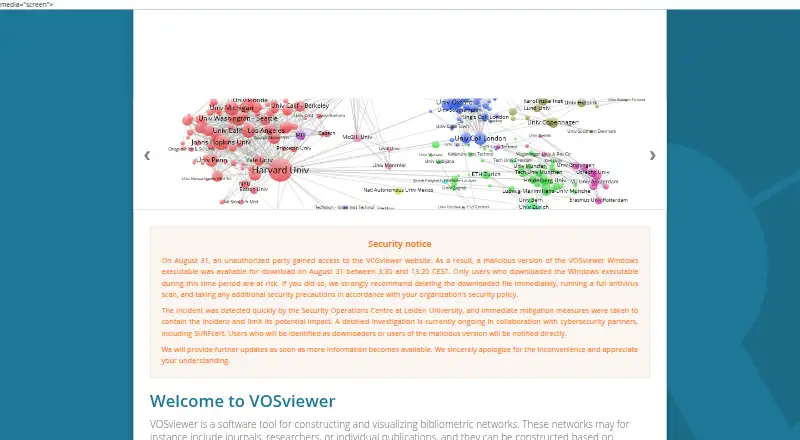
What VOSviewer is
VOSviewer is free software for building and exploring bibliometric networks, including networks that show terms appearing together in scientific literature. Its network types cover citation, bibliographic coupling, co-citation, and co-authorship relationships. Users can work with data from sources including Web of Science, Scopus, Dimensions, Lens, PubMed, Crossref, Europe PMC, OpenAlex, Semantic Scholar, OpenCitations, and WikiData.
Analysis tools include network layout and clustering, English-language text mining, fractional counting, and thesaurus-based data cleaning. Visualizations offer density and overlay views, along with zooming and scrolling. High-resolution screenshots can be saved as bitmap or vector images. The browser-based VOSviewer Online can open VOSviewer JSON files and map and network files. It can share visualizations by link or QR code, or provide embeddable HTML. The stand-alone version supports sharing through Google Drive, Microsoft OneDrive, and Dropbox. VOSviewer Online is also integrated into Digital Science’s Dimensions platform for co-authorship and citation network visualizations.
The software is available for Windows, macOS, Linux, and web use. The download page offers a JAR build for other systems, and the stand-alone application requires Java 8 or higher. The maker describes VOSviewer analyses as useful to research institutions and research funders making strategic decisions. The site includes a manual, video, book chapter, and paper. The maker has also reported an unauthorized website access incident during which a malicious Windows executable was available for download on August 31 from 3:30 to 13:20 CEST; its investigation is ongoing.
Who it suits
VOSviewer suits researchers and others who need to construct or explore bibliometric networks from scientific literature. The maker also describes its analyses as useful to research institutions and research funders supporting strategic decisions.
What it does well
- Free to use for any purpose.
- Supports four bibliometric relationship types, including citation and co-authorship.
- Works with data from a wide range of listed research sources.
- Includes text mining, clustering, fractional counting, and thesaurus-based cleaning.
- Online visualizations can be shared by link, QR code, or embed.
- Screenshots can be saved in high-resolution bitmap or vector formats.
What to know first
- The stand-alone application requires Java 8 or higher.
- The JAR build is the listed route for other systems.
- The maker reports an ongoing investigation into unauthorized website access and a malicious Windows download.
Plans
| Plan | Billed and limits | Price |
|---|---|---|
| Free | Can be used freely for any purpose | Free |
As vosviewer.com lists them, read 8 Oct 2026. The maker's own page has the final word.
Getting started
- Visit https://www.vosviewer.com/.
- Choose the browser-based VOSviewer Online or a stand-alone build for Windows, macOS, or another supported system.
- For the JAR version on other systems, ensure Java 8 or higher is available.
- Open supported research data or a VOSviewer JSON, map, or network file.
- Create a network visualization and share it through the available online or stand-alone sharing options.
VOSviewer is software for mapping citation, co-authorship, and other bibliometric networks from scientific literature. It suits researchers and research institutions that need to examine relationships across publications and share the resulting maps. Its analytical breadth is useful for literature mapping, though its Java requirement and a reported security incident warrant care when choosing the Windows download.
Overview
VOSviewer builds networks from citation, bibliographic coupling, co-citation, and co-authorship relationships, and can map terms that appear together in scientific literature. It accepts data from sources including Web of Science, Scopus, Dimensions, PubMed, Crossref, OpenAlex, Semantic Scholar, and WikiData, giving researchers several routes into a network analysis.
The software combines network layout and clustering with fractional counting, English-language text mining, and thesaurus-based data cleaning. Density and overlay views, along with zooming and scrolling, help readers inspect a map at different levels. High-resolution screenshots can be saved in bitmap or vector formats, which is useful for moving visual results into reports and presentations.
Key features
Mapping and analysis
VOSviewer covers several common bibliometric relationships in one tool. Text mining and thesaurus cleaning extend that work to terms extracted from literature, while fractional counting and clustering provide additional ways to construct and organize networks. These capabilities suit users who want to explore publication patterns rather than manage the screening and review workflow itself.
Sharing visualizations
VOSviewer Online runs in a browser and can open VOSviewer JSON, map, and network files. It can share an interactive visualization by link or QR code, or provide embeddable HTML. That makes it a practical choice when colleagues need to explore a map without installing the stand-alone software. The desktop version also supports sharing through Google Drive, Microsoft OneDrive, and Dropbox.
VOSviewer Online is integrated into Digital Science’s Dimensions platform for co-authorship and citation visualizations. This gives Dimensions users a direct route to those maps within the platform.
Pricing
VOSviewer is free for any purpose. Its Free plan costs nothing, so there is no paid tier to weigh against the core mapping tools.
Platforms
VOSviewer is available for Linux, macOS, Windows, and the web. The stand-alone application requires Java 8 or higher; its build for other systems runs as a JAR file. The browser-based VOSviewer Online avoids the stand-alone Java runtime requirement for interactive sharing.
The maker reported that an unauthorized party accessed its website and that a malicious Windows executable was available for download on August 31 from 3:30 to 13:20 CEST. The investigation is ongoing. Windows users should take this incident into account when choosing a download.
Who it's for
VOSviewer is a strong fit for researchers studying the structure of scientific literature and for research institutions or funders using such analyses to inform strategic decisions. Its range of network types and data sources supports broad bibliometric exploration, and online sharing helps make results accessible to collaborators.
It is less suited to readers looking for a dedicated systematic-review screening tool. Its focus is building and visualizing bibliometric networks, and the stand-alone application’s Java requirement adds setup work for users who prefer a browser-only workflow.
Pros and cons
- Broad bibliometric coverage: Citation, coupling, co-citation, co-authorship, and term co-occurrence networks support several kinds of literature mapping.
- Many data sources: Support for services including Web of Science, Scopus, Dimensions, OpenAlex, and PubMed gives researchers flexibility in assembling publication data.
- Interactive sharing: The online version shares maps by link, QR code, or embedded HTML, making results easier to explore collaboratively.
- Free for any purpose: The full tool is available without a paid plan.
- Java needed for the stand-alone version: Users need Java 8 or higher, which adds a setup requirement; Windows users should also account for the maker’s reported malicious executable incident and ongoing investigation.
Alternatives
For a broader set of literature-review options, see Literature Review Software.
- ASReview is a free option across web, desktop, API, and self-hosted platforms. Choose it when that platform range better fits your workflow.
- RevMan is a freemium option with a free trial and Linux, macOS, web, and Windows support. Consider it when you want to compare a trial-based freemium product.
- Bibliometrix is a free open-source R package available on CRAN, with a Biblioshiny web interface. Choose it if an R-based bibliometric tool and web interface suit your work better.
- EviSynth offers free academic access, unlimited collaborators, and web and mobile platforms. It may suit academic teams prioritizing collaboration across those platforms.
- Rayyan has a free plan capped at three active reviews and two free reviewers, with limited mobile access. Consider it if those review limits fit your needs and mobile access matters.
- Elicit offers a free Basic plan with limited Research Agent and Research Reports usage, alongside search across more than 138 million papers, summaries, and chat with papers. Consider it for those paper-search and reading tools.
- Inciteful is a free web tool whose maker describes its codebase as fully open source. It is an alternative for readers seeking a browser-based option.
- Litmaps has a free plan capped at 20 inputs, 100 articles, and one Litmap, with no collaboration. Its Pro (Education) plan costs $10 a month, billed at $120 per year. Consider it if its mapping limits and education plan fit your needs.
Verdict
Choose VOSviewer if you need a free, capable way to build bibliometric maps from scientific literature and share them interactively. Its range of network types, data sources, and export views makes it especially useful for researchers and institutions examining publication patterns. Look elsewhere if you need a literature-review screening workflow; Windows users should also weigh the reported malicious executable incident and ongoing investigation before downloading.
Verdict
Choose VOSviewer if you need free tools to build and share bibliometric visualizations from scientific literature. Its browser version supports interactive sharing, while the stand-alone version connects with Google Drive, Microsoft OneDrive, and Dropbox. Windows users should take account of the maker's reported malicious executable incident and ongoing investigation when choosing a download.
Questions
Does VOSviewer cost anything?
The Free plan costs nothing and can be used freely for any purpose.
What platforms can I use it on?
It is listed for Linux, macOS, web, and Windows. The download page also offers a JAR file for other systems.
Does the stand-alone version need Java?
Yes. Running VOSviewer requires Java version 8 or higher.
Which data sources does it support?
Listed sources include Web of Science, Scopus, Dimensions, Lens, PubMed, Crossref, Europe PMC, OpenAlex, Semantic Scholar, OpenCitations, and WikiData.
How can I share a visualization?
VOSviewer Online can share it through a link, QR code, or embeddable HTML. The stand-alone sharing feature supports Google Drive, Microsoft OneDrive, and Dropbox.
What has the maker reported about website security?
The maker says an unauthorized party accessed the website and a malicious Windows executable was available for download on August 31 from 3:30 to 13:20 CEST. Its investigation is ongoing.
Facts from VOSviewer's own pages
- Analysis techniques
- It provides network layout and clustering techniques, English-language text mining, fractional counting, and thesaurus-based data cleaning. · vosviewer.com, 8 Oct 2026
- Data sources
- The software supports data from Web of Science, Scopus, Dimensions, Lens, PubMed, Crossref, Europe PMC, OpenAlex, Semantic Scholar, OpenCitations, and WikiData. · vosviewer.com, 8 Oct 2026
- Headquarters
- Leiden, Zuid-Holland, Netherlands · vosviewer.com, 28 Sept 2026
- Intended users
- The maker describes VOSviewer-based analyses for research institutions and research funders to support strategic decision making. · vosviewer.com, 8 Oct 2026
- Network types
- It supports networks based on citation, bibliographic coupling, co-citation, and co-authorship relations. · vosviewer.com, 8 Oct 2026
- Online version
- VOSviewer Online runs in a web browser and can share interactive visualizations or embed them in online platforms. · vosviewer.com, 8 Oct 2026
- Platform integration
- VOSviewer Online is integrated into Digital Science’s Dimensions platform for creating co-authorship and citation network visualizations. · vosviewer.com, 8 Oct 2026
- Purpose
- VOSviewer constructs and visualizes bibliometric networks and can visualize co-occurrence networks of terms extracted from scientific literature. · vosviewer.com, 8 Oct 2026
- Runtime requirement
- Running VOSviewer requires Java version 8 or higher. · vosviewer.com, 8 Oct 2026
- Security notice
- The maker reports that an unauthorized party accessed the website and a malicious Windows executable was available for download on August 31 from 3:30 to 13:20 CEST; its investigation is ongoing. · vosviewer.com, 8 Oct 2026
- Sharing integrations
- The stand-alone version’s sharing feature supports Google Drive, Microsoft OneDrive, and Dropbox. · app.vosviewer.com, 8 Oct 2026
- Supported systems
- The download page provides builds for Windows, macOS, and other systems; the other-systems version runs as a JAR file. · vosviewer.com, 8 Oct 2026
- Support resources
- The site provides a manual with detailed and up-to-date functionality information, along with a video, book chapter, and paper. · vosviewer.com, 8 Oct 2026
- Visualization
- Visualizations include density and overlay views, zooming and scrolling, and high-resolution screenshots saved in bitmap or vector formats. · vosviewer.com, 8 Oct 2026
- Web sharing
- VOSviewer Online can open VOSviewer JSON files and map and network files, and share visualizations through a link, QR code, or embeddable HTML. · app.vosviewer.com, 8 Oct 2026
Where VOSviewer stands on Freedom251
- Graph Visualization Tools Software#5 of 25
- Literature Review Software#14 of 28