Freedom251 › Graph Visualization Tools Software
Kumu
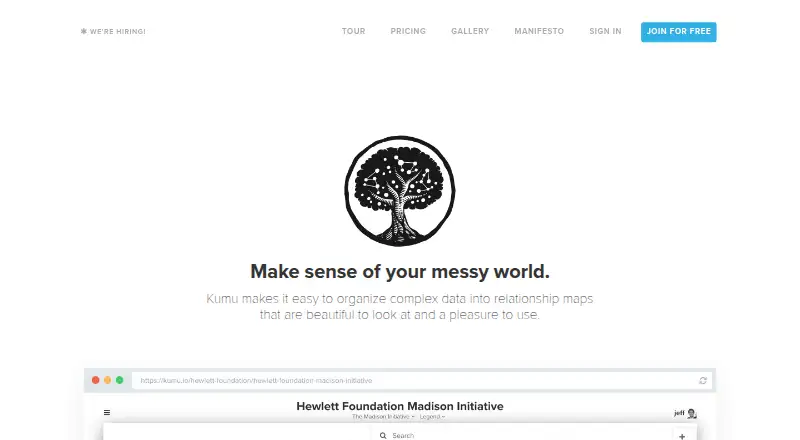
What Kumu is
Kumu helps organizations turn complex information about people, systems, and concepts into relationship maps. It supports stakeholder, systems, social network, community asset, and concept mapping. Maps can be created by hand or built from spreadsheet data, including live data from Google Sheets. For analysis, Kumu provides closeness, betweenness, and eigenvector centrality metrics, along with automated community detection and clustering. A presentation builder and website embeds help users share interactive maps. The maker describes Kumu as a tool for organizations working with complex relationships and systems, including social-sector leaders seeking to create impact. It is available on the web and as self-hosted software. The free Basic workspace includes unlimited public projects, collaborators, maps, and views, but public projects can be seen by anyone and are indexed by search engines. Private projects require a paid project or an eligible student discount; a two-week trial is available for private projects. A private project costs $9/month per project, and a Pro workspace costs $10/month per workspace, with private projects charged at $20/month per project. Enterprise can be self-hosted or managed in AWS, and includes SAML single sign-on, data encryption at rest, and priority support.
Who it suits
Kumu suits organizations that need to map relationships across stakeholders, systems, communities, or concepts. It may also fit social-sector leaders who want to examine complex systems and present interactive maps.
What it does well
- Maps can be created manually or imported from spreadsheets.
- Google Sheets data can be connected live.
- Analysis includes centrality metrics and community detection.
- Interactive maps can be embedded on websites.
- Unlimited collaborators, maps, and views are included for public projects.
What to know first
- Free projects are public and indexed by search engines.
- Private projects require payment or an eligible student discount.
- Pro workspace pricing charges $20/month per private project.
Limits
The free Basic workspace is limited to public projects, which are visible to everyone and indexed by search engines. Private projects cost $9/month per project, while Pro costs $10/month per workspace and charges $20/month per private project.
Plans
| Plan | Billed and limits | Price |
|---|---|---|
| Basic workspace / public projects | Free · Unlimited public projects · unlimited collaborators, maps, and views | Free |
| Pro workspace | $10/month per workspace · Unlimited public projects · private projects $20/month per project · view-only access · custom branding · hourly backups | $10 a month |
| Basic workspace / private project | $9/month per project · Private projects · unlimited collaborators, maps, and views | $9 a month |
| Kumu Enterprise | Annual invoices; pay per user · Self-hosted or managed cloud · SAML single sign-on · priority support · 99.95% uptime SLA | On request |
As kumu.io lists them, read 4 Oct 2026. The maker's own page has the final word.
Getting started
- Visit https://kumu.io/.
- Choose the web service or a self-hosted deployment.
- Create a public project on the free Basic workspace, or start the private-project trial.
- Build a map by hand or import spreadsheet data.
- Use the presentation builder or embed an interactive map on a website.
Kumu is a relationship-mapping tool for organizations working with people, systems, or concepts. It suits teams that need to analyze connections and share maps, not just draw diagrams. Its appeal is the combination of network metrics and interactive presentation; private projects require a paid plan or an eligible student discount.
Overview
Kumu supports stakeholder, systems, social network, community asset, and concept mapping. Teams can build maps manually or import spreadsheet data, including live data from Google Sheets. That flexibility is useful when relationships need to be assembled from existing records or explored visually from scratch. Built-in network analysis and sharing tools make it more capable than a map used only as a static illustration.
The central trade-off is privacy: free projects are visible to everyone and indexed by search engines. That makes the free tier appropriate for public work, but not for sensitive organizational maps.
Key features
Build and analyze maps
Closeness, betweenness, and eigenvector centrality offer different ways to examine network position, while automated community detection and clustering help identify groupings. These features matter when teams need to interpret relationships across a complex network rather than rely on visual inspection alone. Spreadsheet imports, including live Google Sheets data, can also reduce duplicate data entry when information is already maintained in tabular form.
Present and share
A presentation builder and interactive website embeds let teams present maps to audiences beyond their creators. That is useful for communicating relationships in context, though teams should account for project visibility before sharing: free projects are public and searchable.
Security and support
Browser traffic uses HTTPS, projects have separate CouchDB databases, and backups are retained for at least 30 days. Enterprise adds encryption at rest and SAML 2.0 single sign-on. Customers can choose self-hosting or Kumu-managed AWS hosting, including a selected geographic location for managed hosting; the managed option runs each customer on a separate Amazon EC2 instance. Kumu provides help resources and support by email, while Enterprise includes priority support.
Pricing
Kumu has a free tier, a 14-day trial of private projects, and paid plans priced by project or workspace. The free tier is generous on collaborators, maps, and views, but its public-only restriction is decisive for teams handling confidential work.
| Plan | Price | What it includes and who it suits |
|---|---|---|
| Basic workspace / public projects | free | Unlimited public projects, collaborators, maps, and views. A fit for public-facing work that does not require privacy. |
| Basic workspace / private project | $9 a month | $9/month per project, with private projects and unlimited collaborators, maps, and views. Suits a team that needs privacy for a single project without a broader workspace upgrade. |
| Pro workspace | $10 a month | $10/month per workspace, with unlimited public projects, view-only access, custom branding, and hourly backups. Private projects cost $20/month per project, so multiple private projects can make this less economical than the headline workspace price suggests. |
| Kumu Enterprise | Custom pricing | Annual invoices and per-user pricing; self-hosted or managed cloud, SAML single sign-on, priority support, and a 99.95% uptime SLA. It is aimed at organizations needing enterprise security or deployment choices, rather than teams seeking a fixed low-cost plan. |
The two-week private-project trial gives teams a chance to assess paid privacy before committing. Basic private projects are billed per project, while Pro separates the workspace fee from its private-project charge. Enterprise uses annual invoices and per-user pricing.
Platforms
Kumu is available on the web and as self-hosted software. The Enterprise deployment options are particularly relevant to organizations that need to run the system themselves or choose a hosting location for managed AWS service.
Who it's for
Kumu is a strong fit for organizations mapping complex relationships, including social-sector leaders seeking to create impact. Its varied mapping use cases and analysis tools serve teams studying connected people or systems; its presentation and embedding features help those teams communicate what they find. It is a poor fit for confidential work on the free plan, and less compelling when a project needs only a simple static diagram.
Pros and cons
- Pros: Multiple centrality metrics, clustering, and community detection support analysis beyond drawing.
- Pros: Manual creation and spreadsheet imports, including live Google Sheets data, accommodate different ways of maintaining map information.
- Pros: Unlimited collaborators, maps, and views on both the free public tier and the $9/month private-project plan make seat or viewing caps less of a concern.
- Cons: Free projects are public and search-indexed, so private work requires payment or an eligible student discount.
- Cons: Pro charges $20/month per private project on top of its $10/month workspace price, which can raise costs for teams with several private maps.
Alternatives
For a broader set of relationship-intelligence options, see the Relationship Intelligence Software directory.
- Connect The Dots is a freemium option with Android, iOS, web, and API platforms; its free plan caps AI contact searches at 10 per month and lists at two, making it a different choice for readers considering contact-oriented tools.
- Happenstance offers a free plan with usage-limited Happenstance Chat and unlimited connected accounts, friends, and groups. Consider it if those account and group limits better match the intended use.
- Draftboard makes network mapping free with 50 quality paths included, then charges $0.30 per quality path. It is worth considering when a path-based allowance and pay-per-path pricing suit the work.
- Introd offers Google and Microsoft add-ons at $15 a month each for syncing the associated email, contacts, and calendar services. Choose it if that specific sync capability is the priority.
- Polinode has a free web plan for one user with five public networks and six basic metrics, plus a free trial. It may suit an individual whose project fits those caps.
- The Swarm has a free plan with 10 connectors, SaaS features, enriched profiles, and community support, but no API access. Consider it if those connector and profile features fit better than map-centered work.
- Village offers a free-forever plan with 100 credits per month, limited connections, 10 results per AI search, and browser extension, API, and MCP access. Its credit and search limits are relevant if those access options are what you need.
- ExecAtlas is another option to consider.
Verdict
Choose Kumu if your organization needs to map complex relationships, analyze network structure, and present interactive results. Its combination of imports, built-in analysis, and sharing is the case for choosing it; the main reason to look elsewhere is that private projects require payment, with Pro adding a per-project charge on top of its workspace price.
Verdict
Choose Kumu when relationship mapping, built-in network analysis, and interactive sharing are central to your work. Its free plan is suited to public projects; look to a paid project or an eligible student discount if your maps need privacy.
Questions
Does Kumu have a free plan?
Yes. The Basic workspace provides unlimited public projects, collaborators, maps, and views.
How much does a private project cost?
A private project costs $9/month per project.
Is there a free trial?
Yes. Kumu offers a two-week free trial of private projects.
Can Kumu be self-hosted?
Yes. Kumu is available as self-hosted software. Enterprise can be self-hosted or managed in AWS.
What does Kumu Enterprise include?
Enterprise includes SAML single sign-on, data encryption at rest, and priority support. The plan details list a 99.95% uptime figure. Enterprise uses annual invoices and charges per user.
Facts from Kumu's own pages
- Analysis
- Built-in metrics include closeness, betweenness, and eigenvector centrality, alongside automated community detection and clustering. · kumu.io, 4 Oct 2026
- Enterprise deployment
- Enterprise can be self-hosted or managed by Kumu in AWS, with a customer-selected geographic location for managed hosting. · kumu.io, 4 Oct 2026
- Enterprise security
- Enterprise supports data encryption at rest and SAML 2.0 single sign-on; its managed option runs each customer on a separate Amazon EC2 instance. · kumu.io, 4 Oct 2026
- Founded
- 2011 · kumu.io, 28 Sept 2026
- Free-plan limit
- Public projects are visible to everyone and indexed by search engines; private projects require a paid project or an eligible student discount. · kumu.io, 4 Oct 2026
- Map creation
- Users can build maps by hand or import spreadsheet data, including live data from Google Sheets. · kumu.io, 4 Oct 2026
- Mapping use cases
- The maker lists stakeholder, systems, social network, community asset, and concept mapping among Kumu’s uses. · kumu.io, 4 Oct 2026
- Security
- The security page says browser traffic uses HTTPS, each project has a separate CouchDB database, and backups are retained for at least 30 days. · kumu.io, 4 Oct 2026
- Sharing
- Kumu includes a presentation builder and lets users embed interactive maps on websites. · kumu.io, 4 Oct 2026
- Support
- Kumu directs users to its help resources and support email, and Enterprise includes priority support. · kumu.io, 4 Oct 2026
- Trial
- Kumu offers a two-week free trial of private projects. · kumu.io, 4 Oct 2026
- What it does
- Kumu organizes complex data into relationship maps for people, systems, and concepts. · kumu.io, 4 Oct 2026
- Who it is for
- The maker describes Kumu as a tool for organizations working with complex relationships and systems, including social-sector leaders seeking to create impact. · kumu.io, 4 Oct 2026