Freedom251 › HR Analytics Software

Polinode
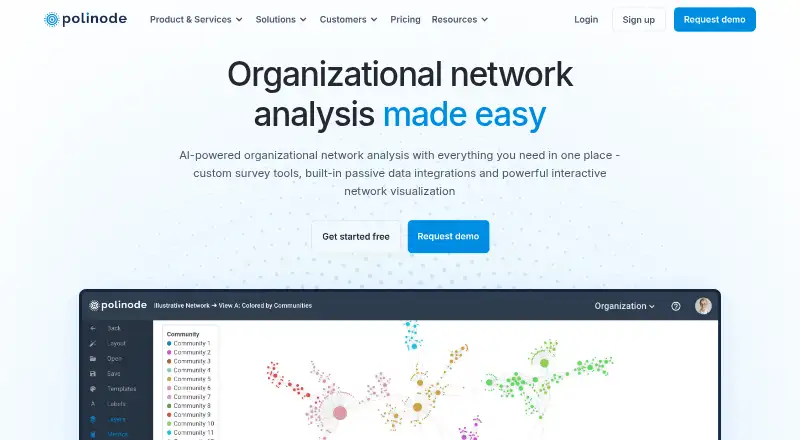
What Polinode is
Polinode is a browser-based tool for organizational network analysis, visualization, and analysis of network data. Users can import Excel, GEXF, or JSON files, collect relationship data through surveys, or use passive data queries. Its survey tool can gather relationships alongside demographic, engagement, culture, and open-text responses. A network visualization can support up to 50,000 nodes and 250,000 edges, with more than 30 metrics. An AI network chat can answer questions about network data, calculate metrics, offer interpretations, and find shortest paths. Passive integrations can access metadata from Office 365, Microsoft Teams, Google Workspace, and Slack; Polinode says they do not read or store message content, and connected data refreshes every 24 hours. These integrations require an organization account and are not available to individual accounts. Free accounts have no private networks; Lite allows five and Professional allows 50. Free accounts receive community support, while Lite and Professional include email support. The free plan is available alongside monthly plans starting at $40 a month.
Who it suits
Polinode may suit people leaders, people analytics teams, consultants, academics, researchers, not-for-profits, and developers working with organizational network data. Passive data integrations are relevant only to organizations, not individual accounts.
What it does well
- Imports Excel, GEXF, and JSON network data.
- Survey tool collects relationship and demographic responses.
- Visualizes networks up to 50,000 nodes and 250,000 edges.
- Free plan includes five public networks.
What to know first
- Free accounts cannot have private networks.
- Passive integrations require an organization account.
- Lite costs $40 a month.
- Free accounts receive community support.
Limits
The Free plan allows one user, five public networks, six basic metrics, no private networks, and community support. Lite costs $40 a month and allows one user, five private networks, and five views per network; Professional costs $80 a month and allows 50 private networks and 200 views per network.
Plans
| Plan | Billed and limits | Price |
|---|---|---|
| Free | per month · 1 user · 5 public networks · 6 basic metrics · $2/respondent credit if needed · community support | Free |
| Lite | per month · 1 user · AI networks chat · 50 public networks · 5 private networks · 30+ metrics · 5 views/network · $2/respondent credit · email support | $40 a month |
| Professional | per month · 1 user · AI networks chat · 50 public networks · 50 private networks · 30+ metrics · 200 views/network · roll-ups · template views · $2/respondent credit · email support | $80 a month |
| Consultant | Let’s Talk! · Multiple users · custom AI prompts · 30+ metrics · volume respondent-credit discounts · organization management · SOC2 report · 24/7 SLA support · optional white labelling | On request |
| Enterprise | Let’s Talk! · Multiple users · custom AI prompts · 30+ metrics · organization management · SOC2 report · 24/7 SLA support · DataShield available · white labelling | On request |
As polinode.com lists them, read 15 Oct 2026. The maker's own page has the final word.
Getting started
- Open the Polinode website.
- Create a Free account or choose a paid plan.
- Import network data from Excel, GEXF, or JSON, or collect it through surveys.
- Use network visualizations and metrics to examine the data.
- For passive data integrations, use an organization account.
Polinode is a browser-based tool for organizational network analysis, combining relationship surveys, network visualizations and metrics. It is best suited to people analytics teams, consultants and researchers who need to map how people connect at work. Its free and individual plans make it approachable, but passive data integrations require an organization account.
Overview
Polinode can build a network from survey responses, imported files or passive data queries. Its survey tool gathers relationship data alongside demographic, engagement, culture and open-text responses, while imports accept Excel, GEXF and JSON. That range suits projects where teams need both purpose-built relationship questions and a way to analyze existing network data.
The visualization tool handles networks of up to 50,000 nodes and 250,000 edges, with more than 30 metrics on paid plans. Free accounts get only six basic metrics, so the free tier is better for a small initial exercise than sustained analysis requiring the full metric set. AI networks chat can answer questions about network data, calculate metrics, interpret results and find shortest paths.
Key features
Survey and passive data collection
Customizable surveys bring relationship mapping together with broader workforce questions. Passive integrations can access metadata from Office 365, Microsoft Teams, Google Workspace and Slack, with connected data refreshed every 24 hours. Polinode says it does not read or store message content. This can help organizations analyze collaboration patterns without collecting message text, but individual accounts cannot use these integrations.
Analysis and security
Paid individual plans unlock the full set of 30-plus metrics; Professional adds roll-up functionality and template views. Polinode says it is AICPA SOC 2 certified, encrypts stored data with AES-256 and uses SSL/TLS in transit. Its infrastructure is hosted in AWS Ireland, with other AWS regions potentially supported on request. Organizations with a regional hosting requirement should confirm whether their preferred region can be supported.
Pricing
Polinode is freemium, with monthly prices for individual plans and custom pricing for organizational plans. Respondent credits cost $2 each where needed.
| Plan | Price | What it includes |
|---|---|---|
| Free | free, billed per month | 1 user, 5 public networks, 6 basic metrics and community support; no private networks. |
| Lite | $40 a month | 1 user, up to 50 public networks, 5 private networks, all 30+ metrics, 5 views per network and email support. |
| Professional | $80 a month | 1 user, up to 50 public networks, 50 private networks, all 30+ metrics, 200 views per network, roll-up functionality, template views and email support. |
| Consultant | Custom pricing | Multiple users, all 30+ metrics, 50 private networks per user, an account manager, 24/7 support with an SLA and volume discounts for respondent credits. |
| Enterprise | Custom pricing | Multiple users, all 30+ metrics, 50 private networks per user, an account manager and 24/7 support with an SLA; passive integrations are an optional extra. |
Free is a no-cost way for one person to work with a handful of public networks, but its six basic metrics and lack of private networks are material constraints. Lite is the entry point for private analysis and full metrics, though its five views per network may be limiting for teams that need several saved perspectives. Professional costs twice as much and raises that cap to 200 views while adding roll-ups and template views; it remains a single-user plan. Consultant and Enterprise are the options for multiple users and higher-touch support, with custom pricing. A free trial is offered.
Platforms
Polinode is web-based, so its network analysis is accessed through a browser.
Who it's for
People leaders and people analytics teams can use Polinode to examine workplace relationships and collaboration patterns. Consultants, academics and researchers may value its survey collection and larger network capacity, while not-for-profits and developers or software vendors are also among its stated user groups. It is a weaker fit for an individual who specifically needs passive integrations, since those require an organization account.
Pros and cons
- Pros: Multiple collection routes—surveys, file imports and organizational passive integrations—support different network-analysis projects.
- Pros: The visualization capacity of up to 50,000 nodes and 250,000 edges, plus 30-plus metrics on paid plans, suits substantial networks.
- Pros: The free tier provides a no-cost starting point, and Lite adds private networks and full metrics for $40 a month.
- Cons: Free has no private networks and only six basic metrics, limiting its use for confidential or deeper analysis.
- Cons: Lite and Professional are single-user plans; teams need a custom-priced organizational tier.
- Cons: Passive integrations are organization-only, and Enterprise treats them as an optional extra.
Alternatives
For broader HR analytics, compare HR Analytics Software; for tools focused on relationship intelligence, see Relationship Intelligence Software.
Zoho Analytics is another freemium option, with a free plan for two users, 10,000 rows and five workspaces; consider it when those limits and its self-hosted platform better suit the work.
Culture Amp is a paid, web-based option with annual pricing that depends on employee count, product and service tier; it may suit buyers seeking that kind of quote-based annual arrangement. Lightcast offers paid consulting projects, ongoing software subscriptions and data delivery, making it an alternative for buyers considering those service and data-delivery models.
One Model has a Data Mesh plan with a standard IDE, configurable API integrations and pay-as-you-go additional data sources and insight packs; consider it when that data-mesh approach is the priority. Reejig lists its Work OS at $250,000 a year for a 12-month contract, a substantially different commitment and pricing model.
Workday Adaptive Planning offers a 30-day trial and spans Android, iOS, macOS, web and Windows; it is worth comparing when those platform options or trial terms matter. Affirmity Employment Law Navigator is a paid web product with pricing by request.
Verdict
Polinode is a strong choice for people analytics teams, consultants and researchers who need to collect relationship data and analyze large organizational networks with a broad metric set. Its free tier gives individuals a low-risk start, while Professional adds much more room for private networks and saved views. Look elsewhere if you need passive integrations as an individual, multiple seats at a fixed published price or more than six metrics without upgrading.
Verdict
Polinode provides several ways to gather network data and analyze it, with account tiers that differ in private-network limits and support. Individual users should note that passive integrations are reserved for organization accounts.
Questions
Is Polinode free?
Yes. The Free plan costs nothing and includes one user, five public networks, six basic metrics, and community support.
How much do the paid plans cost?
Lite costs $40 a month and Professional costs $80 a month. Consultant and Enterprise pricing is listed as “Let’s Talk!”
Which platforms does Polinode support?
Polinode is available on the web.
Can I connect organizational tools?
Passive integrations can access metadata from Office 365, Microsoft Teams, Google Workspace, and Slack. They require an organization account.
What data does a passive integration access?
Polinode says it accesses metadata and does not read or store message content. Connected data refreshes every 24 hours.
What support comes with the plans?
Free accounts have community support, while Lite and Professional include email support. Consultant and Enterprise include an account manager and 24/7 support with an SLA.
Facts from Polinode's own pages
- AI
- AI networks chat can answer questions about network data, calculate metrics, provide interpretations, and find shortest paths. · polinode.com, 5 Oct 2026
- Analysis capacity
- The network visualization tool supports networks of up to 50,000 nodes and 250,000 edges, and includes over 30 metrics. · polinode.com, 5 Oct 2026
- API
- Version 2 of the public API lets account holders create, retrieve, update and delete networks and employee data. · docs.polinode.com, 15 Oct 2026
- API authentication
- New API credentials use bearer tokens over HTTPS; older HTTP Basic credentials remain supported but are deprecated. · docs.polinode.com, 15 Oct 2026
- API scopes
- Enterprise credentials can use separate read and write scopes for networks, metrics, employees, custom fields, responses, surveys and embedding. · docs.polinode.com, 15 Oct 2026
- API SDK examples
- Official API documentation links example calls written in Python and Node.js. · docs.polinode.com, 15 Oct 2026
- Community feature requests
- Polinode’s community lists 37 feature-request topics alongside announcement, networks and survey discussion categories. · community.polinode.com, 15 Oct 2026
- Company profile
- LinkedIn lists Polinode as a privately held information-services company founded in 2014, headquartered in Sydney, with 2–10 employees. · linkedin.com, 15 Oct 2026
- Customers
- Polinode describes its users as people leaders, people analytics teams, consultants, academics and researchers, not-for-profits, and developers or software vendors. · polinode.com, 5 Oct 2026
- Data residency
- The pricing FAQ says servers are in AWS eu-west-1 in Ireland and enterprise and partner agreements include GDPR EU model clauses. · polinode.com, 15 Oct 2026
- Documentation and support
- The guide covers Networks, Surveys, Passive Data, Automations, Social Data, Research Data, API and Embedding, with in-app support tickets, email and tutorial videos. · docs.polinode.com, 15 Oct 2026
- Embedding
- Embedding is organization-enabled, provisions managed Polinode users through the API and creates short-lived embedded sessions. · docs.polinode.com, 15 Oct 2026
- Encryption
- Stored data is encrypted with AES-256 and traffic uses SSL/TLS. · polinode.com, 15 Oct 2026
- Founded
- 2014 · polinode.com, 28 Sept 2026
- Founder
- CB Insights identifies Andrew Pitts as Polinode’s founder and chief executive officer. · cbinsights.com, 15 Oct 2026
- Free trial
- The pricing page says Partners and Enterprises can request free trials, while individuals can trial the service by signing up for a free account. · polinode.com, 5 Oct 2026
- Headquarters
- Sydney, Australia · polinode.com, 28 Sept 2026
- Hosting
- The company says its infrastructure is hosted in AWS Ireland and that other AWS regions may be supported on request. · polinode.com, 5 Oct 2026
- Import formats
- Network data can be imported from Excel, GEXF, or JSON files, or collected through relationship surveys and passive data queries. · polinode.com, 5 Oct 2026
- Independent use description
- A LinkedIn article describes active ONA surveys for samples from 10 to 10,000 people and passive ONA based on email and messaging metadata. · linkedin.com, 15 Oct 2026
- Integrations
- Passive data integrations access metadata from tools including Office 365, Microsoft Teams, Google Workspace, and Slack. · polinode.com, 5 Oct 2026
- Legal entity
- Polinode’s terms identify the Australian company Polinode Pty Ltd and ABN 73 168 704 096. · polinode.com, 15 Oct 2026
- Licence
- Terms grant only a non-exclusive right to access the service and reserve Polinode’s intellectual-property rights, indicating a proprietary SaaS licence rather than open source. · polinode.com, 15 Oct 2026
- Limit: G2 processing speed
- One G2 reviewer reported no major dislikes but asked for faster processing speed. · g2.com, 15 Oct 2026
Where Polinode stands on Freedom251
- HR Analytics Software#3 of 25
- Graph Visualization Tools Software#6 of 25
- Relationship Intelligence Software#7 of 26