
Elicit
What Elicit is
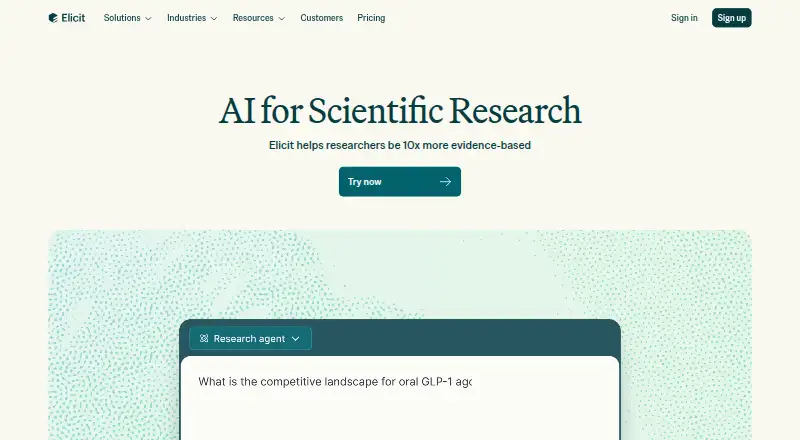
Elicit is an AI research assistant that helps researchers gather and work with evidence from scientific databases, academic journals, public data sources, and uploaded documents. Its Research Agent sessions can draw on a corpus of 138 million academic papers and the wider web, and each session can use up to 20 uploaded resources, including PDF, DOCX, XLSX, PPTX, and JPG files. Elicit offers Research Agent sessions, Research Reports, and Systematic Reviews. AI-generated claims have sentence-level citations to underlying sources. It can find up to 1,000 relevant papers and analyze up to 20,000 data points at once. Research Reports can be exported as PDF or Word files, tables as CSV or Excel, and references as RIS or BIB. Elicit also connects through an MCP server to Claude Desktop, Claude Code, and other compatible clients using OAuth 2.0. API access requires Pro or above and supports paper and clinical-trial searches and research workflows. The Basic plan includes limited usage for Research Agent and Research Reports. Plus is $11 a month, Pro is $39 a month, and Scale is $89 a month. Elicit states it has SOC 2 Type II compliance.
Who it suits
It suits researchers who need to search papers, work with uploaded materials, and produce cited research outputs. API access is for users on Pro or above.
What it does well
- Research Agent draws on 138 million academic papers.
- Supports up to 20 uploaded resources per session.
- AI claims include sentence-level citations.
- Exports reports, tables, and references in several formats.
What to know first
- Basic has limited Research Agent and Report usage.
- API access requires Pro or above.
- Plus costs $11 a month.
Limits
The Basic plan has limited usage for Research Agent and Research Reports. Plus includes standard usage for Research Agent, Research Reports, and Systematic Literature Reviews; Pro specifies 5,000 papers screened, and Scale specifies 200 data sources.
Plans
| Plan | Billed and limits | Price |
|---|---|---|
| Basic | Free · Limited usage for Research Agent and Research Reports · Unlimited search across more than 138 million papers · Unlimited summaries · Unlimited chat with papers with full-text access · Import from Zotero | Free |
| Plus | Per user/month, billed as $132 annually · Standard usage for Research Agent, Research Reports, and Systematic Literature Reviews · Add 5 columns at a time · Search more than 500 thousand clinical trials · Export RIS, CSV, BIB, PDF and DOCX | $11 a month |
| Scale | Per user/month, billed as $2,028 annually · 5x usage for Research Agent, Research Reports, and Systematic Literature Reviews · Extract and interpret figures · Real-time collaboration · Extract from up to 200 data sources · Add 30 columns at a time | $169 a month |
| Pro | Per user/month, billed as $588 annually · Standard usage for Research Agent, Research Reports, and Systematic Literature Reviews · Screen 5,000 papers · Add 20 columns at a time · Extract from up to 135 data sources · API access | $49 a month |
| Enterprise | Custom · Custom usage · Screen 40,000 papers and extract 40 columns · SSO & SAML · 2FA · Custom deployments · Unlimited Search API access | On request |
As elicit.com lists them, read 1 Oct 2026. The maker's own page has the final word.
Getting started
- Visit https://elicit.com/.
- Use Elicit on the web or access it through its API with a Pro plan or above.
- Start with the Basic plan, which includes a free plan.
- Upload up to 20 resources to a Research Agent session if needed.
- Connect through the MCP server to Claude Desktop, Claude Code, or another compatible client using OAuth 2.0.
Elicit is an AI research assistant for evidence-led literature work, combining paper discovery with document analysis and review workflows. It fits researchers who need traceable claims and exportable outputs, while casual users may find the usage ceilings and paid integration features restrictive. Its strongest case is a cited research pipeline rather than a general-purpose chatbot.
Overview
Elicit brings together scientific databases, academic journals, public data, the wider web, and files you upload. The Research Agent can draw on a corpus of 138 million academic papers, so it is suited to broad literature searches as well as projects that mix published work with internal material. Each session accepts up to 20 resources in PDF, DOCX, XLSX, PPTX, or JPG format; that is useful for a defined evidence packet, but less suitable when a project starts with a much larger document set.
The product is headquartered in Covina, California, and is offered as a freemium service through the web and an API.
Key features
Research Agent sessions, Research Reports, and Systematic Reviews cover discovery, synthesis, and structured review work. Elicit can locate up to 1,000 relevant papers and analyze as many as 20,000 data points at once, giving large evidence sets room to be processed without splitting every task into small batches.
AI-generated claims carry sentence-level citations to the underlying sources. That makes summaries more auditable: a reader can follow a specific statement back to its evidence instead of treating the generated narrative as self-supporting. Reports export to PDF or Word, tables to CSV or Excel, and references to RIS or BIB, which helps move results into writing, spreadsheets, and reference managers.
Through its MCP server, Elicit connects with Claude Desktop, Claude Code, and other MCP-compatible clients using OAuth 2.0. API access supports paper and clinical-trial searches and research workflows, but it starts at the Pro tier. Elicit states that it has SOC 2 Type II compliance. For Enterprise customers, it says it does not train on Enterprise data and supports SAML 2.0 SSO and MFA; a dedicated customer-success team provides training, onboarding, and success planning.
Pricing
The Basic plan has limited usage for Research Agent and Research Reports, but includes unlimited search across more than 138 million papers, unlimited summaries, unlimited chat with papers when full text is available, source viewing for answers, and Zotero import. It is a sensible way to evaluate the workflow, though the usage limits make it a poor fit for sustained high-volume reviews.
Plus costs $11 a month, billed monthly. It adds RIS, CSV, BIB, PDF, and DOCX exports, five table columns at a time, unlimited search across more than 500,000 clinical trials, and standard usage for Research Agent, Research Reports, and Systematic Literature Reviews. Choose it when exports and regular review work matter, but API access does not.
Pro costs $39 a month, billed monthly. It includes 5,000 papers screened, 135 data sources, and 10 personalized research alerts, and is the entry point for API access. Scale costs $89 a month, billed monthly, with 200 data sources and 30 columns added to tables at a time. Enterprise has custom pricing and includes 40,000 papers screened and 40 extracted columns, alongside the stated security, identity, and support provisions. The paid plans are priced per user where the published starting price applies, so teams should account for seats.
Platforms
Elicit runs on the web and provides an API. MCP connectivity extends it to compatible Claude clients, while OAuth 2.0 handles authorization.
Who it's for
Elicit is a strong choice for academics, analysts, and teams conducting literature reviews that need citations, systematic workflows, and files that can be handed into office or reference-management tools. Plus suits individual researchers with recurring but moderate workloads. Pro is the practical threshold for developers and research operations that need API calls, alerts, and larger screening capacity; Enterprise is aimed at organizations requiring SSO, MFA, data-use assurances, and guided rollout.
Pros and cons
- Pro: A 138-million-paper corpus and wider-web access support expansive discovery.
- Pro: Sentence-level citations make generated claims easier to verify.
- Pro: Multiple export formats connect reports, tables, and references to downstream work.
- Con: Basic usage limits can interrupt demanding Research Agent and report workloads.
- Con: A session's 20-file upload limit may not suit large internal archives.
- Con: API access is withheld from Basic and Plus, requiring at least Pro.
Alternatives
For an open-source workflow with no licensing fees, ASReview is the better fit; it runs on web, desktop, API, or self-hosted setups, though hardware or server costs remain yours. Choose RevMan when a freemium systematic-review product with a free trial is preferable. VOSviewer is a free option for any purpose across desktop and web platforms.
Bibliometrix suits users wanting an open-source R package with a Biblioshiny web interface. EviSynth offers free academic access, unlimited collaborators, and no subscription. Rayyan is worth choosing for review collaboration when its free tier's three active reviews and two free reviewers are sufficient; paid Essential starts at $4.99 per seat per month. Inciteful keeps its core tools free with no stated usage limits. Litmaps is a focused choice for basic search and citation mapping, with its free tier capped at 20 inputs, 100 articles, and one Litmap.
For broader comparisons, see Literature Review Software, AI Literature Review Software, AI Search Engines, and AI Research Assistants.
Verdict
Choose Elicit if you need one place to search a very large paper corpus, analyze uploaded evidence, and produce cited, exportable research outputs. Look elsewhere if you require unrestricted free usage, a larger per-session file intake, or API access without moving to a Pro-level subscription.
Verdict
Elicit brings paper search, document-based workflows, and cited outputs into one research assistant. The free Basic plan has usage limits, while API access is reserved for Pro and higher.
Questions
Does Elicit have a free plan?
Yes. The Basic plan includes unlimited search across more than 138 million papers, unlimited summaries, and unlimited chat with papers, with limited usage for Research Agent and Research Reports.
How much does Elicit cost?
Plus is $11 a month, Pro is $39 a month, and Scale is $89 a month. The listed details do not give prices for Basic or Enterprise.
Which platforms does Elicit support?
Elicit is available on the web and through an API. API access requires a Pro plan or above.
Can Elicit connect to other tools?
Its MCP server connects to Claude Desktop, Claude Code, and other MCP-compatible clients using OAuth 2.0.
What can I export from Elicit?
Research Reports export as PDF or Word, tables as CSV or Excel, and references as RIS or BIB.
What does Elicit say about enterprise data and security?
Elicit states that it achieved SOC 2 Type II compliance and does not train on Enterprise user data. Enterprise supports SAML 2.0 SSO and MFA.
Facts from Elicit's own pages
- API availability
- Elicit API access requires a Pro plan or above and supports searching papers and clinical trials and running research workflows. · docs.elicit.com, 1 Oct 2026
- Citations
- Elicit supports AI-generated claims with sentence-level citations from underlying sources. · orion.elicit.com, 1 Oct 2026
- Enterprise data
- Elicit says it does not train on Enterprise user data and supports SAML 2.0 SSO and MFA. · elicit.com, 1 Oct 2026
- Enterprise support
- The Enterprise plan includes a dedicated customer success team providing training, onboarding, and success planning. · orion.elicit.com, 1 Oct 2026
- Exports
- Research Reports can be exported as PDF or Word files, tables as CSV or Excel, and references as RIS or BIB. · support.elicit.com, 1 Oct 2026
- Headquarters
- Covina, California, USA · elicit.com, 23 Sept 2026
- Integrations
- Elicit can connect through its MCP server to Claude Desktop, Claude Code, and other MCP-compatible clients using OAuth 2.0. · support.elicit.com, 1 Oct 2026
- Paper corpus
- Research Agent sessions have access to Elicit's full corpus of 138 million academic papers and the larger web. · support.elicit.com, 1 Oct 2026
- Product purpose
- Elicit is an AI research assistant that helps researchers become more evidence-based. · orion.elicit.com, 1 Oct 2026
- Research Agent
- The Research Agent gathers evidence from scientific databases, academic journals, public data sources, and internally uploaded documents. · orion.elicit.com, 1 Oct 2026
- Research workflows
- Elicit offers Research Agent sessions, Research Reports, and Systematic Reviews. · support.elicit.com, 1 Oct 2026
- Scale
- Elicit can find up to 1,000 relevant papers and analyze up to 20,000 data points at once. · orion.elicit.com, 1 Oct 2026
- Security
- Elicit states that it achieved SOC 2 Type II compliance. · elicit.com, 1 Oct 2026
- Uploaded resources
- Each Research Agent session can use up to 20 uploaded resources, including PDFs, DOCX, XLSX, PPTX, and JPG files. · support.elicit.com, 1 Oct 2026
Where Elicit stands on Freedom251
- Ai Search Tools#3 of 21
- AI Search Engines#5 of 28
- AI Literature Review Software#7 of 38
- AI Research Assistants#6 of 28
- Literature Review Software#6 of 28
- Ai Agents Assistants#12 of 26