
Semantic Scholar
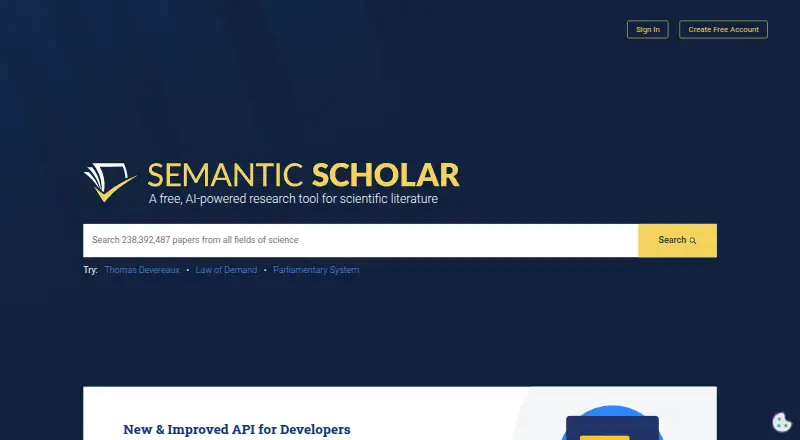
What Semantic Scholar is
Semantic Scholar is a free service for finding and exploring scientific literature, available on the web, through an API, and with browser extensions. Its search uses natural language and machine-learning techniques to identify relevant academic papers. The Academic Graph API page lists 214 million papers, 2.49 billion citations, and 79 million authors. Papers can be accessed without signing in; account holders can organize saved papers into folders, export citations in bulk, and share public folders. Research Feeds recommend papers based on saved items and can send suggestions by email. Semantic Reader includes inline citation cards, paper navigation, contextual definitions, and annotation and highlighting through Hypothesis integration. Ask This Paper generates answers with supporting statements for a limited set of papers and has been tested only on English-language papers. Chrome and Firefox extensions enable searching from highlighted text. The API's introductory key limit is one request per second; API use is limited to internal, non-commercial research or education unless an expanded licence is arranged. The service has no smartphone app, though its website is designed for mobile and desktop.
Who it suits
It suits students, researchers, and readers looking for free scientific paper search and discovery tools. API users should check the rate limits and non-commercial research or education restriction.
What it does well
- Free paper access without a login
- Search uses natural language and machine learning
- Saved-paper folders, bulk citation export, and public sharing
- Chrome and Firefox search extensions
- Research Feeds can send recommendations by email
What to know first
- No smartphone app
- Ask This Paper covers a limited set of papers
- Ask This Paper has been tested only on English-language papers
- Introductory API key limit is one request per second
Limits
The free plan provides access to Semantic Scholar, with papers available without login. Ask This Paper is available only on a limited set of papers, and the introductory API-key rate limit is one request per second; commercial API use requires an expanded license.
Plans
| Plan | Billed and limits | Price |
|---|---|---|
| Free | Free access to Semantic Scholar; no login required to access papers | Free |
As semanticscholar.org lists them, read 2 Oct 2026. The maker's own page has the final word.
Getting started
- Open https://www.semanticscholar.org/ in a browser.
- Search for papers on the web without logging in.
- Sign in to save papers in folders, export citations, or share public folders.
- Install the Chrome or Firefox extension to search from highlighted text.
- Use the API for internal, non-commercial research or educational purposes; most endpoints are public, and API keys have an introductory rate limit.
Verdict
Semantic Scholar combines paper discovery with saved libraries, reading aids, and an API at no cost. Its AI answer feature has limited coverage, and API users should account for its rate and licence terms.
Questions
How much does Semantic Scholar cost?
The Free plan costs nothing, and the service is free to use.
Can I access papers without an account?
Yes. Papers can be accessed without logging in; signing in enables library folders, bulk citation export, and public folder sharing.
Which platforms are available?
Semantic Scholar is available on the web and through an API, with Chrome and Firefox browser extensions. It has no smartphone app, and its website is designed for desktop and mobile devices.
Does Semantic Scholar have an API?
Yes. Most API endpoints are public without authentication. The introductory API-key limit is one request per second on all endpoints, while unauthenticated requests share a 1,000-requests-per-second limit and may be throttled further.
Can the API be used commercially?
The API license limits covered use to internal, non-commercial research or educational purposes. Commercial users are directed to contact AI2 about an expanded license.
Does it integrate with Zotero?
Yes. The Zotero browser extension can save paper information, URLs, available PDFs, and available TLDRs from Semantic Scholar pages to a Zotero library.
Facts from Semantic Scholar's own pages
- AI output limitation
- Semantic Scholar says language-model-generated text in its features may contain errors that can be difficult to detect. · webflow.semanticscholar.org, 2 Oct 2026
- API access and limits
- Most API endpoints are public without authentication, while the introductory API-key rate limit is 1 request per second on all endpoints; public unauthenticated requests share a 1,000 requests per second limit and may be throttled further. · webflow.semanticscholar.org, 2 Oct 2026
- API use terms
- The API license limits covered use to internal, non-commercial research or educational purposes, and directs users seeking commercial use to contact AI2 about an expanded license. · api.semanticscholar.org, 2 Oct 2026
- Ask This Paper
- Ask This Paper provides AI-generated answers with supporting statements, but is available on limited papers and has been tested only on English-language papers. · webflow.semanticscholar.org, 2 Oct 2026
- Browser extensions
- Chrome and Firefox extensions let users search Semantic Scholar from highlighted text and navigate to matching paper pages. · webflow.semanticscholar.org, 2 Oct 2026
- Founded
- 2015 · semanticscholar.org, 28 Sept 2026
- Headquarters
- Seattle, Washington, United States · semanticscholar.org, 28 Sept 2026
- Mobile availability
- Semantic Scholar says it has no smartphone app and that its website is designed for desktop and mobile devices. · webflow.semanticscholar.org, 2 Oct 2026
- Paper library
- Signed-in users can organize saved papers into folders, bulk-export citations, and share public folders with collaborators. · webflow.semanticscholar.org, 2 Oct 2026
- Purpose
- Semantic Scholar provides free, AI-driven search and discovery tools for scientific literature. · webflow.semanticscholar.org, 2 Oct 2026
- Research corpus
- Its Academic Graph API page lists 214 million papers, 2.49 billion citations, and 79 million authors. · webflow.semanticscholar.org, 2 Oct 2026
- Research recommendations
- Research Feeds recommend papers based on papers saved in library folders and can send recommendations by email. · webflow.semanticscholar.org, 2 Oct 2026
- Search and discovery
- Semantic Scholar uses natural language and machine learning techniques to find relevant results across academic papers. · webflow.semanticscholar.org, 2 Oct 2026
- Semantic Reader
- Semantic Reader offers inline citation cards, paper navigation, library saving, contextual definitions, and annotation and highlighting with Hypothesis integration. · webflow.semanticscholar.org, 2 Oct 2026
- Support
- The librarian resources page directs users to the FAQ, a Contact Us form, and tutorial videos for help. · webflow.semanticscholar.org, 2 Oct 2026
- Zotero integration
- The FAQ describes saving paper information, URLs, available PDFs, and available TLDRs from Semantic Scholar pages to a Zotero library using the Zotero browser extension. · webflow.semanticscholar.org, 2 Oct 2026
Where Semantic Scholar stands on Freedom251
- Ai Search Tools#7 of 21
- Research Paper Discovery Tools#17 of 33
- AI Search Engines#21 of 28