Freedom251 › AI Research Assistants

Consensus
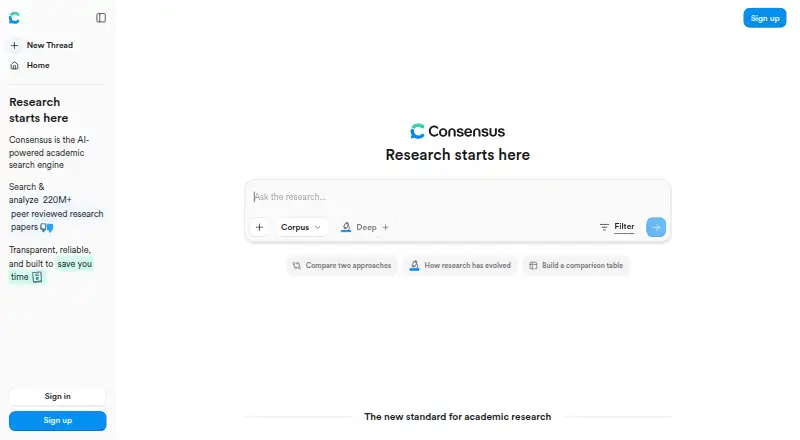
What Consensus is
Consensus is an AI workspace and academic search engine for scientific research. It searches more than 220 million peer-reviewed papers, with the database updated weekly. Its Research Agent can plan multi-step searches, use citation crawling and DOI lookup, and return answers grounded in research with citations. Users can narrow papers by publication date, access status, citation count, journal rank, study design, population, sample size, duration, publisher, field, or country. Medical Mode searches a curated collection of about 8 million papers and 50,000 clinical guidelines from the top 1,000 medical journals. Consensus says citations in AI summaries point to exact paper quotations and identify the source section; PDF text is highlighted when available. It supports Zotero imports and CSV or RIS exports, and is available through ChatGPT, Claude, and Microsoft 365 Copilot. The free tier includes unlimited paper searches, limited Pro messages, three Deep reviews and 30 API and MCP calls monthly. Pro is $20 a month; Deep is $65 a month. Both have lower monthly equivalents when billed annually.
Who it suits
Consensus suits researchers, students, and clinicians looking for research search and citation-backed summaries. Its team plans are aimed at research groups, labs, and academic departments.
What it does well
- Searches a weekly updated database of over 220 million papers.
- Research Agent plans multi-step searches and returns cited answers.
- Medical Mode includes papers and clinical guidelines.
- Imports Zotero libraries and exports CSV or RIS.
- Available on web, Android, iOS, and as an extension.
What to know first
- Free tier limits Pro messages and Deep reviews.
- Free tier includes 30 API and MCP calls monthly.
- Paid plans have monthly API and MCP call allowances.
Limits
The Free Tier has limited Pro messages, three Deep reviews per month, ten Study Snapshots per month, and 30 API and MCP calls per month. Pro costs $20 a month and includes 15 Deep reviews and 250 API and MCP calls monthly; the annual option is $144/year billed annually. Deep costs $65 a month and includes 200 Deep reviews and 1,000 API and MCP calls monthly; the annual option is $540/year billed annually.
Plans
| Plan | Billed and limits | Price |
|---|---|---|
| Free Tier | Unlimited Papers searches · 10 Pro messages/month · 3 Deep reviews/month · 10 Study Snapshots/month · 30 API & MCP calls/month | Free |
| Pro | $20/month or $144/year billed annually ($12/month equivalent) · Unlimited Papers searches · Unlimited Pro messages · 15 Deep reviews/month · Unlimited Study Snapshots · 500 API & MCP calls/month | $20 a month |
| Deep | $65/month or $540/year billed annually ($45/month equivalent) · Unlimited Papers searches · Unlimited Pro messages · 200 Deep reviews/month · Unlimited Study Snapshots · 2,000 API & MCP calls/month | $65 a month |
| Teams | Custom pricing · All Pro features · 50 Deep reviews/user/month · Up to 200 seats · Centralized billing · 500 API & MCP calls/user/month | On request |
| Enterprise | Email for a custom quote · All Team features · Thousands of users · Volume discounts · Library integrations · Training · Development partner program · 500 API & MCP calls/user/month | On request |
As consensus.app lists them, read 15 Oct 2026. The maker's own page has the final word.
Getting started
- Visit the Consensus website or use its Android, iOS, or extension access.
- Create an account to use the Free Tier.
- Import a Zotero library if needed.
- Choose the Free Tier, Pro, or Deep plan for individual use, or contact Consensus about team or enterprise pricing.
Overview
Consensus is an AI workspace for searching and working with scientific literature. It is best suited to researchers, students and clinicians who need scholarly answers they can trace to papers. Its strongest case is the combination of broad academic search and passage-linked citations; readers seeking a general-purpose search assistant may prefer a broader tool.
Key features
Search and medical coverage
Consensus searches more than 220 million peer-reviewed papers in a database updated weekly. Filters for date, open access, citations, journal rank, study design, population, sample size, duration, publisher, field and country give users useful ways to narrow results for a focused literature search. That depth is valuable for academic questions, though the product’s emphasis is not general web search.
Medical Mode searches a curated subset of about 8 million papers and 50,000 clinical guidelines from the top 1,000 medical journals. It gives clinicians and health-focused researchers a more targeted starting point than searching across every discipline, while the broader database may suit interdisciplinary questions better.
Research Agent and citations
Research Agent plans multi-step searches, using tools such as citation crawling and DOI lookup, then returns answers backed by peer-reviewed research. Consensus says each citation in its AI summaries maps to an exact paper quote, with the source section identified and PDF text highlighted when available. That traceability helps readers check how an answer relates to its source rather than treating an AI summary as a substitute for reading.
Reference workflows and integrations
Users can import a Zotero library and export CSV or RIS files compatible with EndNote, Mendeley and Zotero. Consensus is also available in ChatGPT, Claude and Microsoft 365 Copilot. These options make it easier to bring literature into existing reference and AI workflows; API and MCP usage draws from the same monthly allowance, so integrations still need to fit within plan quotas.
Consensus says content sent for AI processing is not used to train its own or third-party models, and account identifiers are not attached to that content. Support is available through in-product Support Chat and at [email protected].
Pricing
The free tier costs nothing. It allows unlimited Papers searches, but limits Pro messages, Deep reviews to 3 per month, Study Snapshots to 10 per month and API & MCP calls to 30 per month. It is a practical way to search papers without a search cap, but users who rely on the deeper research tools may reach the monthly limits.
Pro costs $20 a month, billed at $20/month or $144/year billed annually (equivalent to $12/month). It includes unlimited Papers searches and Pro messages, 15 Deep reviews per month, unlimited Study Snapshots and 250 API & MCP calls per month. It suits regular individual use, although the Deep review allowance remains modest compared with the Deep plan.
Deep costs $65 a month, billed at $65/month or $540/year billed annually (equivalent to $45/month). It keeps unlimited Papers searches and Pro messages, raises Deep reviews to 200 per month, and includes unlimited Study Snapshots and 1,000 API & MCP calls per month. It is aimed at people whose research work needs substantially higher Deep and integration quotas; occasional searchers are unlikely to need that capacity.
Teams uses custom pricing depending on team size. It includes Pro features, 50 Deep reviews per user per month, discounts up to 200 seats, centralized billing and 250 API & MCP calls per team member per month. Enterprise requires a custom quote by email and is for organizations with over 200 users; it adds team features, library integrations, product training and 250 API & MCP calls per user per month.
Paid plans can enable additional API and MCP calls for $0.05 each, up to the plan limit. Team buyers should weigh per-person allowances and seat discounts against their group’s usage, while larger organizations can look to Enterprise for library integrations and training.
Platforms
Consensus is available on the web, Android and iOS, as well as through an extension and API. Its mobile apps extend access beyond desktop research workflows, while API access supports programmatic use within the plan’s shared monthly call allowance.
Who it's for
Consensus is a strong fit for researchers, students and clinicians who search peer-reviewed work and want citations tied to source passages. Its filters, Medical Mode and reference-manager support are especially relevant to structured literature work. Teams are available for research groups, labs and academic departments. People looking mainly for broad web answers, or who need high volumes of AI research without a paid plan, should consider alternatives.
Pros and cons
- Pros: A database of more than 220 million peer-reviewed papers, updated weekly, gives academic searches broad coverage.
- Pros: Extensive filters and a dedicated medical collection help focus searches by study characteristics or clinical subject matter.
- Pros: Citations linked to exact quotes, with section references and PDF highlighting when available, make AI answers easier to verify.
- Pros: Zotero import, CSV and RIS exports, and integrations with ChatGPT, Claude and Microsoft 365 Copilot support existing research workflows.
- Cons: The free tier caps Pro messages, Deep reviews, Study Snapshots and API & MCP calls, even though Papers searches are unlimited.
- Cons: Higher Deep review and API & MCP allowances require more expensive plans, while Teams and Enterprise use custom pricing.
Alternatives
Elicit is worth comparing for research-focused work: its Basic plan has unlimited search across more than 138 million papers, unlimited summaries and unlimited chat with papers, though Research Agent and Research Reports use limited allowances.
Perplexity is a freemium option for people who want a broader search assistant across web and desktop platforms; its free plan has limited daily use, while Pro costs $20 a month for serious work with expanded use.
Andi AI offers a free-forever Andi Search plan with unlimited searches and tools to read, summarize and explain, making it an option for readers who want general search without a paid subscription.
Arc Search is a free mobile browser for readers who want search within a browser rather than an academic research workspace.
Felo Search is another freemium search option, with a free plan capped at 5 professional searches per day and up to 3 file analyses.
You.com is a freemium alternative with 100 queries per day and web and news results on its free plan.
Yahoo Scout is free to try and use without a paid subscription at launch, though some features require a Yahoo account.
Genspark Design has a free plan with 100 credits per day, making it an alternative for readers considering a credit-based product rather than Consensus’s academic research focus.
Explore more options in AI Research Assistants and AI Search Engines.
Verdict
Choose Consensus if your work depends on finding peer-reviewed research and checking AI answers against cited passages. Its broad paper database, precise filters and academic integrations make it a focused research tool, while unlimited Papers searches keep the free tier useful for discovery. Look elsewhere if you need a general-purpose search assistant or higher Deep and API usage without stepping up to a paid plan.
Verdict
Consensus combines broad academic search with filters, research workflows, and citations linked to paper passages. The free tier supports unlimited paper searches, while Pro and Deep add higher usage allowances for other features.
Questions
Is Consensus free?
Yes. Its Free Tier costs nothing and includes unlimited Papers searches, limited Pro messages, three Deep reviews per month, ten Study Snapshots per month, and 30 API and MCP calls per month.
What do Pro and Deep cost?
Pro is $20 a month, or $144/year billed annually. Deep is $65 a month, or $540/year billed annually.
What platforms does Consensus support?
Consensus is available on web, Android, iOS, and as an extension. It is also available in ChatGPT, Claude, and Microsoft 365 Copilot.
Can Consensus export or import reference libraries?
Users can import Zotero libraries and export CSV or RIS files compatible with EndNote, Mendeley, and Zotero.
Does Consensus provide API access?
Yes. API and MCP calls share a monthly allowance by plan. Paid plans can enable additional calls for $0.05 each, up to their plan limit.
Who makes Consensus?
Consensus was founded in 2021 and is headquartered in San Francisco, California, United States.
Facts from Consensus's own pages
- Advanced filters
- Filters include publication date, open-access status, citations, journal rank, study design, human or animal population, sample size, duration, publisher, field, and country. · help.consensus.app, 15 Oct 2026
- AI integrations
- Consensus is available in ChatGPT, Claude, and Microsoft 365 Copilot, and its API and MCP requests share a monthly usage pool. · help.consensus.app, 29 Sept 2026
- API limit
- The API and MCP share monthly call allowances by plan, and paid plans can enable additional calls for $0.05 each up to their plan limit. · help.consensus.app, 29 Sept 2026
- API limits
- API requests are rate-limited to one request per second, and API and MCP calls share the plan's monthly allowance. · help.consensus.app, 15 Oct 2026
- API overage
- Paid plans can enable additional API or MCP usage at $0.05 per call after included credits, subject to plan maximums. · help.consensus.app, 15 Oct 2026
- Chat integrations
- Consensus can be connected to ChatGPT, Claude, and Microsoft 365 Copilot. · consensus.app, 15 Oct 2026
- Citation grounding
- Consensus says every citation in its AI summaries is mapped to an exact quote from the paper, with the source section shown and PDF text highlighted when available. · consensus.app, 29 Sept 2026
- Company founders
- Crunchbase lists Eric Olson and Christian Salem as co-founders. · crunchbase.com, 15 Oct 2026
- Company founding and size
- LinkedIn lists the company as founded in 2022 with 2–10 employees. · linkedin.com, 15 Oct 2026
- Company headquarters
- LinkedIn lists headquarters in San Francisco, California. · linkedin.com, 15 Oct 2026
- Company legal name
- Crunchbase lists the legal name as Consensus NLP inc. · crunchbase.com, 15 Oct 2026
- Consensus Meter
- For yes-or-no questions, the Consensus Meter classifies retrieved studies as supporting, opposing, or possibly supporting the claim. · help.consensus.app, 15 Oct 2026
- Deep review
- Deep reviews break a question into subquestions, run up to 20 targeted searches, screen more than 1,000 papers, and usually analyze up to 50 papers, sometimes up to 100. · help.consensus.app, 15 Oct 2026
- Document upload
- Users can upload PDFs and other research documents, then ask questions about their contents. · help.consensus.app, 15 Oct 2026
- Founded
- 2021 · consensus.app, 23 Sept 2026
- Funding status
- Crunchbase shows four funding rounds, including Seed, Series A, and Series B, but hides the total amounts. · crunchbase.com, 15 Oct 2026
- Headquarters
- San Francisco, California, United States · consensus.app, 23 Sept 2026
- Independent criticism
- CASRAI warns that the Consensus Meter counts retrieved papers without explicitly weighting study design, sample size, statistical power, or risk of bias. · casrai.org, 15 Oct 2026
- Independent limitation
- CASRAI describes Consensus as a broad, continuously changing aggregator rather than a fixed, reproducible systematic-review database. · casrai.org, 15 Oct 2026
- Integrations
- Consensus supports Zotero library import and exports CSV or RIS files compatible with reference managers including EndNote, Mendeley, and Zotero. · help.consensus.app, 29 Sept 2026
- Library access integration
- The product advertises LibKey integration to connect users with institutional journal subscriptions. · consensus.app, 15 Oct 2026
- License
- The public consensus-mcp repository is marked MIT licensed, while the hosted Consensus product is a commercial service. · github.com, 15 Oct 2026
- Limit: mobile performance
- Google Play complaints repeatedly cite slow response times and difficulty opening thread or paper panels in the mobile app. · play.google.com, 15 Oct 2026
- Limit: organization features
- Product Hunt review summaries mention user demand for better storage and retrieval of personal research. · producthunt.com, 15 Oct 2026
Where Consensus stands on Freedom251
- AI Research Assistants#1 of 28
- Ai Search Tools#1 of 21
- AI Search Engines#3 of 28