Vearch
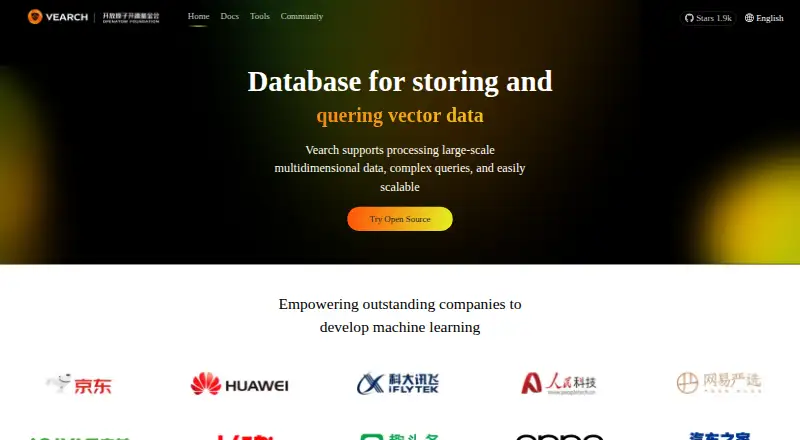
What Vearch is
Vearch is a free, open-source distributed vector database for similarity search in AI applications. It searches embedding vectors and can combine vector search with scalar filtering. The project describes replication and elastic scale-out, and says it can retrieve vectors among millions of objects in milliseconds. Its Router offers REST operations for upserting, deleting, searching, and querying data. Client SDKs are listed for Python, Go, Java, and Rust; integrations include LangChain, LlamaIndex, LangChainGo, and LangChain4j.
Deployment options include Kubernetes through Helm, Docker Compose in standalone or cluster mode, Docker, and compiling from source. The project is licensed under Apache License, Version 2.0. Its storage design uses Raft-based replication for document partitions, while Gamma is the core vector search engine based on Faiss. Support channels include GitHub Issues, an email discussion group, and Slack. The VisualSearch demo requires an image retrieval plugin for object detection and feature extraction. One database-management limitation is that a database cannot be deleted while it contains a space. The repository has no SECURITY.md policy and no published security advisories.
Who it suits
Vearch suits developers and teams building AI applications that need vector similarity search with metadata filtering and want to select a self-hosted deployment approach. Its SDKs and framework integrations may fit teams working in the listed languages and frameworks.
What it does well
- Combines vector search with scalar filtering.
- Lists SDKs for Python, Go, Java, and Rust.
- Supports several deployment approaches.
- Licensed under Apache License, Version 2.0.
What to know first
- A database cannot be deleted while it contains a space.
- VisualSearch requires an image retrieval plugin.
- Repository has no SECURITY.md policy or published advisories.
Plans
| Plan | Billed and limits | Price |
|---|---|---|
| Vearch | Apache License, Version 2.0 · self-hosted deployment | Free |
As vearch.github.io lists them, read 10 Oct 2026. The maker's own page has the final word.
Getting started
- Open the Vearch website and choose a deployment route: Kubernetes with Helm, Docker Compose, Docker, or source compilation.
- For source compilation, use a supported build environment: CentOS, Ubuntu, or Mac OS.
- Choose a client SDK in Python, Go, Java, or Rust, or use the Router REST API.
- Connect a listed integration such as LangChain, LlamaIndex, LangChainGo, or LangChain4j.
Vearch is an open-source, cloud-native vector database for similarity search in AI applications. It fits engineering teams that need to run search infrastructure themselves and connect it to existing language-model or data pipelines. Its deployment and indexing breadth is balanced by an operational deletion constraint and the absence of a repository security policy.
Overview
Vearch combines embedding search with scalar or metadata filtering, allowing applications to narrow nearest-neighbor results by attributes such as category or status. The project describes replication and elastic scale-out, and claims retrieval among millions of objects in milliseconds. That makes the architecture relevant to distributed workloads, although the speed figure is a project claim rather than a guarantee for every configuration.
PartitionServer hosts document partitions and uses Raft-based replication, while Gamma supplies vector search through a Faiss-based engine. The Router exposes REST operations for upsert, delete, search, and query, giving services a conventional API boundary. Apache License 2.0 permits self-hosted use without a commercial subscription.
Key features
- Hybrid search: Vector matching can be combined with scalar filtering, a useful design for recommendation, retrieval, and catalog systems that must enforce metadata conditions.
- Multiple indexes: HNSW, IVFPQ, GPU, IVFFLAT, BINARYIVF, and FLAT are supported. Teams can select an index suited to their workload instead of being locked to one method, but they must understand the operational trade-offs of each choice.
- Client SDKs: Python, Go, Java, and Rust clients reduce the need to build every integration around raw HTTP.
- Framework integrations: LangChain, LlamaIndex, LangChainGo, and LangChain4j connect Vearch to popular orchestration and retrieval stacks, making it a more natural fit for applications already using those frameworks.
- Visual-search path: The VisualSearch demo requires an image-retrieval plugin for object detection and feature extraction. It is therefore not a complete visual-search setup by itself.
- Operational limit: A database cannot be deleted while it still contains a space. Administrators need a cleanup procedure that removes spaces before database removal.
Pricing
Vearch costs nothing under the Vearch plan. It is open source under Apache License 2.0 and intended for self-hosted deployment, so there are no paid seats, hosted quotas, renewal charges, or trial expiry to budget for. This is the right economic model for teams able to operate their own infrastructure; it does not provide a managed service or vendor-operated capacity in this plan.
Platforms
Vearch supports API use on Linux and macOS, with self-hosted deployment. Documented installation routes include Kubernetes through Helm, Docker Compose in standalone or cluster mode, Docker deployment, and compiling from source. The installation guide supports CentOS, Ubuntu, and Mac OS as build environments. This range suits platform teams comfortable choosing and maintaining their own deployment topology.
Who it's for
Choose Vearch for an AI product that needs distributed vector retrieval, metadata constraints, several index families, and direct integration from Python, Go, Java, or Rust. It is particularly appropriate when Kubernetes, Docker, or source-based deployment is already part of the operating model and Apache-licensed software is preferred.
Look elsewhere if you want a fully managed cloud database, a published security process, or simple database lifecycle operations. The space-deletion requirement can complicate automation, and the repository has no SECURITY.md policy or published security advisories.
Pros and cons
Pros
- Apache 2.0 open source: Self-hosting avoids recurring software fees and permits stack-level control.
- Distributed design: Replication and elastic scale-out target growing collections and availability needs.
- Broad integration surface: REST operations, four SDK languages, and four framework integrations support varied application architectures.
- Flexible deployment: Helm, Compose, Docker, and source compilation cover both clustered and standalone setups.
Cons
- Database deletion dependency: A database containing a space cannot be deleted, adding a required cleanup step.
- Self-hosting responsibility: The free plan leaves infrastructure operation, scaling, and maintenance to your team.
- Security governance gap: The repository has no SECURITY.md policy and no published advisories, which may not satisfy formal security-review requirements.
- Visual demo dependency: Image retrieval needs an additional object-detection and feature-extraction plugin.
Alternatives
Chroma is a freemium Apache 2.0 option spanning hosted and self-hosted platforms, a better fit when broad client-platform coverage and a maker-backed cloud path matter.
Qdrant offers a freemium model with a free cloud tier and support across web as well as local platforms, so choose it when a managed starting point is more important than Vearch's deployment flexibility.
Vespa is a paid platform with a free trial and web support; it suits teams prepared to pay for a commercial service rather than operate an entirely free, self-hosted database.
Zvec is a free Apache 2.0 in-process vector database for teams that want a smaller embedded deployment model.
EmergentDB provides freemium community and paid plans, including unlimited vectors on its Community plan, for teams comparing hosted or alternative licensing models.
Weaviate offers a freemium service with a defined free cluster, object, memory, and disk allowances, making it preferable when explicit hosted quotas are useful.
ZeusDB Vector Database is another free, self-hosted option with a Python API, HNSW search, persistence, and metadata filters.
Cloudflare Vectorize provides a freemium Workers-based service with monthly vector-dimension allowances, suited to applications already built on Cloudflare's platform.
Verdict
Vearch is a strong choice for technically capable teams that want Apache-licensed, self-hosted vector search with distributed replication, filtering, many index types, and broad SDK and framework support. Choose it for control and deployment flexibility; look elsewhere for managed operations, stronger published security governance, or uncomplicated database deletion.
Verdict
Vearch offers vector search, filtering, replication, and multiple deployment paths, with client SDKs and framework integrations. Teams should account for the documented database deletion limit and the repository’s lack of a security policy and published advisories.
Questions
Is Vearch free?
Yes. The listed Vearch plan is free, and the project is open source under Apache License 2.0.
Which deployment options does Vearch provide?
The project documents Kubernetes deployment through Helm, Docker Compose in standalone or cluster mode, Docker deployment, and source compilation.
Which programming languages have client SDKs?
Vearch lists SDKs for Python, Go, Java, and Rust.
Which integrations are listed?
The project lists LangChain, LlamaIndex, LangChainGo, and LangChain4j.
What support channels are available?
The project points users to GitHub Issues, an email discussion group, and Slack.
Can a database be deleted while it contains a space?
No. The Vearch 3.5 database guide says a database cannot be deleted while it contains a space.
Facts from Vearch's own pages
- API
- The Router exposes REST endpoints for upsert, delete, search, and query operations. · github.com, 10 Oct 2026
- Community support
- The project points users to GitHub Issues, an email discussion group, and a Slack channel for questions and support. · github.com, 4 Oct 2026
- Deployment
- Documented deployment options include Kubernetes with Helm, Docker Compose, Docker, and source compilation. · github.com, 10 Oct 2026
- Framework integrations
- The README lists LangChain, LlamaIndex, Langchaingo, and LangChain4j integrations. · github.com, 10 Oct 2026
- Hybrid search
- It supports vector search together with scalar filtering. · github.com, 10 Oct 2026
- Integrations
- The project lists integrations with LangChain, LlamaIndex, LangChainGo, and LangChain4j. · github.com, 4 Oct 2026
- License
- Vearch is licensed under Apache License, Version 2.0. · github.com, 10 Oct 2026
- Notable limit
- The Vearch 3.5 database guide says a database cannot be deleted while it contains a space. · vearch.readthedocs.io, 10 Oct 2026
- Product
- Vearch is a cloud-native distributed vector database for similarity search of embedding vectors in AI applications. · github.com, 10 Oct 2026
- Scale and reliability
- The project describes replication and elastic scale-out as features. · github.com, 10 Oct 2026
- SDKs
- The README lists Python, Go, Java, and Rust SDKs. · github.com, 10 Oct 2026
- Search performance
- The project says it can retrieve vectors among millions of objects in milliseconds. · github.com, 10 Oct 2026
- Security policy
- GitHub's security page says the repository has no SECURITY.md policy and no published security advisories. · github.com, 10 Oct 2026
- Storage engine
- PartitionServer hosts document partitions with Raft-based replication, and Gamma is the core vector search engine based on Faiss. · github.com, 10 Oct 2026
- Support
- The project directs users to GitHub Issues, a public email discussion list, and Slack for community support. · github.com, 10 Oct 2026
- Supported build environments
- Vearch's installation guide says CentOS, Ubuntu, and Mac OS are supported for compiling the software. · vearch.readthedocs.io, 10 Oct 2026
- Visual search requirement
- The VisualSearch demo requires an image retrieval plugin for object detection and feature extraction. · github.com, 4 Oct 2026
Where Vearch stands on Freedom251
- Vector Databases#14 of 27