Freedom251 › AI Search and Discovery Platforms Software

Vespa
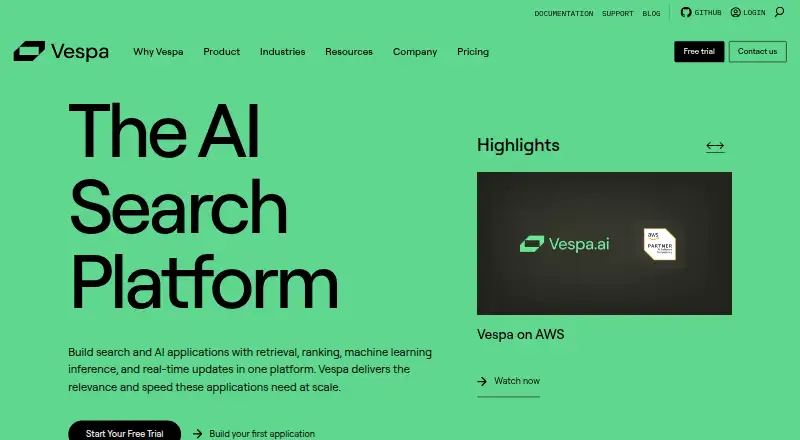
What Vespa is
Vespa is an AI search platform for online, data-driven applications that combines retrieval, ranking, machine-learning inference, and real-time serving. It supports vector and tensor search, positional text search, and structured-data search. Ranking signals can be combined through tensor functions or models in formats such as ONNX and XGBoost; Vespa also supports inference using ONNX Runtime. Its functions are distributed across node clusters, and cluster size can change without affecting queries or writes. Teams can self-manage deployments, use the Vespa Kubernetes Operator, or deploy on Vespa Cloud. Local deployment guidance lists Linux, macOS, and Windows 10 Pro on x86_64 or arm64 with Docker Desktop or Podman Desktop. Vespa Cloud encrypts data at rest and in transit, uses node and endpoint certificates, and automatically updates OS patches. A cloud trial includes $300 in usage credits, requires no credit card, and stops the application when credits run out. Cloud plans have quotas; Startup is limited to development zones.
Who it suits
Vespa describes its platform for teams building AI applications where search quality, ranking, fresh real-time data, or growing retrieval traffic matter. It suits teams choosing between self-managed deployment, an operator, and Vespa Cloud.
What it does well
- Supports vector, tensor, positional text, and structured-data search.
- Can scale clusters without impacting queries or writes.
- Supports ONNX and XGBoost ranking models.
- Cloud trial includes $300 in credits without a card.
- Cloud handles encryption and automatic OS patching.
What to know first
- Cloud plans have quotas.
- Startup is limited to development zones.
- Startup has community support only, with no SLA.
- Enclave adds cloud-provider resource costs.
Limits
The Vespa Cloud trial stops the application when its $300 in usage credits run out. All Vespa Cloud plans have quotas, and Startup is limited to development zones with community support only and no SLA. Enterprise plans list a $20,000 minimum monthly spend.
Plans
| Plan | Billed and limits | Price |
|---|---|---|
| Startup | Resources are charged hourly; community support only, no SLA. · Shared resources · no SSO or autoscaling · no redundancy by default · dev zones only · approx. 15 minutes/day downtime during upgrades unless redundancy is specified | On request |
| Basic | Initial resource unit prices; billed for allocated resources, with prices decreasing by volume. · For applications that do not need 24/7 operational support | On request |
| Commercial | Initial resource unit prices; billed for allocated resources, with prices decreasing by volume. · 24/7 operational support · production response time 1 hour | On request |
| Enterprise | Initial resource unit prices; billed for allocated resources, with prices decreasing by volume; minimum monthly spend of $20,000. · 24/7 deployment support · backup and disaster recovery · SSO · named support representative · dedicated Slack channel | On request |
| Enterprise * | Initial unit prices per hour: vCPU $ 0.18 / hour; Memory GB $ 0.018 / hour; Disk GB $ 0.0007 / hour; GPU Memory GB $ 0.125 / hour · Prices go down with volume · Minimum monthly spend of $20,000 · Backup and disaster recovery · SSO and dedicated support options | $0.18 a month |
| Self Managed | Contact Sales; support response times per contract. · Self-managed deployment including support | On request |
As vespa.ai lists them, read 14 Oct 2026. The maker's own page has the final word.
Getting started
- Visit the Vespa website.
- Choose a deployment route: self-managed, Vespa Kubernetes Operator, or Vespa Cloud.
- For local deployment, use Linux, macOS, or Windows 10 Pro with Docker Desktop or Podman Desktop.
- For Vespa Cloud, start the free trial with its $300 usage credits and no credit card.
- Select a Cloud plan based on its resource rates, quota, and support terms.
Vespa is a search and serving platform for AI applications that combines retrieval, ranking, model inference, and real-time data serving. It suits teams that need to tune relevance as data or retrieval traffic grows. Its strongest case is breadth and deployment choice; the trade-off is a cloud service with quotas and plan-specific operational limits.
Overview
Vespa brings vector and tensor search, positional text search, and structured-data search together. Hybrid search, sparse vectors, metadata filtering, and HNSW indexing support varied retrieval approaches. That makes it a better fit for applications where search quality depends on combining signals than for a team seeking only a simple vector lookup.
Teams can run Vespa themselves, use the Vespa Kubernetes Operator, or deploy on Vespa Cloud. The range is useful when infrastructure needs differ, but self-management puts more operational responsibility on the team, while cloud plans bring quotas and tier-specific terms.
Key features
Ranking and model inference
Ranking signals can be combined with tensor functions or machine-learned models in ONNX and XGBoost formats; Vespa also supports inference through ONNX Runtime. This gives relevance-focused teams room to shape ranking as part of the search system. A beta client for OpenAI-compatible APIs supports providers including OpenAI, Google Gemini, Anthropic, Cohere, and Together.ai, but its beta status makes it a less settled basis for a critical integration.
Scaling and operations
Vespa distributes functions across node clusters and supports changing cluster size without affecting queries or writes. That matters for teams expecting retrieval traffic to increase while their application remains active. Vespa Cloud handles encryption at rest and in transit, node and endpoint certificates, and automatic OS patches, reducing some infrastructure work for cloud users.
Vespa Cloud Enclave runs applications inside a tenant's own AWS, Azure, or GCP account. It can suit organizations that want that account boundary, but provider resource costs are additional to Vespa Cloud charges.
Pricing
Vespa has no free plan. Vespa Cloud’s free trial provides $300 in usage credits without requiring a credit card; the application stops when the credits run out. All Cloud plans have a quota, so the trial is useful for evaluation but not a continuing free deployment.
- Startup: $0.05 a month (billed), with vCPU at $ 0.05 / hour, memory at $ 0.005 / hour per GB, disk at $ 0.0002 / hour per GB, and GPU memory at $ 0.03 / hour per GB. It has shared resources, community support only, development zones only, and no SSO or autoscaling. The low entry price fits development, not production needs that require broader zones or stronger support.
- Basic: $0.10 a month (billed). Initial hourly rates are $ 0.1 / hour per vCPU, $ 0.01 / hour per GB of memory, $ 0.0004 / hour per GB of disk, and $ 0.07 / hour per GB of GPU memory; prices decrease with volume. It suits applications that do not need 24/7 operational support.
- Commercial: $0.15 a month (billed). Initial rates are $ 0.145 / hour per vCPU, $ 0.0145 / hour per GB of memory, $ 0.0005 / hour per GB of disk, and $ 0.1 / hour per GB of GPU memory; prices decrease with volume. It adds 24/7 operational support, backup, and disaster recovery, making it the more relevant step up for teams that need those protections.
- Enterprise: $0.18 a month (billed), with initial rates of $ 0.18 / hour per vCPU, $ 0.018 / hour per GB of memory, $ 0.0007 / hour per GB of disk, and $ 0.125 / hour per GB of GPU memory. The minimum monthly spend is $20,000, a substantial commitment for organizations that need an enterprise-scale plan.
- Enterprise *: $0.18 a month (billed), with the same initial hourly rates and $20,000 minimum monthly spend. Prices decrease with volume; backup, disaster recovery, SSO, and dedicated support options are included. This is for organizations able to meet the minimum and needing those controls.
- Self Managed: custom pricing. It covers self-managed Vespa deployment and unlimited support cases, with a dedicated support representative available.
Startup’s development-zone restriction and community-only support make it a narrow entry point. Basic avoids a stated 24/7 support commitment, while Commercial adds round-the-clock support and recovery provisions. Cloud buyers should weigh hourly resource charges against quotas and the support they need.
Platforms
Vespa supports API, Linux, macOS, self-hosted, web, and Windows deployments. The local deployment guide covers Linux, macOS, and Windows 10 Pro on x86_64 or arm64, using Docker Desktop or Podman Desktop. Python and Java SDKs are available.
Who it's for
Vespa is aimed at teams building AI applications where search relevance, ranking, fresh real-time data, or rising retrieval traffic matter. It is especially compelling when teams want to combine multiple search methods and model-based ranking. It is less suited to buyers seeking a free ongoing cloud tier, or to small projects that do not need this level of search and serving flexibility.
Pros and cons
- Pro: Vector, tensor, text, and structured-data search can share one platform, useful when applications need more than a single retrieval method.
- Pro: Tensor functions and ONNX or XGBoost models support customized ranking, while cluster resizing can avoid interrupting queries or writes.
- Pro: Self-managed, Kubernetes Operator, and Cloud deployment paths let teams choose how much infrastructure to operate.
- Con: Cloud plans all have quotas, and the trial application stops when its $300 credit is depleted.
- Con: Startup is limited to development zones and offers only community support, with no SSO or autoscaling.
- Con: Enterprise plans carry a $20,000 minimum monthly spend, which rules them out for many smaller deployments.
Alternatives
Chroma is worth considering for a freemium option with an Apache 2.0 open-source codebase shared by its database and Chroma Cloud.
Qdrant offers a free tier with a single-node cluster, making it an option for teams whose needs fit its stated 0.5 vCPU, 1GB RAM, and 4 GB disk allowance.
Weaviate has a free tier capped at one cluster per user, 100,000 objects, 1 GB memory, and 10 GB disk; that may suit a bounded cloud workload.
Cloudflare Vectorize has a free Workers tier with monthly queried and stored vector-dimension allowances, a fit to consider for usage that stays within those caps.
Epsilla has a free tier capped at one team member, one project, one AI application, one knowledge base, 10M vector storage, and 50 messages per month; data is cleared after three months.
KDB.AI offers a free Cloud Starter Edition with 4 GB memory per instance, 30 GB storage, and a 10 MB query-size limit.
LanceDB is a free alternative with open-source software for local or storage-path connections.
Milvus is a free open-source option developed by Zilliz and associated with the LF AI & Data Foundation.
For broader comparisons, see Vector Databases, Search Databases, and Database Software.
Verdict
Choose Vespa if your team needs flexible retrieval, tunable model-based ranking, and real-time serving across a deployment path it can operate. Its combination of search methods and cluster scaling is the central reason to choose it. Look elsewhere if you need a free ongoing cloud plan, a less constrained entry tier, or cannot justify the Enterprise minimum.
Verdict
Vespa offers varied search and ranking methods alongside self-managed and cloud deployment paths. Teams should account for Cloud quotas, the Startup plan’s development-zone limit, and trial credits that stop the application when depleted.
Questions
Does Vespa have a free plan?
No. Vespa lists paid pricing from $0.05 and offers a Cloud free trial with $300 in usage credits.
How does the Vespa Cloud trial work?
It provides $300 in usage credits, requires no credit card, and stops the application when the credits run out.
What deployment options are available?
Vespa can be self-managed, run with the Vespa Kubernetes Operator, or deployed on Vespa Cloud.
Which local systems are supported?
The local deployment guide lists Linux, macOS, and Windows 10 Pro on x86_64 or arm64, with Docker Desktop or Podman Desktop.
What does the Startup plan include?
Startup uses shared resources, offers community support only, and is limited to development zones. It has no SSO or autoscaling.
Does Vespa integrate with model providers?
Vespa provides a beta client for OpenAI-compatible APIs, including OpenAI, Google Gemini, Anthropic, Cohere, and Together.ai.
Facts from Vespa's own pages
- API
- Applications can write data through HTTP/2, the Document API, or client tools, and can query through the Query API or custom request handlers. · docs.vespa.ai, 14 Oct 2026
- Cloud service trial
- The Vespa Cloud page offers a free trial without requiring a credit card. · cloud.vespa.ai, 14 Oct 2026
- Company legal name
- The Norwegian business registry lists the company as VESPA.AI AS. · virksomhet.brreg.no, 14 Oct 2026
- Company size
- Gartner Peer Insights lists the company as having 11–50 employees. · gartner.com, 14 Oct 2026
- Customer cloud accounts
- Vespa Cloud Enclave runs applications inside a tenant's own AWS, Azure, or GCP account, with cloud-provider resource costs charged in addition to Vespa Cloud costs. · docs.vespa.ai, 4 Oct 2026
- Deployment
- Vespa can be self-managed, run with the Vespa Kubernetes Operator, or deployed on Vespa Cloud. · docs.vespa.ai, 4 Oct 2026
- Documentation depth
- Vespa documentation is organized into guides, tutorials, and reference material covering features and APIs. · docs.vespa.ai, 14 Oct 2026
- Extensible processing
- Application packages can include custom Java components to process queries, results, and document writes. · docs.vespa.ai, 14 Oct 2026
- Founded
- Gartner Peer Insights lists Vespa’s founding year as 2023. · gartner.com, 14 Oct 2026
- Free plan
- No · cloud.vespa.ai, 22 Sept 2026
- Funding
- Vespa.ai announced a $31 million Series A investment from Blossom Capital on November 1, 2023. · vespa.ai, 14 Oct 2026
- Grouping and aggregation
- Search results can be grouped into nested groups and aggregated for uses such as navigation and result diversity. · docs.vespa.ai, 14 Oct 2026
- Headquarters
- Vespa says its headquarters and engineering hub are in Trondheim, Norway. · vespa.ai, 14 Oct 2026
- Integrations
- Vespa Cloud Enclave can run applications in customer accounts on AWS, Azure, or Google Cloud Platform. · docs.vespa.ai, 14 Oct 2026
- Licence
- The Vespa repository states that its code is licensed under Apache 2.0. · github.com, 14 Oct 2026
- Limit: Cost and resources
- A PeerSpot reviewer said Vespa was costly relative to Elasticsearch and resource-intensive, and advised that its learning curve and infrastructure costs may make it a poor fit outside enterprise use. · peerspot.com, 14 Oct 2026
- Limit: Documentation and setup
- A PeerSpot review summary identifies documentation for beginners and setup difficulty as challenges. · peerspot.com, 14 Oct 2026
- Limit: Learning curve
- A PeerSpot reviewer cited a steep learning curve as a challenge when using Vespa for e-commerce search. · peerspot.com, 14 Oct 2026
- Limit: Migration and authentication
- A PeerSpot review summary says migration scripts are difficult and mentions a lack of user authentication. · peerspot.com, 14 Oct 2026
- Machine-learned ranking
- Vespa supports ranking expressions using signals from queries and documents, including models in ONNX and XGBoost formats. · vespa.ai, 14 Oct 2026
- ML models
- Vespa supports ONNX and XGBoost models for ranking, and model inference using ONNX Runtime. · vespa.ai, 4 Oct 2026
- Notable limit
- All Vespa Cloud plans have a quota, and the Startup plan is limited to development zones. · cloud.vespa.ai, 4 Oct 2026
- Partners
- Vespa lists OpenAI, NVIDIA, Anyscale, and LangChain among its industry partners. · vespa.ai, 14 Oct 2026
- Praise: Customer support
- A Gartner reviewer praised the Vespa team’s responsiveness, technical knowledge, and help with deployment questions. · gartner.com, 14 Oct 2026
Where Vespa stands on Freedom251
- AI Search and Discovery Platforms Software#1 of 28
- Ai Databases#2 of 40
- Vector Databases#2 of 27
- Site Search Software#2 of 25
- Search Databases#3 of 30
- Database Software#8 of 74