
Infinity
What Infinity is
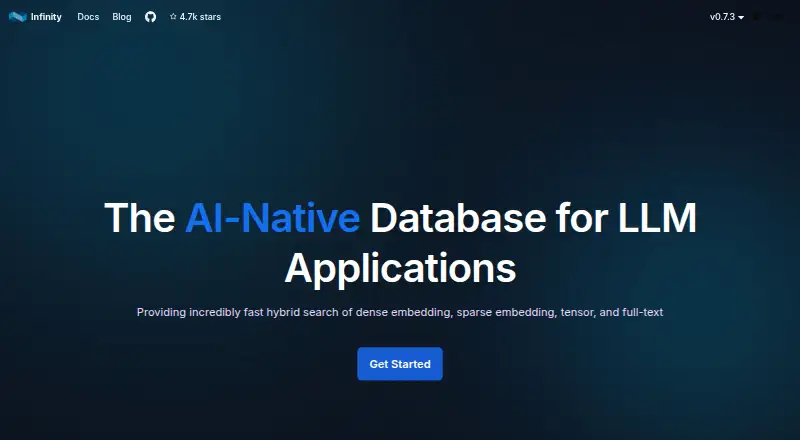
Infinity is an open-source database built for AI applications using large language models, with a particular focus on retrieval-augmented generation. Its hybrid search spans dense and sparse embeddings, tensors, and full text, with filtering and support for strings, numeric values, and vectors. Listed rerankers include RRF, weighted sum, and ColBERT. The project’s homepage claims 0.1 millisecond query latency and up to 15K QPS on million-scale vector datasets.
Developers can work through Python and HTTP APIs; the Python client is installed with pip. Deployment guides cover Docker and Linux packages in deb, rpm, or tgz formats. Supported systems include Linux and macOS, plus Windows 10 or later through WSL or WSL2, on x86_64 hardware with AVX2. Python 3.10 or later is required. Search choices include HNSW for faster dense-vector search and IVF for lower memory use. Filtering and full-text search have configuration requirements, and tensor search can bring substantial storage overhead. Infinity is free and open source under the Apache-2.0 license.
Who it suits
Infinity suits developers building retrieval-augmented generation applications who need hybrid search and Python or HTTP interfaces. It is a fit for teams able to deploy on supported systems and configure indexes, analyzers, and search behavior.
What it does well
- Hybrid search covers dense and sparse embeddings, tensors, and full text.
- Filtering supports metadata and indexed conditional queries.
- Python SDK and HTTP API references are available.
- Docker and Linux package deployment options are documented.
- Apache-2.0 licensed and free to use.
What to know first
- Conditional filters must operate through an index.
- Full-text indexing requires a tokenizer or analyzer.
- Tensor search can add significant storage overhead.
- Client and server versions must match exactly in client-server mode.
Limits
Infinity is free. Conditional filters require an index, full-text indexing requires a tokenizer or analyzer, and tensor search may have significant storage overhead.
Getting started
- Visit the Infinity website.
- Install the Python client with pip, or use the HTTP API.
- Choose Docker deployment or a Linux package in deb, rpm, or tgz format.
- Use a supported Linux, macOS, or Windows 10-or-later environment with WSL or WSL2.
- Meet the x86_64 AVX2 and Python 3.10-or-later requirements.
- Configure indexes for conditional filters and specify a tokenizer or analyzer for full-text indexing.
Verdict
Choose Infinity if you are developing an LLM or retrieval-augmented generation application and want an open-source database with hybrid search. Look elsewhere if your search design depends on tensor search without added storage, or if you cannot meet its system and version requirements.
Questions
How much does Infinity cost?
Infinity is free and open source.
Which platforms does it support?
Its listed platforms are API, Linux, macOS, self-hosted, and Windows. The quickstart specifies Windows 10 or later with WSL or WSL2.
What search methods does Infinity support?
It supports hybrid search across dense embeddings, sparse embeddings, tensors, and full text, with filtering.
Which developer APIs are available?
The documentation provides Python and HTTP API references, including a Python SDK.
What license does Infinity use?
The project’s GitHub repository lists the Apache-2.0 license.
What system requirements are specified?
The supported environment guidance specifies x86_64 with AVX2 support and Python 3.10 or later.
Facts from Infinity's own pages
- API options
- The docs provide Python and HTTP API references, and the homepage says Infinity has a Python API. · infiniflow.org, 8 Oct 2026
- Cluster storage
- The cluster guide says supported shared storage is MinIO and describes a cluster with one leader, up to four followers, and learner nodes. · infiniflow.org, 8 Oct 2026
- Community
- The homepage links to Infinity's GitHub repository and Discord community. · infiniflow.org, 8 Oct 2026
- Community support
- The homepage links to the project’s X account, GitHub, and Discord community. · infiniflow.org, 8 Oct 2026
- Data types
- Infinity supports data types including strings, numerics, and vectors. · infiniflow.org, 8 Oct 2026
- Deployment
- The quickstart documents deploying Infinity with Docker, while the binary guide offers Linux packages in deb, rpm, or tgz formats. · infiniflow.org, 8 Oct 2026
- Developer interface
- The homepage describes an intuitive Python API, and the docs provide a Python SDK and HTTP API reference. · infiniflow.org, 8 Oct 2026
- Full-text search
- The search guide says full-text indexing requires specifying a tokenizer or analyzer, and most built-in analyzers require resource files. · infiniflow.org, 8 Oct 2026
- Intended use
- The maker describes Infinity as designed for retrieval-augmented generation applications. · infiniflow.org, 8 Oct 2026
- License
- The project’s GitHub repository lists the Apache-2.0 license. · github.com, 8 Oct 2026
- Performance
- The homepage states 0.1 milliseconds query latency and up to 15K QPS on million-scale vector datasets. · infiniflow.org, 8 Oct 2026
- Performance claims
- The homepage claims 0.1 millisecond query latency and up to 15K QPS on million-scale vector datasets. · infiniflow.org, 8 Oct 2026
- Purpose
- Infinity describes itself as an AI-native database for LLM applications that provides hybrid search. · infiniflow.org, 8 Oct 2026
- Python API
- The homepage describes an intuitive Python API, and the docs show installing the client with pip. · infiniflow.org, 8 Oct 2026
- Ranking
- Its listed rerankers include RRF, weighted sum, and ColBERT. · infiniflow.org, 8 Oct 2026
- Rerankers
- The homepage names RRF, weighted sum, and ColBERT as supported rerankers. · infiniflow.org, 8 Oct 2026
- Search
- It supports hybrid search across dense embeddings, sparse embeddings, tensors, and full text, with filtering. · infiniflow.org, 8 Oct 2026
- Search constraints
- The search guide says conditional filters must work through an index; secondary-index filters support logical comparisons and membership expressions. · infiniflow.org, 8 Oct 2026
- Search methods
- It supports hybrid search across dense embeddings, sparse embeddings, tensors, and full text, as well as filtering. · infiniflow.org, 8 Oct 2026
- Supported environments
- The quickstart lists Linux, macOS, and Windows 10 or later with WSL or WSL2; it specifies x86_64 with AVX2 support and Python 3.10 or later. · infiniflow.org, 8 Oct 2026
- Tensor guidance
- The search guide cautions that tensor search can have significant storage overhead and recommends tensors for reranking in hybrid search. · infiniflow.org, 8 Oct 2026
- Vector search
- The search guide says HNSW is aimed at faster dense-vector search and IVF uses less memory; incoming streaming vectors are searched by brute force alongside indexed results. · infiniflow.org, 8 Oct 2026
- Version requirement
- The Python API documentation says client and server versions must match exactly in client-server mode. · infiniflow.org, 8 Oct 2026
Where Infinity stands on Freedom251
- Vector Databases#11 of 27