
Zvec
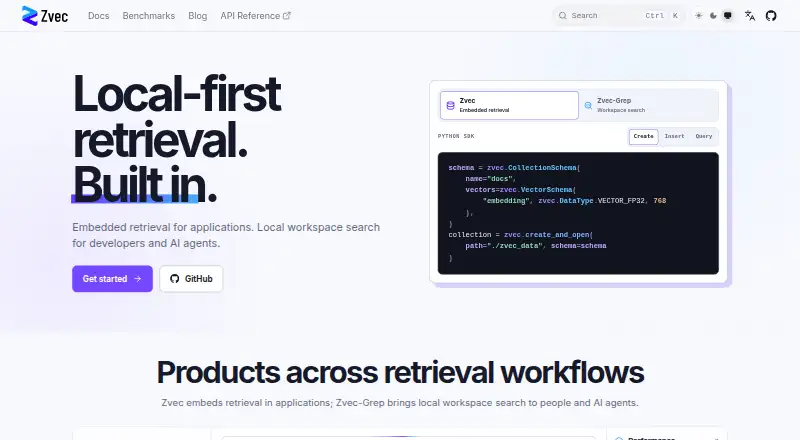
What Zvec is
Zvec is an open-source vector database that runs inside an application, so it can index and query vectors without a separate server or external infrastructure. It supports dense and sparse vectors, full-text search, hybrid retrieval, and structured filters. Listed index options include Flat, HNSW, IVF, DiskANN, and RaBitQ variants; quantization options include FP16, INT8, INT4, RaBitQ, and PQ. Write-ahead logging supports persistence after process crashes or power failures. Multiple processes can read a collection at once, but writing is limited to one process at a time.
SDKs are listed for Python, Node.js, Go, Rust, Dart, C, and C++. The README names Linux, macOS, and Windows, with prebuilt SDK binaries also available for Android and iOS. Named integrations include Logseq, MyContext, ReMe, txtai, and CocoIndex. Zvec-Grep, part of the product family, searches local code, documentation, and text-based data by exact text, keywords, or meaning. The software is free and self-hosted under the Apache-2.0 license.
Who it suits
Zvec suits application developers building prototypes, local development tools, embedded or edge applications, and production systems. Its in-process design also fits teams that want to keep vector search local rather than operate a separate service.
What it does well
- Runs locally without a server or external infrastructure.
- Supports dense and sparse vectors, full-text, and hybrid retrieval.
- Provides multiple index and quantization options.
- Write-ahead logging supports persistence after failures.
- SDKs and prebuilt binaries cover multiple languages and platforms.
What to know first
- Writes are exclusive to one process at a time.
- Self-hosted deployment requires managing the runtime environment.
- No security certification or compliance standard is stated.
Plans
| Plan | Billed and limits | Price |
|---|---|---|
| Zvec | Open-source in-process vector database · Apache License 2.0 | Free |
As zvec.org lists them, read 8 Oct 2026. The maker's own page has the final word.
Getting started
- Open the Zvec website.
- Choose a listed SDK for your language: Python, Node.js, Go, Rust, Dart/Flutter, C, or C++.
- Use a supported Linux, macOS, or Windows system, or a published prebuilt SDK binary for Android or iOS.
- Deploy Zvec locally as a self-hosted, in-process database.
Zvec is a free, open-source vector database for developers who want to put search directly inside an application. It is best suited to local, embedded, and edge projects where one process can own writes; its search and indexing range is broad, but that single-writer rule is a real architectural constraint.
Overview
Zvec indexes and queries vectors in-process, without a separate server, daemon, or external infrastructure. That can simplify prototypes and local development, and gives embedded and edge applications a way to keep vector storage close to the application. The maker also presents it for production systems, but production suitability depends on whether the workload can funnel writes through one process.
Multiple processes may read the same collection at once, while writes are exclusive to one process. This is workable for read-heavy applications with a clearly owned write path; it is a poor fit when several processes must update the same collection concurrently. Write-ahead logging preserves data across process crashes or power failures, an important safeguard when storage is embedded in the application.
Key features
Search and indexing
Zvec supports dense and sparse vectors, full-text search, and hybrid retrieval with structured filters. That combination gives developers options for searches that mix semantic matches with keywords or metadata constraints. Its listed index types include Flat, HNSW, IVF, DiskANN, HNSW-RaBitQ, and IVF-RaBitQ. Quantization options include FP16, INT8, INT4, RaBitQ, and PQ, a broad toolkit for tuning search and representation rather than a single fixed indexing path.
SDKs and adjacent tools
Official SDKs are listed for Python, Node.js, Go, Rust, and Dart/Flutter, with C and C++ also linked from the product site. That range can serve projects built in several common application languages, though the breadth of SDK choices does not remove the need to design around exclusive writes. Named integrations include Logseq, MyContext, ReMe, txtai, and CocoIndex.
The product family also includes Zvec-Grep, a local workspace search CLI and MCP tool for people and AI agents. It searches local code, documentation, and text-based data by exact text, keywords, or meaning, making it relevant to local-workspace search needs distinct from embedding Zvec in an application.
Local deployment and support
Zvec runs locally and in-process, with no external infrastructure required. Its repository identifies Apache-2.0 licensing, and the maker describes it as private. Documentation points users to GitHub issues and community channels including DingTalk, WeChat, Discord, and X. These are community routes for help rather than a stated support commitment.
Pricing
Zvec costs free and is open source under the Apache License 2.0. There is no paid tier or trial to weigh: it suits developers seeking a self-hosted database without a license charge. The trade-off is that deployment and application integration remain part of the user's work, rather than being handled by a separate hosted service.
Platforms
The README lists Linux, macOS, and Windows; prebuilt SDK binaries are published for those platforms as well as Android and iOS. The product is self-hosted and exposes APIs, which suits teams embedding it across desktop, mobile, and server-side environments. Platform support does not change the single-process write limit.
Who it's for
Zvec is aimed at application developers building prototypes, local development tools, embedded software, edge applications, or production systems that can centralize writes. Its local operation and broad language support are useful when a project should not depend on a separate vector database service. Teams requiring multiple concurrent writers should choose an architecture designed for that access pattern instead.
Pros and cons
- Pros: In-process operation avoids a separate server or external infrastructure, making local and embedded deployment practical.
- Pros: Dense and sparse vectors, full-text and hybrid search, structured filters, and numerous index and quantization choices offer flexibility for retrieval design.
- Pros: Apache-2.0 licensing and a free plan make it accessible for self-hosted use without a license fee.
- Cons: Writes are exclusive to one process, which rules it out for workloads that need concurrent writers.
- Cons: Users who need hosted operations will need a different service model; Zvec is self-hosted and runs locally.
Alternatives
Compare vector databases if you want to assess more options for your workload. Choose Chroma if freemium access and a codebase shared by its open-source database and Chroma Cloud fit better. Qdrant is worth considering when a freemium option with a free single-node cloud tier is preferable to Zvec's in-process model.
Vespa is a paid alternative with a free trial if you are prepared to evaluate a paid service. EmergentDB offers a free Community plan with unlimited vectors, queries, and writes, which may suit workloads where write concurrency is more important than Zvec's local in-process approach. Vearch is another free, Apache-licensed, self-hosted option.
Weaviate may fit better if a defined free cloud allowance is useful: its free plan includes one cluster, 100,000 objects, 1 GB memory, 10 GB disk, and one collection. ZeusDB Vector Database is a free self-hosted alternative with a Python API, HNSW search, optional product quantization, persistence, and metadata filters. Cloudflare Vectorize is oriented toward API and web use, with a free Workers allowance for queried and stored vector dimensions.
Verdict
Choose Zvec if you are a developer who wants free, Apache-2.0 vector storage embedded in a local application, and can route all writes through one process. Its combination of retrieval methods, index choices, SDKs, and crash-resilient persistence makes it a capable fit for that design. Look elsewhere if simultaneous writers or a hosted database service is central to your requirements.
Verdict
Zvec offers local vector storage and search with a broad set of search, index, and SDK options. Its single-writer constraint is worth considering for applications that need concurrent writes.
Questions
How much does Zvec cost?
Zvec is listed as free and open source, with a price of $0 plan.
Does Zvec have a free plan or free trial?
A free plan is listed. No free trial is listed.
Which platforms does it support?
The README lists Linux, macOS, and Windows. Prebuilt SDK binaries are published for Linux, macOS, Windows, Android, and iOS.
Is Zvec open source?
Yes. It is identified as open source under the Apache-2.0 license.
Which SDK languages are listed?
Python, Node.js, Go, Rust, Dart/Flutter, C, and C++ are listed.
What integrations are named?
The product site names Logseq, MyContext, ReMe, txtai, and CocoIndex.
Facts from Zvec's own pages
- Agent tools
- The product family includes Zvec-Grep, a local workspace search CLI and MCP tool for people and AI agents. · zvec.org, 8 Oct 2026
- Concurrency limit
- Multiple processes can read the same collection simultaneously, while writes are exclusive to one process. · zvec.org, 8 Oct 2026
- Indexes
- The site lists Flat, HNSW, IVF, and DiskANN index types, plus FP16, INT8, INT4, RaBitQ, and PQ quantization. · zvec.org, 8 Oct 2026
- Integrations
- The product site names integrations with Logseq, MyContext, ReMe, txtai, and CocoIndex. · zvec.org, 8 Oct 2026
- Languages and APIs
- Official SDKs are listed for Python, Node.js, Go, Rust, and Dart/Flutter, with C and C++ also linked from the product site. · github.com, 8 Oct 2026
- Privacy and deployment
- Zvec runs in-process and locally, with no server or external infrastructure required. · zvec.org, 8 Oct 2026
- Search types
- It supports dense and sparse vectors, full-text search, and hybrid retrieval with structured filters. · zvec.org, 8 Oct 2026
- Security and compliance
- The maker describes Zvec as private and the repository identifies Apache-2.0 licensing; the pages opened do not state a security certification or compliance standard. · zvec.org, 8 Oct 2026
- Storage
- Write-ahead logging provides persistence across process crashes or power failures. · zvec.org, 8 Oct 2026
- Support
- The documentation directs users to report issues on GitHub and lists community channels including DingTalk, WeChat, Discord, and X. · github.com, 8 Oct 2026
- Supported content
- Zvec-Grep searches local code, documentation, and text-based data using exact text, keywords, or meaning. · zvec.org, 8 Oct 2026
- Supported platforms
- The README lists Linux, macOS, and Windows, and says prebuilt SDK binaries are published for Linux, macOS, Windows, Android, and iOS. · github.com, 8 Oct 2026
- What it does
- Zvec is an open-source, in-process vector database for indexing and querying vectors without a server, daemon, or external infrastructure. · zvec.org, 8 Oct 2026
- Who it is for
- The maker describes Zvec for application developers and presents use cases spanning prototyping, local development, embedded and edge applications, and production systems. · zvec.org, 8 Oct 2026
Where Zvec stands on Freedom251
- Vector Databases#19 of 27