
EmergentDB
What EmergentDB is
EmergentDB is an open-source vector database that can be self-hosted or used as a managed cloud service. It is licensed under AGPL-3.0 and supports Linux, web access, and REST API endpoints for batch vector insertion and search. A TypeScript SDK can insert vectors, and the site says embeddings may come from any source. The database automatically discovers a search strategy for the data without manual tuning or configuration. Listed index types are Flat, HNSW, IVF, PQ, and Emergent; SDK languages include TypeScript and Python. The free Community plan includes unlimited vectors, queries, and writes, community support, and the Bolt-lite engine. Managed plans include Launch, listed at $24 a year billed annually, with a 500K-vector limit, and Scale, listed at $66 a year billed annually, with 2.5M vectors and a dedicated instance. The site lists US, EU, and Asia-Pacific data residency, ISO 27001, SOC 2 Type II, GDPR, and HIPAA-ready status. It also describes a crash-safe write-ahead log and publishes latency, recall, and benchmark claims for specified workloads.
Who it suits
It suits developers or teams building vector search who want automatic search-strategy selection and REST API access. The self-hosted option and managed plans cater to different deployment preferences.
What it does well
- Automatically discovers a search strategy.
- Supports batch insertion and REST API search.
- Free Community plan includes unlimited vectors, queries, and writes.
- Offers self-hosted and managed cloud deployment.
What to know first
- Community support is listed for the free plan.
- Launch is limited to 500K vectors.
- Scale is limited to 2.5M vectors.
Limits
The free Community plan lists unlimited vectors, queries, and writes. Managed Launch is limited to 500K vectors, while Scale is limited to 2.5M vectors; both list unlimited queries and writes.
Plans
| Plan | Billed and limits | Price |
|---|---|---|
| Community | Unlimited vectors · Unlimited queries & writes · AGPL-3.0 · Community support · Bolt-lite engine | Free |
| Launch | billed annually · 500K vectors · Unlimited queries & writes · SOC 2 · GDPR · 99.9% SLA | $24 a year |
| Launch | 500K vectors · Unlimited queries & writes · SOC 2 · GDPR · 99.9% SLA | $29 a month |
| Scale | billed annually · 2.5M vectors · Unlimited queries & writes · Dedicated instance · HIPAA-ready · 99.95% SLA | $66 a year |
| Scale | 2.5M vectors · Unlimited queries & writes · Dedicated instance · HIPAA-ready · 99.95% SLA | $79 a month |
As emergentdb.com lists them, read 9 Oct 2026. The maker's own page has the final word.
Getting started
- Visit the EmergentDB website.
- Choose self-hosted deployment or a managed cloud plan.
- Use the Community plan for free, or select Launch or Scale for managed cloud.
- Insert vectors through the TypeScript SDK or REST API endpoints.
- Search vectors through REST API endpoints.
EmergentDB is an open-source vector database that can run on your infrastructure or as a managed cloud service. It suits developers who want automatic search-strategy selection, REST and SDK access, and generous query and write allowances. The main decision is whether its vector ceilings and AGPL-3.0 license fit your deployment and governance requirements.
Overview
EmergentDB is licensed under AGPL-3.0 and supports self-hosted Linux deployments as well as web-accessible managed use. Its defining feature is automatic optimization: it discovers a search strategy for your data without requiring manual tuning or configuration. That reduces index-management work, but teams that need explicit control over every indexing decision may prefer a more conventional workflow.
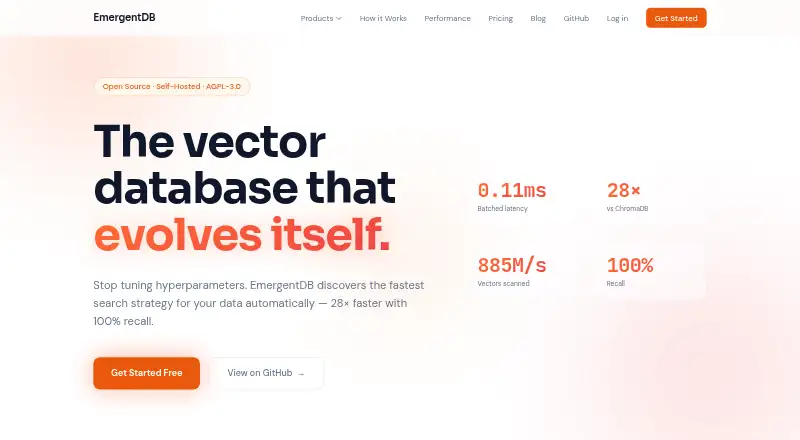
The database supports Flat, HNSW, IVF, PQ, and Emergent index types. The homepage claims 0.11ms batched latency and 100% recall at 10 million vectors across all dimensions, plus batched performance 18–28 times faster than ChromaDB and 2.5 times faster than FAISS across 768D–3072D. Those claims make EmergentDB worth evaluating for latency-sensitive workloads, while real-world results will depend on your data and traffic.
Key features
Insertion and search
REST API endpoints handle batch vector insertion and vector search. A TypeScript SDK offers another insertion route, and the product says it accepts vectors from any embedding source. TypeScript and Python are the listed SDK languages, giving teams in either ecosystem a direct integration path.
Durability and operations
A crash-safe write-ahead log is designed to protect writes, and the product says a 10GB index can reopen in microseconds. The managed service offers unlimited queries and writes on both paid tiers, so usage volume is constrained primarily by the vector allowance rather than operation counts.
Security and residency
EmergentDB lists ISO 27001, SOC 2 Type II, GDPR, and HIPAA-ready status. Managed regions in the US, EU, and Asia-Pacific provide built-in data residency choices. These controls make the service more plausible for regulated deployments, although the Scale plan is the one that explicitly includes HIPAA-ready status.
Pricing
Community — free. This tier includes unlimited vectors, unlimited queries and writes, AGPL-3.0 licensing, community support, and the Bolt-lite engine. It is the natural starting point for experiments, personal projects, and teams comfortable running the open-source edition. Community support and the Bolt-lite engine may be limiting for organizations seeking contractual service commitments or the managed features of paid plans.
Launch — $24 a year, billed annually. Launch includes a managed cloud deployment, a 500K-vector limit, unlimited queries and writes, SOC 2, GDPR, and a 99.9% SLA. It fits production services below that vector ceiling that need managed hosting and a published availability commitment. The annual billing term and 500K cap matter for fast-growing indexes.
Scale — $66 a year, billed annually. Scale raises the allowance to 2.5M vectors and adds dedicated resources, a dedicated instance, HIPAA-ready status, and a 99.95% SLA, while retaining unlimited queries and writes. It is the stronger choice for larger or compliance-sensitive workloads, but its ceiling still requires planning for datasets beyond 2.5 million vectors.
Platforms
EmergentDB is available through an API and web service, on Linux, and as self-hosted software. Deployment is therefore flexible: teams can keep the AGPL-3.0 database in their own environment or choose managed cloud hosting.
Who it's for
Choose EmergentDB if you want vector search without hand-tuning strategies, need unlimited query and write operations, or require a choice between self-hosting and managed deployment. Launch is aimed at smaller production indexes, while Scale targets dedicated infrastructure and higher compliance needs. It is less suitable when your dataset will exceed the paid vector limits, when annual billing is undesirable, or when your organization cannot adopt AGPL-3.0 software.
Pros and cons
- Pros: Automatic strategy discovery reduces manual index configuration.
- Pros: Community offers unlimited vectors, queries, and writes at no charge.
- Pros: Paid plans combine unlimited operations with SOC 2, GDPR, SLAs, and regional hosting choices.
- Pros: REST endpoints plus TypeScript and Python SDK support fit varied application stacks.
- Cons: Launch and Scale impose 500K and 2.5M vector limits respectively.
- Cons: Paid plans are billed annually, reducing flexibility for short-term deployments.
- Cons: AGPL-3.0 licensing and community support on the free tier may not suit every commercial governance model.
- Cons: Automatic optimization can be a drawback for teams that require manual control of search strategy.
Alternatives
Chroma is a better fit if you want an Apache 2.0 open-source database and broad client-platform coverage, including mobile and desktop systems.
Qdrant suits teams seeking a freemium service with a free cloud tier and a single-node allowance of 0.5 vCPU, 1GB RAM, and 4GB disk.
Vespa is the alternative when usage-based resource pricing and a free trial matter more than a permanent free plan.
Zvec is preferable for an Apache-licensed, open-source in-process vector database.
Vearch is another free, Apache-licensed choice for self-hosted deployment.
Weaviate offers a freemium hosted option with a free cluster capped at 100,000 objects, 1GB memory, and 10GB disk.
ZeusDB Vector Database fits readers wanting a free self-hosted database with a Python API, HNSW search, persistence, and metadata filters.
Cloudflare Vectorize is the choice for API and web deployments tied to Workers quotas, including 5 million stored vector dimensions and 30 million queried dimensions per month on its free tier.
Browse more options in Vector Databases.
Verdict
EmergentDB is a strong choice for developers who want automatic search optimization, self-hosting or managed cloud, and unlimited operations. Pick it for the free Community tier or for managed Launch and Scale deployments when their vector limits, annual billing, and AGPL-3.0 licensing fit. Look elsewhere if you need a more permissive license, usage beyond 2.5 million vectors on the listed paid plans, or complete manual control over indexing.
Verdict
EmergentDB combines vector search APIs and automatic strategy discovery with self-hosted and managed deployment choices. The Community plan is free, while the paid plans have listed vector limits and annual-billed prices.
Questions
Is EmergentDB free?
Yes. Community is listed as free and includes unlimited vectors, queries, and writes.
What do the paid plans cost?
Launch is listed at $24 a year, billed annually. Scale is listed at $66 a year, billed annually.
Can I host EmergentDB myself?
Yes. Self-hosted deployment is listed, alongside managed cloud.
Which platforms and SDK languages are listed?
The listed platforms are API, Linux, self-hosted, and web. SDK languages include TypeScript and Python.
Is EmergentDB open source?
Yes. It is licensed under AGPL-3.0.
What limits apply to the managed plans?
Launch has a 500K-vector limit and Scale has a 2.5M-vector limit. Both list unlimited queries and writes.
Facts from EmergentDB's own pages
- Automatic optimization
- The database discovers the search strategy for your data automatically, without manual tuning or configuration. · emergentdb.com, 9 Oct 2026
- Benchmarks
- The site reports 18–28× faster batched performance than ChromaDB and 2.5× faster than FAISS across 768D–3072D. · emergentdb.com, 9 Oct 2026
- Data residency
- The site lists US, EU, and Asia-Pacific regions and says data residency is built in. · emergentdb.com, 9 Oct 2026
- Durability
- The site describes a crash-safe write-ahead log and says a 10GB index reopens in microseconds. · emergentdb.com, 9 Oct 2026
- Managed service
- Launch is listed as managed cloud with 500K vectors and unlimited queries and writes. · emergentdb.com, 9 Oct 2026
- Performance claim
- The homepage claims 0.11ms batched latency and 100% recall, tested at 10M vectors across all dimensions. · emergentdb.com, 9 Oct 2026
- Product
- EmergentDB is an open-source, self-hosted vector database licensed under AGPL-3.0. · emergentdb.com, 9 Oct 2026
- Scale service
- Scale is listed with dedicated resources, a dedicated instance, and a 2.5M-vector limit. · emergentdb.com, 9 Oct 2026
- SDK and embeddings
- Vectors can be inserted through a TypeScript SDK, and the site says any embedding source can be used. · emergentdb.com, 9 Oct 2026
- Security and compliance
- The site lists ISO 27001, SOC 2 Type II, GDPR, and HIPAA-ready status. · emergentdb.com, 9 Oct 2026
- Support
- The Community plan includes community support. · emergentdb.com, 9 Oct 2026
- Vector operations
- The homepage describes batch vector insertion and vector search through REST API endpoints. · emergentdb.com, 9 Oct 2026
Where EmergentDB stands on Freedom251
- Vector Databases#4 of 27