Freedom251 › Data Visualization Software
Tulip
What Tulip is
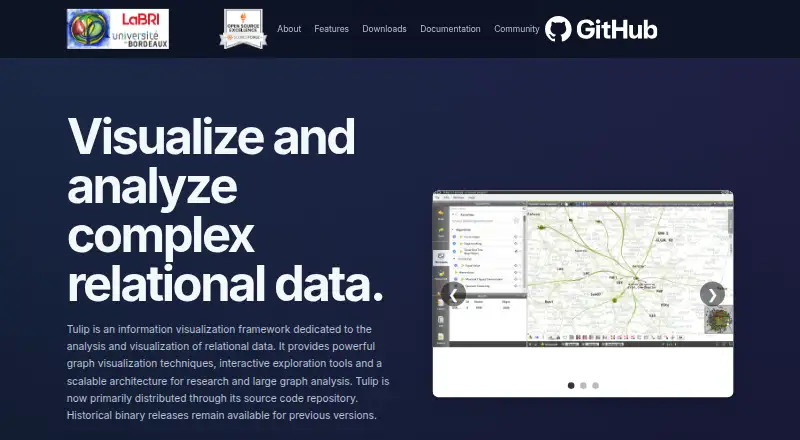
Tulip is a free information-visualization framework for analyzing and exploring relational data, especially large graphs. Its interactive desktop environment provides graph-drawing algorithms and supports filtering, selection and dynamic layouts for navigating data. The project describes graphs of up to a million nodes and edges, with views including node-link diagrams, adjacency matrices, geographic views, histograms, parallel coordinates and scatter plots. A plugin architecture lets researchers and developers add algorithms and visualizations in C++ or Python. Tulip’s Python interface exposes almost all of the C++ API for graph manipulation, algorithms, workflow automation and pure-Python plugins. Documented imports include CSV, TLP, GEXF, GML, GraphML, JSON, Pajek and UCINET; export plugins include CSV, GML, JSON, SVG, TLP and TLPB. Tulip runs on Linux, macOS and Windows, with an API also listed. It is free software under the GNU Lesser General Public License version 3 or later. The project no longer provides precompiled binaries; current development distribution uses its source repository, while historical official binaries reach version 6.0.1.
Who it suits
Tulip suits researchers, educators and developers exploring large relational datasets or building custom graph-analysis workflows. Its plugin and Python support also fit experimentation and scientific visualization.
What it does well
- Interactive exploration with filtering and dynamic layouts
- Designed for graphs up to a million nodes and edges
- C++ and Python plugin architecture
- Broad documented graph import and export formats
- Free software under LGPL v3 or later
What to know first
- No longer provides precompiled binaries
- Current development version is distributed through source
- Desktop platform support excludes mobile systems
- Historical official binaries stop at version 6.0.1
Verdict
Tulip offers extensive graph visualization and programming access without a software charge. Users should be prepared to obtain current builds from the source repository rather than precompiled installers.
Facts from Tulip's own pages
- Algorithms and extensibility
- Tulip provides graph algorithms and a plugin architecture; plugins can be written in C++ or Python. · github.com, 12 Oct 2026
- Audience
- The site says Tulip is widely used in research and education for exploring large relational datasets. · tulip.labri.fr, 11 Oct 2026
- Dashboard type
- interactive · tulip.labri.fr, 23 Sept 2026
- Data formats
- The framework supports TLP text and binary graph formats and documents CSV import and CSV, GML, JSON, SVG, TLP, and TLPB export plugins. · github.com, 12 Oct 2026
- Data sources
- CSV; TLP; TLP binary; other graph formats are referenced,but not enumerated on the opened official pages · tulip.labri.fr, 23 Sept 2026
- Development
- Tulip is developed at LaBRI by researchers and engineers and is maintained through community-driven development and open contributions. · tulip.labri.fr, 12 Oct 2026
- Distribution
- Tulip is primarily distributed through its source code repository; historical binaries up to version 6.0.1 are described as the last officially distributed binary versions. · tulip.labri.fr, 11 Oct 2026
- Distribution limit
- The project says it no longer provides precompiled binaries; the latest development version is distributed through its source repository, while historical binaries go up to version 6.0.1. · tulip.labri.fr, 12 Oct 2026
- Exports
- The Python documentation lists CSV, GML, JSON, SVG, TLP and TLPB export plugins. · tulip.labri.fr, 11 Oct 2026
- Extensibility
- Its plugin architecture lets researchers and developers add custom algorithms and visualizations. · tulip.labri.fr, 11 Oct 2026
- Free plan
- Yes · tulip.labri.fr, 23 Sept 2026
- Graph formats
- The Python documentation lists import plugins for GEXF, GML, GraphML, JSON, Pajek, UCINET and other graph sources. · tulip.labri.fr, 11 Oct 2026
- Graph scale
- The project describes Tulip as designed to analyze, draw, and visualize very large graphs, up to a million nodes and edges. · github.com, 12 Oct 2026
- Graph visualization
- It provides graph drawing algorithms and interactive rendering for exploring large scale graphs. · tulip.labri.fr, 11 Oct 2026
- Intended users
- The maker describes Tulip as used in research and education for exploring large relational datasets, and for experimentation, teaching, and scientific visualization. · tulip.labri.fr, 12 Oct 2026
- Interactive exploration
- Tulip supports interactive graph exploration through filtering, selection, and dynamic layouts. · tulip.labri.fr, 12 Oct 2026
- Large datasets
- The site says Tulip is designed to handle large relational datasets efficiently with optimized visualization techniques. · tulip.labri.fr, 11 Oct 2026
- License
- The project identifies Tulip as free software under the GNU Lesser General Public License, version 3 or later. · github.com, 12 Oct 2026
- Maker
- Tulip is developed at LaBRI and maintained by researchers and engineers from LaBRI and its scientific ecosystem. · tulip.labri.fr, 11 Oct 2026
- Platform
- desktop · tulip.labri.fr, 23 Sept 2026
- Platforms
- Tulip can be installed or compiled on Linux, macOS, and Windows; the current site says historical binaries are available only for older releases. · github.com, 12 Oct 2026
- Purpose
- Tulip is an information visualization framework for analyzing and visualizing relational data and graphs. · tulip.labri.fr, 12 Oct 2026
- Python
- Python scripting supports workflow automation and analysis, and Python plugins can be written in pure Python. · tulip.labri.fr, 11 Oct 2026
- Python integration
- Tulip Python exposes almost all of the C++ API, supports graph manipulation and algorithms, and lets users write plugins in Python. · tulip.labri.fr, 12 Oct 2026
Where Tulip stands on Freedom251
- Data Visualization Software#42 of 98