Freedom251 › PC Benchmark Software
tinymembench
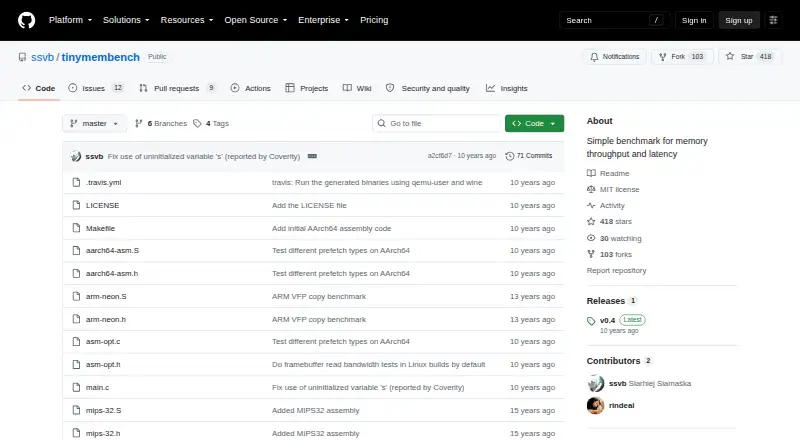
What tinymembench is
tinymembench is a free command-line program for measuring memory performance on Linux, Windows, and Android. It measures peak bandwidth during sequential memory access and latency during random memory access, and its workload areas also include framebuffer read performance. For bandwidth measurements, it runs different assembly code on aligned memory blocks and tries different prefetch strategies.
The public repository provides source code and a Makefile under the MIT License. Linux and Windows builds can be made with make; Windows builds use mingw32 and msys. Linux users can pass compiler optimization options through CFLAGS when running make. The README gives examples of cross-compiling for ARM on Linux with an ARM GNU compiler, and of building a static Android binary, transferring it to a device with adb, and running it there. A wiki page linked from the README contains benchmark results for some hardware. The repository includes an Issues section for project discussions and issue reports. GitHub identifies Siarhiej Siamaška as the maintainer. The MIT license provides the software “AS IS” without warranty of any kind.
Who it suits
tinymembench suits people who want a command-line tool to measure memory bandwidth or latency on Linux, Windows, or Android. It is also relevant to developers who want source code and build examples for ARM or Android.
What it does well
- Measures sequential-access memory bandwidth and random-access latency.
- Includes framebuffer read performance among its workload areas.
- Source code and a Makefile are publicly available.
- Supports Linux and Windows builds using make.
- README includes ARM cross-compilation and Android build examples.
- Distributed under the MIT License.
What to know first
- Uses a command-line interface.
- The MIT license provides the software without warranty.
- The stated Windows build route uses mingw32 and msys.
Limits
The software is provided under the MIT License “AS IS” without warranty of any kind.
Plans
| Plan | Billed and limits | Price |
|---|---|---|
| tinymembench | Simple memory benchmark program | Free |
As github.com lists them, read 11 Oct 2026. The maker's own page has the final word.
Getting started
- Open the tinymembench GitHub repository.
- For Linux or Windows, build the program by running make; Windows builds use mingw32 and msys.
- On Linux, optionally supply compiler optimization settings through CFLAGS when running make.
- For ARM on Linux, follow the README's cross-compilation example using an ARM GNU compiler.
- For Android, build the static binary, push it to a device with adb, and run it there.
Verdict
Choose tinymembench if you need a free command-line memory benchmark and are comfortable building or running command-line software. Look elsewhere if you require warranty coverage or a graphical interface.
Questions
How much does tinymembench cost?
The listed tinymembench plan costs nothing.
Which operating systems are supported?
The listed operating systems are Linux, Windows, and Android.
What does tinymembench measure?
It measures peak bandwidth for sequential memory accesses and latency for random memory accesses. Its workload areas also include framebuffer read performance.
Is tinymembench open source?
The public repository provides source code and a Makefile under the MIT License.
Does it have a command-line interface?
Yes. It is a command-line program.
Who maintains tinymembench?
GitHub identifies Siarhiej Siamaška as the maintainer.
Facts from tinymembench's own pages
- Android
- The README gives an example of cross-compiling a static binary and pushing it to an Android device with adb to run it. · github.com, 11 Oct 2026
- ARM
- The README gives an example of cross-compiling for ARM on Linux with an ARM GNU compiler. · github.com, 11 Oct 2026
- Bandwidth method
- It measures bandwidth by running different assembly code for aligned memory blocks and trying different prefetch strategies. · github.com, 11 Oct 2026
- Build
- The program can be compiled on Linux or Windows using mingw32 and msys by running make. · github.com, 11 Oct 2026
- CLI or automation
- Yes · github.com, 23 Sept 2026
- Distribution
- The repository is public and provides the source code and a Makefile. · github.com, 11 Oct 2026
- Free plan
- Yes · github.com, 23 Sept 2026
- License
- The repository provides the software under the MIT License. · github.com, 11 Oct 2026
- Maintainer
- The GitHub profile identifies the maintainer as Siarhiej Siamaška. · github.com, 11 Oct 2026
- Optimization
- On Linux, compiler optimization options can be supplied through CFLAGS when running make. · github.com, 11 Oct 2026
- Operating systems
- Linux; Windows; Android · github.com, 23 Sept 2026
- Purpose
- tinymembench measures peak bandwidth for sequential memory accesses and latency for random memory accesses. · github.com, 11 Oct 2026
- Results
- The project README points to a wiki page containing benchmark results for some hardware. · github.com, 11 Oct 2026
- Support
- The repository has an Issues section for reporting and discussing project issues. · github.com, 11 Oct 2026
- Warranty
- The MIT license states that the software is provided “AS IS” without warranty of any kind. · github.com, 11 Oct 2026
- Workload areas
- memory bandwidth; memory latency; framebuffer read performance · github.com, 23 Sept 2026
Where tinymembench stands on Freedom251
- PC Benchmark Software#40 of 73
- PC benchmark tools#45 of 70