Freedom251 › PC benchmark tools
sysbench
What sysbench is
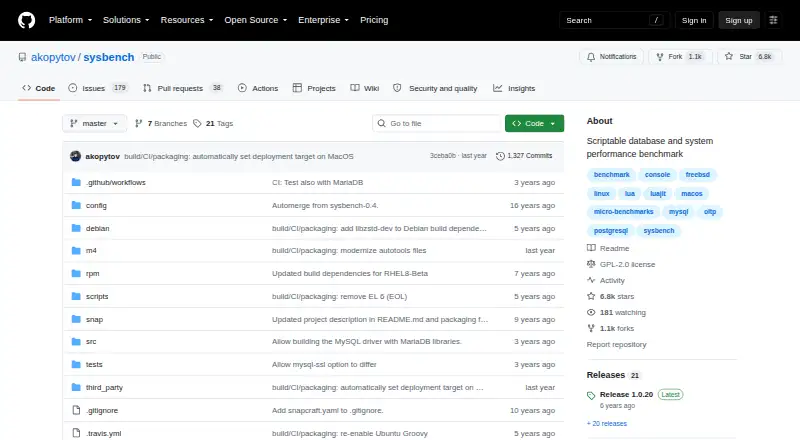
sysbench is a free, scriptable, multithreaded benchmark tool based on LuaJIT, commonly used for database benchmarking. Its bundled tests cover OLTP-like database workloads, filesystem I/O, CPU, memory, threads, and POSIX mutexes, and it can create complex workloads without a database server. Results include rates and latency measures such as percentiles and histograms. Users can write custom benchmarks in Lua by implementing predefined hooks; the executable can also run scripts as a general-purpose Lua interpreter. Command-line options set run-time or event limits, worker thread count, and average event rate. Build instructions describe MySQL support by default and PostgreSQL as an optional configuration. sysbench runs on Linux and macOS; Windows users are directed to Windows Subsystem for Linux because native Windows builds were dropped as of version 1.0. Linux package instructions cover x86_64, i386, and aarch64, and macOS packages are available through Homebrew. The project is licensed under GPL-2.0 and offers GitHub Issues for questions and bug reports.
Who it suits
sysbench suits users comfortable running command-line benchmarks and configuring scripts. It can serve database benchmarking needs or custom system workload tests on Linux and macOS.
What it does well
- Bundled workloads cover databases, filesystems, and system resources.
- Reports rates, latency percentiles, and histograms.
- Lua hooks allow custom benchmark creation.
- Free and licensed under GPL-2.0.
What to know first
- Native Windows builds are unsupported.
- Windows use requires Windows Subsystem for Linux.
- PostgreSQL support is an optional build configuration.
Limits
Windows users need Windows Subsystem for Linux because native Windows builds are unsupported. PostgreSQL support requires an optional build configuration.
Plans
| Plan | Billed and limits | Price |
|---|---|---|
| sysbench | Open-source benchmark tool · GPL-2.0 license | Free |
As github.com lists them, read 11 Oct 2026. The maker's own page has the final word.
Getting started
- Open the sysbench GitHub project page.
- On Linux, follow the package instructions for your distribution and architecture.
- On macOS, install the package through Homebrew.
- On Windows, use Windows Subsystem for Linux.
- Choose bundled tests or implement custom benchmark hooks in Lua.
Verdict
sysbench offers a broad set of built-in workloads alongside Lua-based customization and detailed rate and latency reporting. Windows users need to use Windows Subsystem for Linux rather than a native build.
Questions
Is sysbench free?
Yes. It has a free plan and is licensed under GPL-2.0.
Which workloads can it benchmark?
Bundled benchmarks cover OLTP-like database workloads, filesystem I/O, CPU, memory, threads, and POSIX mutexes. It can also create workloads that do not involve a database server.
Can I create custom benchmarks?
Yes. Users can implement predefined hooks in Lua scripts to create benchmarks.
Which operating systems can run sysbench?
It is available for Linux and macOS. Windows users are directed to Windows Subsystem for Linux because native Windows builds were dropped.
Which databases are supported?
Build instructions describe MySQL support by default and PostgreSQL as an optional build configuration.
Where can I get help?
The project provides GitHub Issues for questions and bug reports.
Facts from sysbench's own pages
- Bundled benchmarks
- Bundled benchmarks cover OLTP-like database workloads, filesystem I/O, CPU, memory, threads, and POSIX mutexes. · github.com, 11 Oct 2026
- CLI or automation
- Yes · github.com, 24 Sept 2026
- Concurrency
- The README says sysbench has low overhead with thousands of concurrent threads and can generate and track hundreds of millions of events per second. · github.com, 11 Oct 2026
- Custom benchmarks
- Users can create benchmarks by implementing predefined hooks in Lua scripts. · github.com, 11 Oct 2026
- Custom test profiles
- Yes · github.com, 24 Sept 2026
- Custom workloads
- Users can create benchmarks by implementing predefined hooks in Lua scripts. · github.com, 11 Oct 2026
- Database support
- Build instructions describe MySQL support by default and PostgreSQL support as an optional build configuration. · github.com, 11 Oct 2026
- Free plan
- Yes · github.com, 24 Sept 2026
- Intended users
- The README describes sysbench for database benchmarking and for building custom system workloads, so it is aimed at users who can run command-line benchmarks and configure scripts. · github.com, 11 Oct 2026
- License
- The repository lists the project under the GPL-2.0 license. · github.com, 11 Oct 2026
- Linux availability
- Linux packages are offered through package repositories for x86_64, i386, and aarch64, with installation instructions for Debian/Ubuntu, RHEL/CentOS, Fedora, and Arch Linux. · github.com, 11 Oct 2026
- Linux packages
- The README describes Linux binary packages for x86_64, i386, and aarch64, with installation instructions for Debian/Ubuntu, RHEL/CentOS, Fedora, and Arch Linux. · github.com, 11 Oct 2026
- Lua interpreter
- sysbench can also run as a general-purpose Lua interpreter for scripts using its executable in place of lua. · github.com, 11 Oct 2026
- macOS
- The README says current macOS packages are available through Homebrew. · github.com, 11 Oct 2026
- macOS availability
- The README directs macOS users to install the package through Homebrew. · github.com, 11 Oct 2026
- Operating systems
- Linux,macOS,Windows via Windows Subsystem for Linux · github.com, 24 Sept 2026
- Other workloads
- It can create complex workloads that do not involve a database server. · github.com, 11 Oct 2026
- Purpose
- sysbench is a scriptable, multithreaded benchmark tool based on LuaJIT, most often used for database benchmarks. · github.com, 11 Oct 2026
- Release status
- The releases page lists version 1.0.20 as the latest release. · github.com, 11 Oct 2026
- Release versioning
- The README says sysbench aims to follow Semantic Versioning as much as possible. · github.com, 11 Oct 2026
- Security
- GitHub reports that the project has no detected security policy and no published security advisories. · github.com, 11 Oct 2026
- Statistics
- It reports rate and latency statistics, including latency percentiles and histograms. · github.com, 11 Oct 2026
- Support
- The repository provides GitHub Issues for project questions and bug reports. · github.com, 11 Oct 2026
- Use and limits
- The command-line options allow limits on run time or total events, and set worker thread count and average event rate. · github.com, 11 Oct 2026
Where sysbench stands on Freedom251
- PC benchmark tools#7 of 70
- PC Benchmark Software#36 of 73