Freedom251 › IoT Edge Platforms

ThingsBoard
What ThingsBoard is
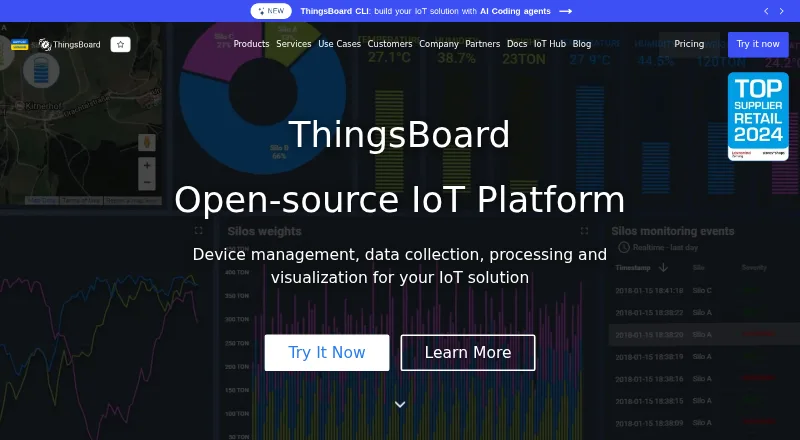
ThingsBoard is an IoT platform for managing devices and collecting, processing, and visualizing their data. Its real-time IoT and SCADA dashboards include more than 300 built-in widgets and support custom widgets. Native connectivity covers MQTT, CoAP, HTTP, LwM2M, and SNMP; an IoT Gateway adds protocols including Modbus, BACnet, CAN bus, BLE, and OPC-UA. Rule Engine nodes support data processing and platform customization. Integrations connect external services and gateways such as AWS IoT, Azure IoT Hub, Google Cloud Pub/Sub, LoRaWAN servers, MQTT brokers, and OPC-UA servers. Deployment choices include cloud, dedicated Private Cloud, and on-premises, including fully offline self-managed installations. Security options include two-factor authentication, OAuth 2.0/SSO, JWT tokens, API keys, and HTTPS/TLS configuration. The free cloud plan lists five devices, five assets, and one million data points per month; the listed Prototype Cloud plan is $39 a month. Cloud plans have device and data-point limits.
Who it suits
ThingsBoard suits IoT projects that need device connectivity, data processing, and visualization, from early setup through scaling. Its cloud, private cloud, on-premises, and offline deployment options serve different infrastructure needs.
What it does well
- Dashboards offer more than 300 built-in widgets.
- Supports native IoT protocols and gateway protocols.
- Can be deployed on-premises, including fully offline.
- Free cloud plan includes five devices and five assets.
- Security options include two-factor authentication and OAuth 2.0/SSO.
What to know first
- Free cloud plan is limited to five devices.
- Cloud plans have device and data-point limits.
- Paid subscriptions are required for Support Portal access.
Limits
The free ThingsBoard Cloud plan includes 5 devices, 5 assets, and 1M data points per month. The listed Prototype Cloud plan at $39/mo includes 50 devices, 50 assets, and 10M data points per month.
Plans
| Plan | Billed and limits | Price |
|---|---|---|
| Free | billed monthly · 5 devices · 5 assets · 1M data points/mo | Free |
| Prototype | billed monthly · 50 devices · 50 assets · 10M data points/mo | $49 a month |
| Pilot | billed monthly · 100 devices · 100 assets · 100M data points/mo | $149 a month |
| Startup | billed monthly · 500 devices · 500 assets · 500M data points/mo | $399 a month |
| Business | billed monthly · 1,000 devices · 1,000 assets · 1B data points/mo | $749 a month |
| Free (ThingsBoard Cloud) | monthly · 5 devices · 5 assets · 1M data points/month · community support | Free |
| Free (On-premises) | $0 /month · 100 devices · 100 assets · 1 production instance | Free |
| Pilot (ThingsBoard Cloud) | monthly · 100 devices · 100 assets · 1 production instance | $149 a month |
The first 8 of 20 plans, as thingsboard.io lists them, read 22 Sept 2026. The maker's own page has the final word. Every plan
Getting started
- Visit the ThingsBoard website.
- Choose a cloud, dedicated Private Cloud, or on-premises deployment.
- Select the free plan or review paid plans, which start at $49/mo.
- Connect devices using supported protocols or an IoT Gateway.
- Build dashboards with built-in or custom widgets.
ThingsBoard is a broad IoT platform for connecting and managing devices, processing their data, and building operational dashboards. It best suits teams with varied connectivity or deployment needs; its main trade-off is that cloud plans impose firm device and data-point ceilings.
Overview
Founded in 2016, ThingsBoard covers the path from device connectivity and data collection through server-side processing and visualization. Bringing those jobs together can suit projects that would otherwise need separate systems, though smaller, single-purpose deployments may not need the breadth.
Teams can choose ThingsBoard Cloud, dedicated Private Cloud, or on-premises deployment, including fully offline self-managed installations. That flexibility is valuable where hosting location or offline operation matters, but self-managed deployment is a different commitment from choosing a managed cloud plan.
Key features
Native connectivity covers MQTT, CoAP, HTTP, LwM2M, and SNMP. The IoT Gateway extends that range to protocols including Modbus, BACnet, CAN bus, BLE, and OPC-UA, which makes ThingsBoard a strong fit for mixed device fleets and industrial systems.
Real-time IoT and SCADA dashboards use more than 300 built-in widgets and support custom widgets. That breadth allows teams to shape operational views, rather than being limited to a small template set. A library of Rule Engine nodes supports data processing and platform customization, with real-time stream processing. Anomaly detection and machine-learning tools are also included.
Integrations connect external services and gateways such as AWS IoT, Azure IoT Hub, Google Cloud Pub/Sub, LoRaWAN servers, MQTT brokers, and OPC-UA servers. Security options include two-factor authentication, OAuth 2.0/SSO, JWT tokens, API keys, and HTTPS/TLS configuration. ThingsBoard Cloud uses infrastructure compliant with SOC II and ISO 27001 and offers North America or EU data regions.
Pricing
ThingsBoard uses a freemium model, with a free trial also offered. Cloud plans are governed by device and data-point quotas; additional entity and API-call packs can be purchased subject to plan rules. These caps make it important to size a project against both its device count and monthly data volume, not just its starting cost.
- Free: free, billed monthly, with 5 devices, 5 assets, and 1M data points/mo. It is suited to a small evaluation or pilot, but the low quotas constrain ongoing deployments.
- Prototype (ThingsBoard Cloud): $39 a month, billed $39 /month, with 50 devices, 50 assets, and 10M data points/mo. It raises the entry-level cloud limits for a small connected project.
- Prototype: $49 a month, billed monthly, with 50 devices, 50 assets, and 10M data points/mo.
- Pilot (On-premises): $99 a month, billed $99 /month, with 100 devices, 100 assets, and 1 production instance. It suits a modest self-managed deployment.
- Pilot (ThingsBoard Cloud): $99 a month, billed $99 /month, with 100 devices, 100 assets, and 100M data points/mo.
- Pilot: $149 a month, billed monthly, with 100 devices, 100 assets, and 100M data points/mo.
- Startup (ThingsBoard Cloud): $299 a month, billed $299 /month, with 500 devices, 500 assets, and 500M data points/mo.
- Startup (On-premises): $299 a month, billed $299 /month, with 500 devices, 500 assets, and 2 production instances.
- Startup: $399 a month, billed monthly, with 500 devices, 500 assets, and 500M data points/mo.
- Business: $749 a month, billed monthly, with 1,000 devices, 1,000 assets, and 1B data points/mo.
- Free (On-premises): free, billed $0 /month, with 100 devices, 100 assets, and 1 production instance. It offers a higher device ceiling than the free cloud option, for teams prepared to self-manage.
- Free (ThingsBoard Cloud): free, billed $0 /month, with 5 devices, 5 assets, and 1M data points/mo.
Paid subscriptions provide access to the ThingsBoard Support Portal, and Startup and Business include priority support. The published monthly prices make quota comparisons straightforward, but growing fleets may need higher plans or add-on packs.
Platforms
ThingsBoard supports Android, iOS, Linux, macOS, Windows, web, API, and self-hosted use. The combination of client platforms and self-managed deployment options accommodates teams with different operating environments.
Who it's for
ThingsBoard is best for IoT teams that need protocol range, real-time dashboards and processing, and a choice of managed, private, or self-managed deployment. Offline operation and the broad gateway protocol support are particular advantages for industrial or infrastructure projects. A small cloud project with few devices may find the entry caps restrictive as data volume grows.
Pros and cons
- Pros: Broad native and gateway protocol support helps connect heterogeneous fleets.
- Pros: More than 300 built-in widgets, custom widgets, and real-time SCADA visualization give teams substantial dashboard scope.
- Pros: Cloud, Private Cloud, and offline-capable on-premises deployment provide meaningful hosting flexibility.
- Cons: The free cloud plan is limited to 5 devices, 5 assets, and 1M data points/mo, so it is mainly suitable for evaluation or very small projects.
- Cons: Paid cloud tiers remain quota-based, requiring teams to track device and data-point growth.
Alternatives
Consider InfluxDB if its freemium model and pay-for-what-you-use Cloud Serverless option better fit a usage-based choice; it also has an InfluxDB 3 Core single-node plan.
TDengine is worth comparing if fully open-source TSDB software with clustering under the AGPL license is the priority.
Datacake may suit a smaller fleet: its free plan covers 5 devices and its Hobby plan covers up to 25 devices, with one year of data retention.
TagoIO offers a free plan with 5 devices and 5 dashboards, while its Starter plan provides 100 devices per profile.
Ubidots is an option for non-commercial projects through its free STEM plan, which covers 3 devices.
Zoho IoT is an alternative with a Standard plan covering 100 devices/assets, 240 M datapoints storage, and 12 months of data retention.
Losant Enterprise IoT Platform offers a Launch plan at $250 a month with 100,000 payloads per month and 90 days of data retention.
OpenRemote is another option to compare.
For broader comparisons, see IoT Analytics Software, IoT Device Management Platforms, and IoT Edge Platforms.
Verdict
Choose ThingsBoard when a project needs broad device connectivity, real-time processing and dashboards, and deployment control in one platform. Its protocol and hosting flexibility are compelling, but small cloud deployments should look elsewhere if the low device and data-point ceilings do not leave enough room to grow.
Verdict
ThingsBoard covers device connectivity, processing, dashboards, and multiple deployment models. Compare the device and data-point limits with your project needs, and note that paid subscriptions provide Support Portal access.
Questions
Is there a free plan?
Yes. The ThingsBoard Cloud free plan includes 5 devices, 5 assets, and 1M data points per month. A separate free on-premises plan includes 100 devices, 100 assets, and 1 production instance.
How much does ThingsBoard cost?
The listed ThingsBoard Cloud Prototype plan costs $39/mo. The general paid starting price is $49/mo; other listed plans include Pilot at $99/mo and Startup at $299/mo for ThingsBoard Cloud.
What platforms does ThingsBoard support?
Listed platforms include Android, iOS, Linux, macOS, Windows, web, API, and self-hosted.
Can ThingsBoard run on premises or offline?
Yes. Deployment options include on-premises installations, including fully offline self-managed setups, as well as cloud and dedicated Private Cloud.
Which protocols and integrations are supported?
Native connectivity includes MQTT, CoAP, HTTP, LwM2M, and SNMP. The IoT Gateway supports protocols including Modbus, BACnet, CAN bus, BLE, and OPC-UA; integrations include AWS IoT, Azure IoT Hub, Google Cloud Pub/Sub, LoRaWAN servers, MQTT brokers, and OPC-UA servers.
What security and support options are available?
Security options include two-factor authentication, OAuth 2.0/SSO, JWT tokens, API keys, and HTTPS/TLS configuration. Paid subscriptions provide access to the Support Portal, and Startup and Business plans include priority support.
Facts from ThingsBoard's own pages
- API
- REST, WebSocket, Entity Data Query, Alarm Query and MCP server APIs are documented, with an interactive Swagger interface and API-key authentication. · thingsboard.io, 14 Oct 2026
- App complaint
- An Apple App Store reviewer complains that iPhone options are too small or hidden and real-time/history settings cannot be adjusted. · apps.apple.com, 14 Oct 2026
- Cloud compliance
- ThingsBoard states its cloud infrastructure uses ISO 27001 and SOC II compliant facilities, with North American and EU data regions. · thingsboard.io, 14 Oct 2026
- Company headquarters
- The company lists 110 Duane Street, Suite 1C, New York, NY 10007 as its headquarters. · thingsboard.io, 14 Oct 2026
- Company history
- ThingsBoard says it began in 2016 with two co-founders and established ThingsBoard Inc. in 2018. · thingsboard.io, 14 Oct 2026
- Compliance and residency
- The maker states ThingsBoard Cloud is hosted on infrastructure compliant with SOC II and ISO 27001, and offers North America or EU data regions. · thingsboard.io, 29 Sept 2026
- Crunchbase legal name
- Crunchbase identifies the maker as ThingsBoard, Inc., a private for-profit company founded by Andrew Shvayka. · crunchbase.com, 14 Oct 2026
- Dashboards
- Dashboards provide responsive pages with charts, tables, maps, controls, aliases, time windows, actions, sharing and embedding. · thingsboard.io, 14 Oct 2026
- Deployment
- ThingsBoard offers cloud, dedicated Private Cloud, and on-premises deployments, including fully offline self-managed installations. · thingsboard.io, 29 Sept 2026
- Device connectivity
- The platform supports MQTT, Modbus, LoRaWAN, HTTP, OCPP, OPC-UA, CoAP, Sigfox, BACnet and S7 connectivity. · thingsboard.io, 14 Oct 2026
- Documentation
- Documentation covers connectivity guides, APIs and SDKs, dashboards, widgets, rule nodes, integrations, OTA, alarms, mobile and custom extensions. · thingsboard.io, 14 Oct 2026
- Edge operation
- ThingsBoard Edge runs platform functions locally, stores telemetry and continues dashboards and alarms during connectivity loss before synchronizing. · thingsboard.io, 14 Oct 2026
- Founded
- 2016 · thingsboard.io, 28 Sept 2026
- Free trial
- ThingsBoard Cloud offers a 30-day free trial, and the maker says no credit card is required to start. · thingsboard.io, 29 Sept 2026
- Gateway connectors
- The IoT Gateway supplies 15 built-in connectors including MQTT, Modbus, OPC-UA, BACnet, Siemens S7, REST, BLE, CAN, FTP, KNX, ODBC, OCPP, SNMP, Socket and XMPP. · thingsboard.io, 14 Oct 2026
- Integrations
- Documented integrations include AWS IoT, Azure IoT Hub, Google Pub/Sub, MQTT brokers, Kafka, OPC-UA and LoRaWAN network servers. · thingsboard.io, 14 Oct 2026
- Intended users
- The maker describes the platform as covering IoT projects from initial device connectivity through visualization, server-side processing, and scaling. · thingsboard.io, 29 Sept 2026
- Licence
- Version 4.4 and later use Business Source License 1.1 and are source-available rather than OSI open source; releases before 4.4 remain Apache 2.0. · thingsboard.io, 14 Oct 2026
- Limit: CoAP
- The CoAP integration documentation states that downlink support is currently unavailable. · thingsboard.io, 14 Oct 2026
- Limit: customization
- G2 reviewers report difficult widget creation, limited scripting options, non-customizable Professional reporting and missing input widgets. · g2.com, 14 Oct 2026
- Limit: developer automation
- A G2 reviewer reports no programmatic rule-chain creation or rule-chain unit testing. · g2.com, 14 Oct 2026
- Limit: learning curve
- G2 reviewers say the platform’s flexibility creates a steep learning curve for less technical users. · g2.com, 14 Oct 2026
- Limit: MicroPython
- A TrustRadius review identifies the absence of a MicroPython library for downlink data as a limitation. · tr-web.stage.trustradius.com, 14 Oct 2026
- Limit: queue durability
- The in-memory rule-engine queue is intended for single-node use and loses messages when the server restarts; Kafka is required for clustered durability. · thingsboard.io, 14 Oct 2026
Where ThingsBoard stands on Freedom251
- IoT Edge Platforms#2 of 9
- IoT Analytics Software#10 of 24
- IoT Device Management Platforms#8 of 18