Freedom251 › IoT Analytics Software
Ubidots
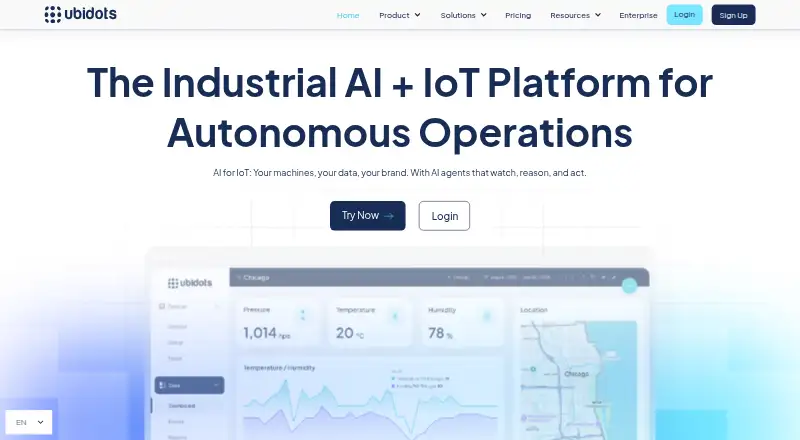
What Ubidots is
Ubidots is a platform for building applications that collect, process, display, and act on data from connected devices. Devices and machines can send information using MQTT or HTTP, and dashboards use widgets to show device data. Synthetic variables perform statistical or arithmetic calculations on raw values over a chosen time frame. Events can respond to variable conditions, inactive devices, or schedules and trigger email, SMS, voice calls, Slack messages, or webhooks. Plugins support connections such as AWS IoT, OpenWeather, and LoRaWAN, as well as custom cron, webhook, and widget plugins. Android and iOS apps show devices, historical data, web dashboards, event logs, and push notifications, but cannot create or edit dashboards. The standard app is for account owners and admins; end users need an on-demand white-labeled app. Ubidots lists a free STEM plan for non-commercial projects, with three devices, and Professional at $99 / month. A typical core-platform account starts with a free 30-day trial.
Who it suits
Ubidots suits system integrators and enterprise customers building IoT applications. Its free STEM plan is aimed at educational or personal non-commercial projects.
What it does well
- Accepts device data over MQTT or HTTP.
- Events can trigger several notification and action types.
- Plugins include AWS IoT, OpenWeather, and LoRaWAN.
- Free STEM plan includes three devices.
What to know first
- Mobile app cannot create or edit dashboards.
- End users need an on-demand white-labeled app.
- Professional is $99 / month.
Limits
The free STEM plan covers three devices and non-commercial projects. Professional is $99 per month and includes 50 devices, 10 million dots per month, six months of data retention, five organizations, and up to five end users. Each device includes up to 20 variables for billing; additional variables may be billed as additional devices.
Plans
| Plan | Billed and limits | Price |
|---|---|---|
| Ubidots STEM | Free · Non-commercial only · 3 devices · 1 dashboard · 10 variables/device · 1 month retention · 4,000 ingestion dots/day | Free |
| Professional | $99 / month · 50 devices · 10 million dots/month · 6 months retention · 5 organizations · 5 end users | $99 a month |
| Industrial | Custom · 1 to thousands of devices · 24 months retention · custom capacity · 20 dots/s throughput | On request |
| Enterprise | Custom · 1 to thousands of devices · over 24 months retention · private deployment · SSO · SLA options | On request |
As ubidots.com lists them, read 15 Oct 2026. The maker's own page has the final word.
Getting started
- Visit the Ubidots website.
- Choose STEM for a non-commercial project or review the paid plans.
- Begin the typical core-platform account's free 30-day trial if appropriate.
- Send device data using MQTT or HTTP.
- Use dashboards and widgets to view device data.
- Configure synthetic variables, events, or plugins as needed.
Overview
Ubidots is a full-stack IoT service for ingesting device readings, calculating derived values, visualizing them, and triggering operational responses. It fits system integrators and enterprise teams that want these stages in one hosted platform, while STEM targets educational and personal non-commercial work. Its integrated workflow is a strong reason to choose it; mobile-user restrictions and device-based billing can make other approaches preferable for wider audiences or unusual device schemas.
Key features
Devices and machines can publish data through MQTT or HTTP, giving projects two established ingestion paths. Widget-based dashboards turn those readings into views for operators and customers. Synthetic variables apply arithmetic and statistical operations across a selected time frame, so teams can derive useful indicators instead of displaying only raw telemetry.
Events can evaluate variable conditions, detect device inactivity, or run on schedules. They can send email, SMS, voice calls, Slack messages, or webhooks, covering both human escalation and system-to-system automation. Plugins connect AWS IoT, OpenWeather, and LoRaWAN, with custom cron, webhook, and widget plugins available when built-in connections do not fit.
Real-time stream processing, custom dashboards, anomaly detection, and machine-learning tools broaden its appeal beyond basic monitoring. Security capabilities include HTTPS with SSL, MQTT with TLS, token authentication, and token revocation. Infrastructure is hosted in AWS's us-east-2 (Ohio) data center; private deployment in another data center or cloud provider is offered on Enterprise tiers.
The iOS and Android apps show devices, historical variable data, web dashboards, event logs, and push notifications. They cannot create or edit dashboards, so administration remains a web task. Standard mobile access is for account owners and administrators; end users need an on-demand white-labeled app, an important limitation for customer-facing deployments.
Pricing
Ubidots uses a freemium model. A typical core-platform account starts with a free 30-day trial, allowing evaluation before a paid commitment. Billing counts each device with up to 20 variables; additional variables may be charged as additional devices, so a variable-heavy design can consume quota faster than its physical device count suggests.
Ubidots STEM
This plan is free (0.00 USD) for non-commercial projects and includes three devices. It is appropriate for classroom work, experiments, and personal prototypes, but the non-commercial condition and three-device ceiling rule it out for production or commercial deployments.
Professional
Professional costs $99 a month. It includes 50 devices, 10M dots per month, six months of data retention, five organizations, up to five end users, and community support. That package suits a small commercial rollout with moderate telemetry and a limited user group. The device, data-volume, retention, and seat caps are meaningful constraints for larger fleets or long-term historical analysis.
Industrial
Industrial has custom pricing and supports one to thousands of devices, custom capacity, 24 months of retention, and standard support. It is the logical step when Professional's quotas or community-only support are insufficient, but budgeting requires a quote.
Enterprise
Enterprise is also custom priced, with one to thousands of devices, custom capacity, more than 24 months of retention, private deployment, SSO, SLAs, and a technical account manager. Choose it when governance, contractual availability, or deployment location matters as much as telemetry features.
Platforms
Ubidots is available on web, Android, iOS, and through an API. The API and MQTT/HTTP ingestion support connected applications, while the mobile apps are mainly for viewing and operational follow-up rather than dashboard authoring.
Who it's for
System integrators and enterprise customers are the clearest audience: they can combine ingestion, calculations, dashboards, alerts, integrations, and security controls in one service. Professional fits a 50-device-or-smaller commercial deployment with up to five end users. STEM is suitable for non-commercial education and personal projects. Look elsewhere if end users must freely build dashboards in a mobile app, if private hosting is required below Enterprise, or if billing by device penalizes a design with many variables.
Pros and cons
Pros
- End-to-end IoT workflow: ingestion, derived variables, dashboards, events, and integrations are covered in one platform.
- Broad event delivery: email, SMS, voice, Slack, and webhooks support varied escalation paths.
- Flexible integration surface: AWS IoT, OpenWeather, LoRaWAN, and custom plugin types extend the core service.
- Enterprise controls: private deployment, SSO, SLAs, and a technical account manager are available on Enterprise.
Cons
- Mobile administration gap: dashboard creation and editing are unavailable in the iOS and Android apps.
- Restricted standard mobile audience: ordinary end users need a separate on-demand white-labeled app.
- Quota-sensitive billing: variables beyond 20 per device can be billed as additional devices.
- Professional limits: 50 devices, 10M dots monthly, six months of retention, and five end users may not suit expanding deployments.
Alternatives
ThingsBoard is worth choosing when you need Linux, macOS, Windows, or self-hosted options alongside web and mobile access; its Free plan covers five devices and 1M data points per month.
OpenRemote is a sensible alternative for a free, self-hosted IoT platform with community support.
Thinger.io suits projects seeking cloud tiers sized for 100 or 1,000 devices and substantial storage.
Arduino IDE is the better choice when the need is a free, open-source development environment rather than a hosted IoT application platform.
Datacake offers a five-device free tier and a 25-device Hobby plan priced at 25 EUR per month.
Kaa IoT Platform is an option for API, web, or self-hosted deployments, including a free five-device plan and a 99.00 USD monthly tier for up to 100 devices.
Losant Enterprise IoT Platform is aimed at teams comfortable with higher-priced plans, starting at $250 a month for 100,000 payloads and 90 days of retention.
Mender is preferable when the core requirement is Linux device over-the-air updating rather than dashboards and event automation.
For broader discovery, browse IoT Device Management Platforms and IoT Analytics Software.
Verdict
Choose Ubidots if you are building a commercial or enterprise IoT application that needs data ingestion, calculated metrics, dashboards, and automated actions together, with a path from a 30-day trial to enterprise controls. Choose another platform if mobile end users must author dashboards, if you need private deployment without Enterprise terms, or if device-and-variable billing and Professional's quotas do not match your fleet.
Verdict
Ubidots combines device data ingestion, calculations, dashboards, and event-driven actions. Check the mobile app limits and plan terms against your intended users and device count.
Questions
Is there a free plan?
Yes. Ubidots STEM is free for non-commercial projects and includes three devices.
How much does Ubidots cost?
Professional is $99 per month. Industrial and Enterprise have custom pricing.
Is there a free trial?
Yes. A typical core-platform account begins with a free 30-day trial.
Which platforms are supported?
Ubidots lists Android, iOS, web, and API platforms.
Can devices send data over MQTT?
Yes. Devices and machines can send data using MQTT or HTTP.
What can the mobile apps do?
They show devices, historical variable data, web dashboards, event logs, and push notifications. Dashboard creation and editing are unavailable in the app.
Facts from Ubidots's own pages
- Alerts and actions
- Events can respond to variable conditions, device inactivity, or schedules and trigger actions such as email, SMS, voice calls, Slack messages, or webhooks. · help.ubidots.com, 30 Sept 2026
- Android app downloads
- Google Play shows the Ubidots IoT app with 5K+ downloads and an April 1, 2026 update. · play.google.com, 15 Oct 2026
- API
- The REST API uses versioned endpoints and token authentication, with tokens revocable or expiring after six hours when API-created and unused. · help.ubidots.com, 15 Oct 2026
- Company founded
- LinkedIn lists Ubidots as founded in 2013. · linkedin.com, 15 Oct 2026
- Company headquarters
- LinkedIn lists headquarters in Medellín, Antioquia, Colombia. · linkedin.com, 15 Oct 2026
- Company size
- LinkedIn lists 11–50 employees and identifies the company as privately held. · linkedin.com, 15 Oct 2026
- Core licence
- The hosted Ubidots service and underlying software are proprietary under its terms of service. · ubidots.com, 15 Oct 2026
- Customers
- Ubidots describes its platform as serving system integrators and enterprise customers, and offers STEM for educational or personal non-commercial projects. · ubidots.com, 30 Sept 2026
- Dashboards
- The platform provides customizable real-time dashboards and more than 20 widget types. · ubidots.com, 15 Oct 2026
- Data aggregation
- Data aggregation transforms raw telemetry into trend-oriented insights. · ubidots.com, 15 Oct 2026
- Data processing
- Synthetic variables can calculate insights from raw data, including statistical and arithmetic operations over a time frame. · help.ubidots.com, 30 Sept 2026
- Developer tooling
- The public GitHub organization lists a Python client, CLI, MCP server, Node-RED node and device libraries. · github.com, 15 Oct 2026
- Device billing
- For billing, each device includes up to 20 variables; additional variables may be billed as additional devices. · help.ubidots.com, 30 Sept 2026
- Device management
- Devices group time-series variables, with a stated soft limit of 20 variables per device. · help.ubidots.com, 15 Oct 2026
- Documentation depth
- Documentation covers REST APIs, MQTT/HTTP/TCP/UDP interfaces, device libraries, examples, plugins and a help center. · ubidots.com, 15 Oct 2026
- Fleet management
- Device Groups and Device Types support bulk operations, standardized configurations and fleet onboarding. · ubidots.com, 15 Oct 2026
- Funding
- Crunchbase lists Ubidots as seed-funded and records funding rounds in 2013 and 2016, with amounts obscured on the page. · crunchbase.com, 15 Oct 2026
- Google Tag Manager integration
- Google Tag Manager can be used with Ubidots alongside HubSpot or Intercom support widgets. · ubidots.com, 15 Oct 2026
- Hosting
- Self-service accounts are hosted by default in AWS Ohio, with private deployments available on AWS, GCP, IBM or Azure. · ubidots.com, 15 Oct 2026
- Integrations
- Ubidots documents Zapier connections to Google Sheets, Slack, Twilio, Gmail and social-media workflows. · help.ubidots.com, 15 Oct 2026
- Legal name
- Crunchbase identifies the legal name as Connected World Company LLC and also lists IoT Services Inc. as an alternate name. · crunchbase.com, 15 Oct 2026
- Limit: integration gaps
- A G2 reviewer reported difficulty getting LoRaWAN devices working and pushing data to Databricks. · g2.com, 15 Oct 2026
- Limit: learning curve
- A reviewer says the broad feature set creates an initial learning curve and that some functions are not immediately intuitive. · capterra.com, 15 Oct 2026
- Limit: lower-tier features
- A reviewer reports that advanced features are restricted on lower-tier plans. · capterra.com, 15 Oct 2026
Where Ubidots stands on Freedom251
- IoT Analytics Software#11 of 24
- IoT Device Management Platforms#10 of 18