Freedom251 › IoT Edge Platforms
EdgeX Foundry
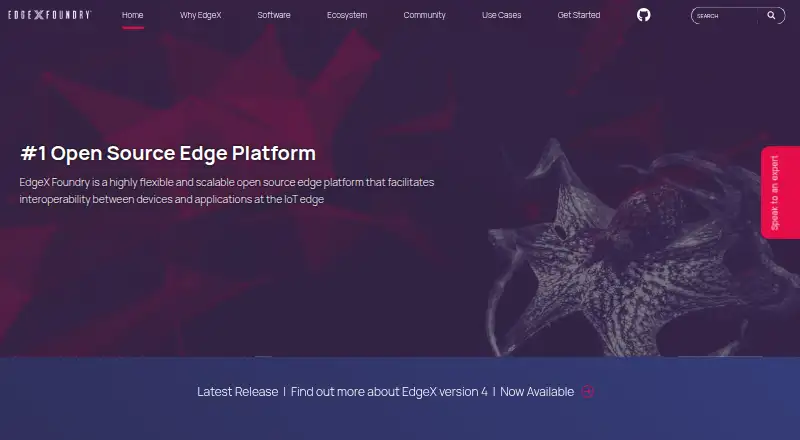
What EdgeX Foundry is
EdgeX Foundry is a free, open-source edge platform for connecting IoT devices with applications across vendors. Device services translate sensor and device data into a common EdgeX structure, and can translate commands back into device protocols. Local rules and application services can process data at the edge before it is sent to cloud or other external systems.
Its modular, plug-and-play microservices architecture includes documented device services for MQTT, Modbus, BACnet, REST, ONVIF, OPC UA, BLE, and SNMP. Developers can build device connectors with the Device Service SDK and processing pipelines with the Application Functions SDK. Security documentation covers a secret store, API gateway, microservice authentication, and secure MessageBus. Deployment options include a Docker quick start and native build instructions. EdgeX 4.0 is identified as an LTS release, uses PostgreSQL by default, and may not be backward compatible with the previous 3.x series. Redis is no longer delivered with it, though users may choose Redis or Valkey.
Who it suits
EdgeX Foundry suits teams connecting IoT devices and applications, and developers building device connectors or data-processing pipelines. The project describes separate getting-started paths for users, developers, device service developers, and application service developers.
What it does well
- Open-source and free.
- Processes data locally before external transfer.
- Documented device services cover multiple protocols.
- SDKs support connectors and processing pipelines.
- Offers Docker quick start and native build instructions.
What to know first
- EdgeX 4.0 may not be backward compatible with 3.x.
- Redis is no longer delivered with EdgeX 4.0.
- PostgreSQL is the default database in EdgeX 4.0.
Getting started
- Visit the EdgeX Foundry website.
- Choose the getting-started path for users, developers, device service developers or application service developers.
- Use the Docker quick start or follow the instructions to build and run EdgeX natively on your operating system.
- Select device services for your devices and protocols.
- Use the SDKs to create connectors or data processing pipelines as needed.
EdgeX Foundry is a free, vendor-neutral open-source platform for connecting IoT devices and applications. It is best suited to teams that need to integrate varied devices and build their own edge-processing services. Its modular architecture offers flexibility, but choosing it means taking responsibility for deployment and planning carefully around the 4.0 upgrade.
Overview
EdgeX connects device protocols to applications through services that translate device data into a common structure and can translate commands back to device protocols. Teams can run local rules on edge data before sending it to the cloud, which suits deployments that need processing close to devices. That flexibility comes with operational work: teams must assemble and run the services their deployment needs.
Key features
Modular connectivity
Its plug-and-play microservices let teams shape a deployment around their devices and processing needs. Device services cover protocols including MQTT, Modbus, BACnet, REST, ONVIF, OPC UA, BLE and SNMP. This breadth is useful across mixed device environments, but protocol support still requires teams to configure and operate the relevant services.
Custom services and local processing
The Device Service SDK lets developers create connectors, while the Application Functions SDK supports data-processing pipelines. Application services process data locally before passing it to external systems. This is a strong fit for teams with development capacity and specific integration requirements; it is less attractive when a ready-made, managed workflow is the priority.
Security and deployment
Security documentation covers a secret store, API gateway, microservice authentication and secure MessageBus. A Docker quick start and native build-and-run instructions give teams deployment options, while the project provides distinct starting paths for users and service developers. The project also directs visitors to experts and products and services from LF Edge member companies for support.
Version and database considerations
EdgeX 4.0 is an LTS release, but may not be backward compatible with the prior 3.x series. It also changes the default database to PostgreSQL and no longer delivers Redis, although users may choose Redis or Valkey. Teams upgrading from 3.x should account for both compatibility and database changes before adopting 4.0.
Pricing
EdgeX Foundry is free, with a free plan and no free trial. There are no paid tiers or published usage caps in its pricing model. The trade-off is that teams take on the work of deploying and maintaining the platform and its services.
Platforms
EdgeX supports API, Linux, macOS, self-hosted and Windows environments. Docker quick-start and native operating-system instructions provide deployment routes for teams choosing how to run it.
Who it's for
EdgeX suits developers and organizations building custom IoT integrations, especially where devices use different protocols or data must be processed locally. Its SDKs and microservices make it adaptable for teams able to operate a self-hosted platform. It is a weaker fit for teams seeking a turnkey managed service or an upgrade path with assured compatibility between major series.
Pros and cons
Pros
- Free and open source, making it viable to build and run without a software-plan charge.
- Broad documented device-service protocol coverage helps connect varied equipment through a common data structure.
- Local rules and application services support edge processing before data leaves the deployment.
- SDKs and modular microservices let developers extend connectors and processing pipelines.
Cons
- Teams must select, deploy and operate the services their implementation needs.
- EdgeX 4.0 may not be backward compatible with 3.x, requiring upgrade planning.
- PostgreSQL becomes the default in 4.0, and Redis is no longer delivered, which may require database changes for existing deployments.
Alternatives
IoT Edge Platforms is a useful starting point for comparing the category. Choose ThingsBoard instead if a freemium offering with a free tier, trial and a published 5-device, 5-asset and 1M-data-points-per-month cap better fits your evaluation. Mender is a better match when the priority is open-source over-the-air updates, with a free tier and a paid Basic plan capped at 50 devices.
Consider Siemens Opcenter instead for order management, track and trace, and non-conformance management across SaaS, VPC or on-premises options. KubeEdge is another free, Linux-based alternative. ZEDEDA Edge Intelligence Platform, Fogwing Edge and Wind River Studio are paid alternatives. AWS IoT Greengrass is a paid option for Linux and Windows; its pay-as-you-go plan charges $0.16 a month for each active Core device, with the first three Core devices per month included for one year under the Free Tier.
Verdict
Choose EdgeX Foundry if your team needs a free, extensible way to connect heterogeneous IoT devices and process data locally, and can manage a self-hosted microservices platform. Look elsewhere if you need a turnkey service or cannot accommodate the potential 4.0 compatibility break and database change.
Verdict
EdgeX Foundry provides a modular way to connect IoT devices and process their data at the edge. Teams considering EdgeX 4.0 should note its possible incompatibility with the prior 3.x series and its changed database defaults.
Questions
Does EdgeX Foundry cost anything?
It is free and open source, and the site lists a free plan.
What platforms does EdgeX Foundry support?
The listed platforms are API, Linux, macOS, self-hosted and Windows.
Does it offer a free trial?
No, the listed facts say there is no free trial.
Which protocols do its device services cover?
Documented protocols include MQTT, Modbus, BACnet, REST, ONVIF, OPC UA, BLE and SNMP.
What database does EdgeX 4.0 use?
PostgreSQL is the default database. Redis is no longer delivered with EdgeX, though users may choose Redis or Valkey.
What is the compatibility status of EdgeX 4.0?
The project identifies 4.0 as an LTS release and says it may not be backward compatible with the prior 3.x series.
Facts from EdgeX Foundry's own pages
- Architecture
- EdgeX uses a modular, plug-and-play microservices architecture. · edgexfoundry.org, 4 Oct 2026
- Database
- EdgeX 4.0 makes PostgreSQL the default database; Redis is no longer delivered with EdgeX, though users may choose to use Redis or Valkey. · edgexfoundry.org, 4 Oct 2026
- Data processing
- Application services support local data processing before data is sent to external systems. · edgexfoundry.org, 4 Oct 2026
- Device connectivity
- Device services connect sensors and devices, translate their data into a common EdgeX structure, and can translate commands back to device protocols. · docs.edgexfoundry.org, 4 Oct 2026
- Download and deployment
- The project offers a Docker quick start and instructions to build and run EdgeX natively on an operating system. · docs.edgexfoundry.org, 4 Oct 2026
- Edge processing
- The platform connects devices and runs local rules on edge data before sending data to the cloud. · edgexfoundry.org, 4 Oct 2026
- Extensibility
- Developers can use the Device Service SDK to create device connectors and the Application Functions SDK to create data processing pipelines. · edgexfoundry.org, 4 Oct 2026
- Intended users
- The project describes user, developer, device service developer, and application service developer paths for getting started. · edgexfoundry.org, 4 Oct 2026
- Latest release
- The site identifies EdgeX 4.0 as an LTS release and says it may not be backward compatible with the previous 3.x series. · edgexfoundry.org, 4 Oct 2026
- Protocols
- The documentation lists device services for protocols including MQTT, Modbus, BACnet, REST, ONVIF, OPC UA, BLE, and SNMP. · edgexfoundry.org, 4 Oct 2026
- Security
- EdgeX security documentation covers a secret store, API gateway, microservice authentication, and secure MessageBus. · docs.edgexfoundry.org, 4 Oct 2026
- Support
- The site directs visitors to speak to an expert and points users to EdgeX products and services from LF Edge member companies. · edgexfoundry.org, 4 Oct 2026
- What it does
- EdgeX Foundry is a vendor-neutral, open-source edge platform for interoperability between IoT devices and applications. · edgexfoundry.org, 4 Oct 2026
Where EdgeX Foundry stands on Freedom251
- IoT Edge Platforms#1 of 9