Freedom251 › Platform Engineering Software

Terrateam
What Terrateam is
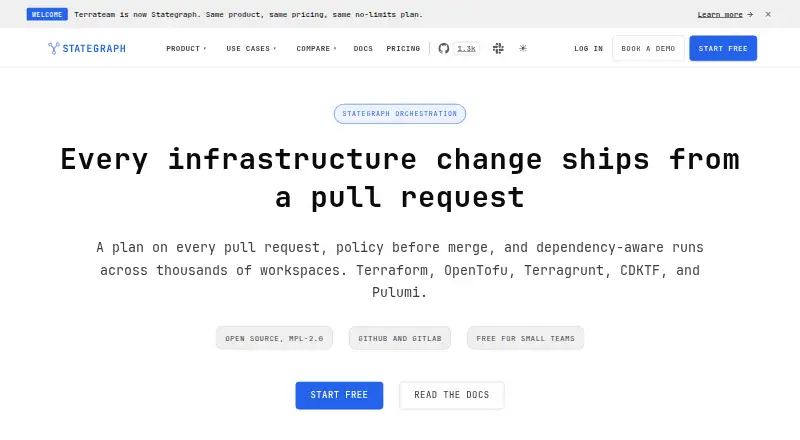
Terrateam’s orchestration engine continues as Stategraph Orchestration, which plans infrastructure changes from pull requests. It supports Terraform, OpenTofu, Terragrunt, CDKTF, and Pulumi. For each pull request, the product creates a plan and posts the result as a comment; changes can be applied on merge or by comment. Apply requirements can include Checkov, Conftest, OPA, or custom checks, and a failing check can open an approval gate. Drift schedules can run hourly through monthly, use tag queries, and open an issue or reconcile drift. Deployment options include hosted Stategraph Cloud, self-hosted, or BYOC in AWS, GCP, or Azure. Plans and applies run on customer GitHub Actions or GitLab CI runners, so cloud credentials stay there. The Free plan lists GitHub and GitLab support. Free and Open Source plans include community support; Orchestration Pro adds priority email and Slack support. Orchestration Pro costs $12,000 a year, billed annually. The security page describes SAML 2.0 and OIDC single sign-on, scoped access tokens, an immutable transaction timeline, PostgreSQL encryption at rest, and TLS in transit.
Who it suits
Terrateam may suit teams managing infrastructure changes through pull requests with Terraform or other supported IaC tools. Its hosted, self-hosted, and BYOC options offer different deployment paths.
What it does well
- Supports five listed infrastructure-as-code tools.
- Plans and applies run on customer CI runners.
- Drift schedules range from hourly to monthly.
- Free and Open Source plans include community support.
What to know first
- Free plan lists three users and 50 runs per month.
- Free plan has one concurrent worker.
- Orchestration Pro costs $12,000 a year, billed annually.
- Infrastructure as a Database starts at $25,000 a year.
Limits
The Free plan includes 3 users, 50 runs per month, 1 concurrent worker, and 30-day audit retention. Open Source is limited to up to 3 active users a month per GitHub or GitLab installation. Orchestration Pro costs $1,000 a month billed annually and includes unlimited users, runs, and concurrent workers with 365-day audit retention.
Plans
| Plan | Billed and limits | Price |
|---|---|---|
| Free | $0 forever · 3 users · 50 runs/month · 1 concurrent worker · 30-day audit retention · Community support | Free |
| Open Source | $0 forever · MPL-2.0 · Up to 3 active users a month per GitHub or GitLab installation · Unlimited runs and concurrent workers · Community support | Free |
| Orchestration Pro | $12,000 / year; $1,000 a month, billed annually. · Unlimited users, runs, and concurrent workers · 365-day audit retention · Priority email and Slack support · Onboarding session | $12,000 a year |
| Infrastructure as a Database | $25,000 / year; starting price, annual contract. · Single-tenant with isolated Postgres · Dedicated support and custom SLA | $25,000 a year |
As terrateam.io lists them, read 7 Oct 2026. The maker's own page has the final word.
Getting started
- Visit the Terrateam website.
- Choose hosted Stategraph Cloud, self-hosted deployment, or BYOC in AWS, Google Cloud, or Azure.
- Connect GitHub or GitLab for the Free plan.
- Run plans and applies on your GitHub Actions or GitLab CI runners.
- Choose the Free, Open Source, Orchestration Pro, or Infrastructure as a Database plan.
Terrateam is an infrastructure orchestration engine built around pull requests, policy gates, and drift response. It suits teams managing Terraform or related tools through GitHub or GitLab that want execution to remain in their own CI environment. The strongest case is a controlled, multi-tool workflow; the main reservation is the steep jump from limited free tiers to a $12,000 annual Pro plan.
Overview
Terrateam’s engine, now continuing as Stategraph Orchestration, turns infrastructure changes into reviewable pull-request work. It creates a plan for each pull request and posts that plan as a comment, then permits an apply when the request is merged or when an authorized comment triggers it. That keeps proposed and executed changes close to the code review process, but makes a pull-request-centered workflow a poor fit for teams that primarily operate outside Git hosting.
The orchestration layer covers Terraform, OpenTofu, Terragrunt, CDKTF, and Pulumi. Teams can run it as hosted Stategraph Cloud, self-host it, or deploy it in their own AWS, Google Cloud, or Azure account through BYOC. Plans and applies execute on the customer’s GitHub Actions or GitLab CI runners, so cloud credentials remain in that customer-controlled environment rather than being handed to the service.
Key features
Plans, approvals, and policies
Apply requirements can invoke Checkov, Conftest, OPA, or custom checks. A failed check can open an approval gate, giving platform teams a practical way to stop non-compliant changes before execution. This is more useful than a simple pass/fail report when several groups share responsibility for infrastructure, although it adds process that may be unnecessary for a small project.
Drift handling
Drift schedules run from hourly to monthly and can be narrowed with tag queries. When drift is found, Terrateam can open an issue or reconcile it. That range supports different operating rhythms for critical and lower-risk resources, while the choice between ticketing and automatic reconciliation lets teams balance visibility against intervention.
Security and operations
Security controls include SAML 2.0 and OIDC single sign-on, capability-scoped access tokens, and an immutable transaction timeline. PostgreSQL data is encrypted at rest and connections use TLS in transit. The product’s security page said it was pursuing SOC 2 Type II certification when last updated on 7 November 2024; organizations requiring a completed certification should verify its current status before procurement.
Pricing
Terrateam uses a freemium model with a 30-day trial for paid use. The Free plan costs $0 forever and allows 3 users, 50 runs per month, one concurrent worker, 30-day audit retention, and community support. It is a sensible evaluation tier or fit for a small team with modest change volume, but the run and user caps will constrain growing environments.
Open Source is also $0 forever under the MPL-2.0 license. It allows up to 3 active users per month for each GitHub or GitLab installation, with unlimited runs and concurrent workers, plus community support. That removes the execution quotas, but the active-user limit and self-managed open-source model make it better for organizations comfortable operating the software themselves than for broad internal adoption.
Orchestration Pro costs $12,000 per year, equivalent to $1,000 per month billed annually. It adds unlimited users, runs, and concurrent workers, 365-day audit retention, priority support by email and Slack, and an onboarding session. This is the tier for established platform teams that need scale and vendor assistance; the annual commitment is substantial for smaller deployments.
Infrastructure as a Database starts at $25,000 per year on an annual contract. It provides a single-tenant deployment with isolated Postgres, dedicated support, and a custom SLA. Organizations with isolation and contractual support requirements should consider it; others are likely paying for guarantees they do not need.
Platforms
Terrateam is offered through an API and web interface, with Linux and self-hosted deployment options. Self-hosted execution and BYOC support teams that need infrastructure control, while hosted Stategraph Cloud reduces deployment responsibility. GitHub and GitLab are the supported Git hosts named for the Free plan.
Who it's for
Terrateam is a strong match for platform engineering groups standardizing infrastructure changes across several IaC tools, especially where policy approval and drift response are operational requirements. It also suits security-conscious teams that want credentials to stay on their own CI runners and need SSO or an auditable transaction history.
It is less suitable for an individual operator, a team without GitHub or GitLab workflows, or a small deployment likely to exceed 50 monthly runs but unable to justify the Pro commitment. The Open Source tier can bridge that gap when self-management is acceptable.
Pros and cons
Pros
- Pull-request execution: Plans, comments, and merge- or comment-based applies keep infrastructure review and delivery in one workflow.
- Broad IaC coverage: Terraform, OpenTofu, Terragrunt, CDKTF, and Pulumi support reduces the need for separate orchestration patterns.
- Flexible drift response: Hourly-to-monthly schedules, tag scoping, issue creation, and reconciliation support different risk profiles.
- Credential control: Customer GitHub Actions or GitLab CI runners execute plans and applies, keeping cloud credentials in the customer environment.
Cons
- Free-tier ceilings: Three users, 50 monthly runs, one worker, and short audit retention limit the Free plan.
- Large paid commitment: Pro requires $12,000 annually, even though its monthly equivalent is $1,000.
- Community-only lower tiers: Free and Open Source plans do not include priority email or Slack support.
- Git-centric operation: Teams that do not manage changes through GitHub or GitLab will get less value from the workflow.
Alternatives
Terraform is the more direct choice when you need an infrastructure-as-code tool itself, with a free tier covering 500 managed resources and one concurrent remote run rather than Terrateam’s orchestration focus.
Choose KubeVela for a free, Apache-2.0 self-hosted Kubernetes control plane.
Northflank fits teams seeking an application platform with a free Sandbox for two services, one database, and two cron jobs.
Pulumi is preferable when Pulumi itself is the primary workflow; its Free plan supports one user and unlimited projects, stacks, environments, updates, and history, with a workflow-minute allowance.
Backstage is the alternative for a free, self-hosted developer portal framework.
Cycloid suits teams wanting a SaaS orchestration platform with a free tier for up to five users and one workspace.
Upbound is another infrastructure platform option with a free Community tier.
VMware Workstation Pro is a free desktop virtualization product for Windows or Linux hosts, not an infrastructure pull-request orchestrator.
For broader category browsing, see Platform Engineering Software and Infrastructure as Code Tools.
Verdict
Choose Terrateam if your platform team wants pull-request plans, enforceable policy gates, scheduled drift handling, and customer-controlled CI execution across multiple IaC tools. Its free tiers provide credible ways to start, while Pro supplies the scale and support larger organizations need. Look elsewhere if you need a non-Git workflow, a simple standalone IaC tool, or cannot commit to the $12,000 annual Pro price.
Verdict
Terrateam brings pull-request planning, policy checks, and drift handling together for supported infrastructure tools. The free plans include usage limits, while Orchestration Pro is an annual paid option.
Questions
Does Terrateam have a free plan?
Yes. The Free plan costs $0 forever and includes 3 users, 50 runs per month, 1 concurrent worker, and 30-day audit retention.
How much does Orchestration Pro cost?
It costs $12,000 per year, billed annually, or $1,000 a month on an annual billing basis.
Which infrastructure tools does it support?
It supports Terraform, OpenTofu, Terragrunt, CDKTF, and Pulumi.
Can Terrateam be self-hosted?
Yes. It is available as hosted Stategraph Cloud, self-hosted, or BYOC in AWS, Google Cloud, or Azure.
Which Git providers are supported on the Free plan?
The Free plan lists GitHub and GitLab support.
Facts from Terrateam's own pages
- Company history
- The company says Terrateam’s first commit was in 2021 and its engine became open source under MPL-2.0 in 2024. · stategraph.com, 7 Oct 2026
- Deployment options
- The product is available as hosted Stategraph Cloud, self-hosted, or BYOC in an AWS, GCP, or Azure account. · stategraph.com, 7 Oct 2026
- Drift detection
- Drift schedules can run hourly through monthly, can be scoped by tag query, and can open an issue or reconcile drift. · stategraph.com, 7 Oct 2026
- Encryption
- The security page says PostgreSQL data is encrypted at rest and connections use TLS in transit. · stategraph.com, 7 Oct 2026
- Founded
- 2021 · terrateam.io, 28 Sept 2026
- Git hosting
- The Free plan lists GitHub and GitLab support. · stategraph.com, 7 Oct 2026
- Policy and approvals
- Apply requirements can include Checkov, Conftest, OPA, or custom checks, and failing checks can open an approval gate. · stategraph.com, 7 Oct 2026
- Previous Terrateam security statement
- Terrateam’s security page says it was in the process of obtaining SOC 2 Type II certification when that page was last updated on 7 November 2024. · terrateam.io, 7 Oct 2026
- Product scope
- Terrateam’s orchestration engine continues as Stategraph Orchestration, which plans infrastructure changes from pull requests. · stategraph.com, 7 Oct 2026
- Pull request workflows
- The product creates a plan for each pull request and posts the result as a comment, with apply available on merge or by comment. · stategraph.com, 7 Oct 2026
- Runner and credentials
- Plans and applies run on the customer’s GitHub Actions or GitLab CI runners so cloud credentials stay there. · stategraph.com, 7 Oct 2026
- Security controls
- The security page describes SAML 2.0 and OIDC single sign-on, capability-scoped access tokens, and an immutable transaction timeline. · stategraph.com, 7 Oct 2026
- Support
- The Free and Open Source plans include community support, while Pro includes priority support by email and Slack. · stategraph.com, 7 Oct 2026
- Supported IaC tools
- Orchestration supports Terraform, OpenTofu, Terragrunt, CDKTF, and Pulumi. · stategraph.com, 7 Oct 2026
Where Terrateam stands on Freedom251
- Platform Engineering Software#14 of 31
- Infrastructure as Code Tools#18 of 31