Freedom251 › Local Kubernetes Tools
Talos Linux
What Talos Linux is
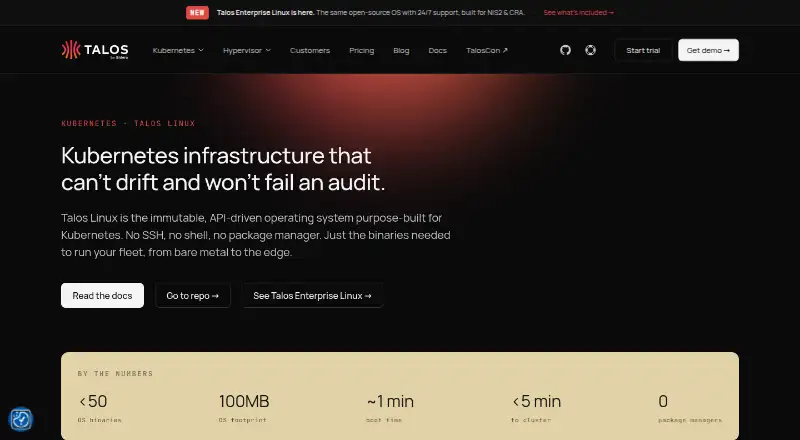
Talos Linux is an immutable, API-driven operating system purpose-built for Kubernetes. It has no SSH, shell, or package manager; node interaction instead uses a secured gRPC API with mutual TLS. The system has a 100MB footprint and fewer than 50 binaries. Machine state is declared in configuration, and operating system and Kubernetes upgrades are delivered together as an atomic image with rollback safety. Security capabilities include CIS hardening, mutual TLS, SELinux, and trusted boot. Talos runs on cloud platforms, bare metal, virtualized platforms, single-board computers, and local Docker or QEMU environments, on amd64 and arm64 architectures. The operating system is free and open source under MPL-2.0 and does not collect telemetry. Talos Omni manages provisioning, upgrades, configuration, and backups across clusters, with SaaS and self-hosted options. The free Talos Linux plan includes community support. Talos Enterprise Linux costs $1,000 a year, billed per node, with a 10-node minimum; Omni, 24/7/365 support, and FIPS 140-3 builds are included. Sidero also lists support with SLA-backed response times, Kubernetes control-plane coverage, and guidance for Cilium, MetalLB, and Rook-Ceph.
Who it suits
Talos suits teams running Kubernetes across cloud, bare-metal, edge, homelab, or regulated and air-gapped environments. It also supports single-board computers and local Docker or QEMU environments.
What it does well
- Free and open source under MPL-2.0.
- No telemetry collection by the operating system.
- Atomic, rollback-safe operating system and Kubernetes upgrades.
- Runs across cloud, bare metal, virtualized, and local environments.
What to know first
- No SSH, shell, or package manager.
- Enterprise plan has a 10-node minimum.
- Enterprise pricing is $1,000 a year, billed per node.
Limits
The free plan includes community support. Talos Enterprise Linux has a 10-node minimum and costs $1,000 per node per year.
Plans
| Plan | Billed and limits | Price |
|---|---|---|
| Talos Linux | Free, forever · Open source · MPL-2.0 · Community support | Free |
| Talos Enterprise Linux | $1,000 per node per year · 10-node minimum · Omni included · 24/7/365 support · FIPS 140-3 builds | $1,000 a year |
As siderolabs.com lists them, read 30 Sept 2026. The maker's own page has the final word.
Getting started
- Visit the Talos Linux website.
- Choose the free Talos Linux plan or Talos Enterprise Linux.
- Select a supported deployment environment, such as cloud, bare metal, or local Docker or QEMU.
- Use talosctl from Linux, macOS, or Windows to interact with Talos nodes.
- Configure machine state and Kubernetes component image versions.
Verdict
Talos Linux offers Kubernetes-focused node management through a secured API and a declarative lifecycle. Its lack of SSH, shell, and package manager is a defining operational constraint; enterprise support requires a 10-node minimum.
Questions
Is Talos Linux free?
Yes. The Talos Linux plan is free and is open source under the Mozilla Public License 2.0.
What does Talos Enterprise Linux cost?
It costs $1,000 a year, billed at $1,000 per node per year, with a 10-node minimum.
Which platforms does Talos support?
Talos runs on cloud, bare-metal, virtualized, single-board-computer, local Docker, and local QEMU environments. talosctl is supported on Linux, macOS, and Windows.
Is Talos open source?
Yes. Talos Linux is free and open source under the Mozilla Public License 2.0.
What does Talos Omni do?
Talos Omni manages provisioning, upgrades, configuration, and backups across clusters. It is available as SaaS or self-hosted.
What support comes with the Enterprise plan?
The plan includes 24/7/365 support, SLA-backed response times, Kubernetes control-plane coverage, and guidance for Cilium, MetalLB, and Rook-Ceph.
Facts from Talos Linux's own pages
- Access model
- Talos Linux has no SSH, shell, or package manager; node interaction uses a secured gRPC API with mutual TLS. · siderolabs.com, 30 Sept 2026
- Architectures
- The supported architectures listed for Talos Linux are amd64 and arm64. · talos.dev, 30 Sept 2026
- Audience
- Sidero describes Talos Linux as serving homelabs, enterprises, bare-metal deployments, edge sites, and regulated or air-gapped environments. · siderolabs.com, 30 Sept 2026
- Community
- Talos Linux is Kubernetes conformance-tested and Sidero Labs is a Silver Member of the CNCF. · siderolabs.com, 30 Sept 2026
- Deployment
- Talos runs on cloud platforms, bare metal, virtualized platforms, single-board computers, and local Docker or QEMU environments. · talos.dev, 30 Sept 2026
- Fleet management
- Talos Omni manages provisioning, upgrades, configuration, and backups across clusters and is available as SaaS or self-hosted. · siderolabs.com, 30 Sept 2026
- Footprint
- The operating system contains fewer than 50 binaries and has a 100MB footprint. · siderolabs.com, 30 Sept 2026
- Headquarters
- Goleta, California, United States · siderolabs.com, 28 Sept 2026
- License
- Talos Linux is free and open source under the Mozilla Public License 2.0. · siderolabs.com, 30 Sept 2026
- Lifecycle
- Talos defines machine state declaratively and upgrades the operating system and Kubernetes together as one atomic, rollback-safe image. · siderolabs.com, 30 Sept 2026
- Purpose
- Talos Linux is an immutable, API-driven operating system purpose-built for Kubernetes. · siderolabs.com, 30 Sept 2026
- Security
- Talos Linux includes CIS hardening, mutual TLS, SELinux, and trusted boot capabilities. · siderolabs.com, 30 Sept 2026
- Security compliance
- Sidero states that Talos offers FIPS 140-3 compliant builds, CIS benchmarking, an SBOM on every release, and SOC 2 Type II compliance. · siderolabs.com, 30 Sept 2026
- Support
- Talos Linux support includes SLA-backed response times, Kubernetes control-plane coverage, 24×7 coverage, and guidance for Cilium, MetalLB, and Rook-Ceph. · siderolabs.com, 30 Sept 2026
- Telemetry
- Talos Linux itself does not collect telemetry data. · siderolabs.com, 30 Sept 2026
Where Talos Linux stands on Freedom251
- Local Kubernetes Tools#21 of 23