Freedom251 › Local Kubernetes Tools
MicroShift
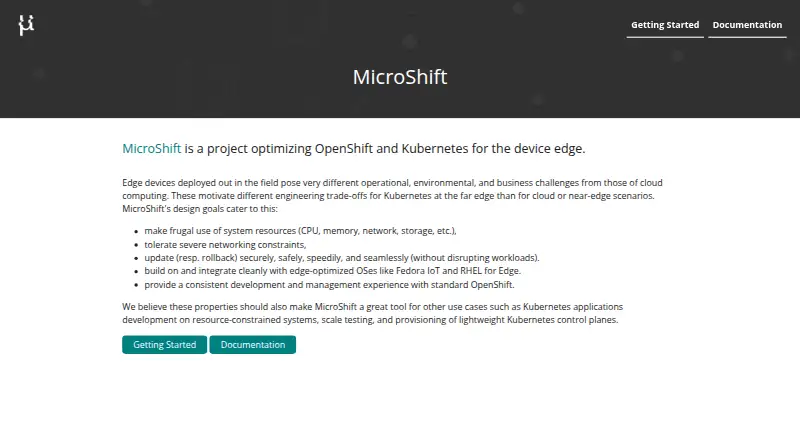
What MicroShift is
MicroShift is an OpenShift Kubernetes project for small form factor systems and edge computing. It is designed to use limited CPU, memory, network, and storage resources, and to operate amid severe network constraints. Its update goals include secure, safe, quick changes that avoid interrupting workloads.
The software runs as one systemd service, combining a minimal OpenShift control plane with a worker node. Included infrastructure services are DNS, an ingress router, service CA, OVN-Kubernetes CNI, and LVMS storage. OLM, Gateway API, cert-manager, and SR-IOV are optional components distributed as separate RPM packages. MicroShift uses CRI-O, supports a local registry and an add-on catalog, and does not offer a graphical interface or multi-node clusters.
The stated minimums are an x86_64 or aarch64 processor, Red Hat Enterprise Linux with Extended Update Support, 2 CPU cores, 2GB RAM, and 2GB of free root storage. The supported operating system is Red Hat Enterprise Linux 9.8. Production deployments can run on bare metal or on hypervisors supported and certified for Red Hat Enterprise Linux 9. The Kubernetes version follows the MicroShift release; MicroShift 4.22 is derived from OpenShift Container Platform 4.22.
Who it suits
MicroShift suits teams deploying Kubernetes on small form factor or edge systems where CPU, memory, storage, or network resources are constrained. The free Upstream build is intended for development and testing, while production deployments can use supported bare metal or hypervisors.
What it does well
- Designed to conserve CPU, memory, network, and storage resources.
- Runs as a single systemd service with a minimal control plane and worker node.
- Includes DNS, ingress routing, service CA, OVN-Kubernetes CNI, and LVMS storage.
- Optional components are available as separate RPM packages.
- Upstream build requires no Red Hat subscriptions or pull secrets.
- Supports local registries and an add-on catalog.
What to know first
- Does not support multi-node clusters.
- Does not include a graphical interface.
- Production requirements include Red Hat Enterprise Linux with Extended Update Support.
- Pricing for paid use is available on request.
Limits
The free MicroShift Upstream plan is for development and testing. It runs without Red Hat subscriptions or pull secrets; no other free-plan quota is stated.
Plans
| Plan | Billed and limits | Price |
|---|---|---|
| MicroShift Upstream | Upstream development and testing build; no Red Hat subscriptions or pull secrets required | Free |
As microshift.io lists them, read 8 Oct 2026. The maker's own page has the final word.
Getting started
- Visit the MicroShift website.
- Choose the free MicroShift Upstream plan for development and testing, or request pricing for paid use.
- For production, prepare supported bare metal hardware or a hypervisor certified for Red Hat Enterprise Linux 9.
- Meet the minimum architecture, operating system, CPU, memory, and root storage requirements.
- Use the upstream documentation for building or host deployment, or select another linked deployment guide.
Verdict
Choose MicroShift for a small-footprint OpenShift Kubernetes deployment at the edge, especially when its single-node design and resource goals fit the environment. The free Upstream plan covers development and testing; production use should account for the stated Red Hat Enterprise Linux requirements and paid pricing on request.
Questions
Is MicroShift free?
A free MicroShift Upstream plan is available for development and testing. The pricing model is also listed as paid, with pricing on request.
Which operating systems are listed?
The supported operating system is Red Hat Enterprise Linux 9.8. Upstream deployment options also list CentOS 9, CentOS 10, Fedora, Ubuntu, and macOS; macOS uses Podman machine in rootful mode.
What are the minimum requirements?
The stated minimums are x86_64 or aarch64, Red Hat Enterprise Linux with Extended Update Support, 2 CPU cores, 2GB RAM, and 2GB free root storage.
Does MicroShift support multi-node clusters or have a graphical interface?
No multi-node cluster support or graphical interface is listed.
What license does MicroShift use?
The repository lists an Apache-2.0 license.
Which Kubernetes version does it run?
The Kubernetes version is tied to the MicroShift release. MicroShift 4.22 is derived from OpenShift Container Platform 4.22.
Facts from MicroShift's own pages
- Architecture
- MicroShift runs as a single systemd service with a minimal OpenShift control plane and worker node. · github.com, 7 Oct 2026
- Architectures
- MicroShift and its main components are available for x86_64 and aarch64 architectures. · github.com, 8 Oct 2026
- Deployment
- MicroShift can run on the host or inside a Bootc container. · github.com, 8 Oct 2026
- Distribution
- RPM and DEB packages built in a container can be installed and run on the listed operating systems. · github.com, 8 Oct 2026
- Documentation
- The upstream repository links documentation for building, versioning, host deployment, Bootc deployment, and GitHub workflows. · github.com, 8 Oct 2026
- Downloads
- Prebuilt MicroShift artifacts are published on the repository's Releases page, and nightly RPMs are published on COPR. · github.com, 8 Oct 2026
- Included services
- The listed infrastructure services include DNS, ingress router, service CA, OVN-Kubernetes CNI, and LVMS storage. · github.com, 7 Oct 2026
- License
- The repository lists an Apache-2.0 license. · github.com, 7 Oct 2026
- Networking
- Its design goals include tolerating severe networking constraints. · github.com, 7 Oct 2026
- Operating systems
- The upstream repository lists CentOS 9, CentOS 10, Fedora, Ubuntu, and macOS deployment options, with macOS using Podman machine in rootful mode. · github.com, 8 Oct 2026
- Optional components
- Optional components listed include OLM, Gateway API, cert-manager, and SR-IOV, delivered as separate RPM packages. · github.com, 7 Oct 2026
- Production use
- The openshift/microshift repository says production deployments can run on bare metal hardware or hypervisors supported and certified for Red Hat Enterprise Linux 9. · github.com, 8 Oct 2026
- Purpose
- MicroShift optimizes OpenShift Kubernetes for small form factor and edge computing. · github.com, 8 Oct 2026
- Requirements
- The stated minimums include x86_64 or aarch64 CPU architecture, Red Hat Enterprise Linux with Extended Update Support, 2 CPU cores, 2GB RAM, and 2GB free root storage. · github.com, 7 Oct 2026
- Resource use
- Its design goals include frugal use of CPU, memory, network, and storage resources. · github.com, 7 Oct 2026
- Scope
- The openshift/microshift repository describes MicroShift as a small form factor OpenShift/Kubernetes project optimized for edge computing. · github.com, 8 Oct 2026
- Subscription distinction
- The upstream repository says its build runs without Red Hat subscriptions or pull secrets. · github.com, 8 Oct 2026
- Updates
- Its design goals include updating securely, safely, speedily, and seamlessly without disrupting workloads. · github.com, 7 Oct 2026
- Upstream build
- MicroShift Upstream lets contributors and testers build from the original MicroShift sources with OKD payload images. · github.com, 8 Oct 2026
Where MicroShift stands on Freedom251
- Local Kubernetes Tools#18 of 23