Freedom251 › Local Kubernetes Tools
KWOK
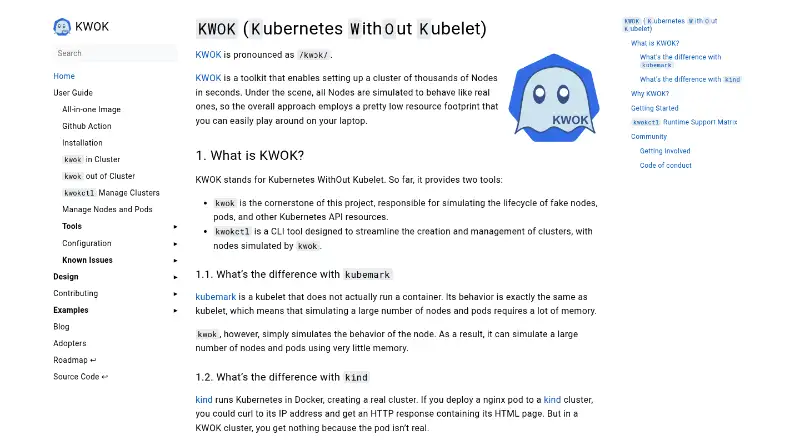
What KWOK is
KWOK is a free, Apache-2.0 licensed toolkit for simulating Kubernetes nodes, pods, and other API resources. It lets users create cluster environments quickly: the project says it can create 20 nodes or pods per second and reliably maintain 1,000 nodes and 100,000 pods. The toolkit has two command-line tools: `kwok` simulates resource lifecycles, while `kwokctl` creates and manages clusters. You can configure node types, labels, taints, capacities, conditions, and pod behaviors to explore test scenarios and edge cases. KWOK works with Kubernetes API-compliant tools and clients, including kubectl, Helm, and Kui. Documentation includes integration examples for Argo, Istio, Kueue, Linkerd, Prometheus, Metrics Server, and Ray, as well as instructions for enabling Prometheus and using it as a Grafana data source. It supports Linux, macOS, and Windows, with installation through Homebrew, WinGet, Go, or downloadable binaries. Multi-node clusters are supported, and Kubernetes versions can be selected through the kubeVersion configuration option. Container runtime options include binary, Docker, Podman, Nerdctl, and kind. Simulated pods do not run real workloads, such as serving an HTTP response.
Who it suits
KWOK suits Kubernetes developers and teams that need to create simulated clusters for testing API clients, configurations, or edge cases. It is useful when a scenario calls for large node and pod counts without real workload behavior inside the simulated pods.
What it does well
- Simulates clusters with up to 1,000 nodes and 100,000 pods reliably.
- Creates 20 nodes or pods per second, according to the project.
- Configures node properties and pod behaviors for test scenarios.
- Works with kubectl, Helm, Kui, and Kubernetes API-compliant clients.
- Supports multi-node clusters and selectable Kubernetes versions.
What to know first
- Simulated pods do not run real workloads.
- Pods cannot perform behavior such as serving an HTTP response.
Limits
KWOK simulates pods rather than running them. They do not perform real workload behavior, such as serving an HTTP response.
Plans
| Plan | Billed and limits | Price |
|---|---|---|
| KWOK | Apache-2.0 licensed open-source toolkit · simulates Kubernetes nodes, pods, and clusters | Free |
As kwok.sigs.k8s.io lists them, read 8 Oct 2026. The maker's own page has the final word.
Getting started
- Install KWOK using Homebrew, WinGet, Go, or a downloadable binary.
- Use `kwokctl` to create and manage a cluster.
- Configure node and pod properties for the scenario.
- Connect Kubernetes API-compliant tools or clients to the cluster.
Verdict
Choose KWOK when you need to exercise Kubernetes tools or configurations against simulated clusters at scale. Look elsewhere when your tests require pods to run actual workloads or serve responses.
Questions
Is KWOK free?
Yes. The KWOK plan is free, and the project is Apache-2.0 licensed.
Which operating systems does KWOK support?
The supported operating systems are Linux, macOS, and Windows.
How can I install KWOK?
Installation options include Homebrew, WinGet, Go, and downloadable binaries.
What scale does KWOK support?
The project says KWOK can reliably maintain 1,000 nodes and 100,000 pods, and create 20 nodes or pods per second.
Which tools work with a KWOK cluster?
KWOK works with Kubernetes API-compliant clients, including kubectl, Helm, and Kui. Documentation also provides integration examples for Argo, Istio, Kueue, Linkerd, Prometheus, Metrics Server, and Ray.
Can pods in KWOK serve an HTTP response?
No. KWOK simulates pods rather than running them, so they do not perform real workload behavior such as serving an HTTP response.
Facts from KWOK's own pages
- Community support
- Users can reach the maintainers through GitHub issues and discussions or the Kubernetes #kwok and #kwok-dev Slack channels. · kwok.sigs.k8s.io, 8 Oct 2026
- Configuration
- Users can configure node types, labels, taints, capacities, conditions, and pod behaviors to test scenarios and edge cases. · kwok.sigs.k8s.io, 8 Oct 2026
- Installation
- The project documents installation through Homebrew, WinGet, Go, and downloadable binaries. · kwok.sigs.k8s.io, 8 Oct 2026
- Integrations
- The documentation includes integration examples for Argo, Istio, Kueue, Linkerd, Prometheus, Metrics Server, and Ray. · kwok.sigs.k8s.io, 8 Oct 2026
- Known issue
- With AWS, GCP, or Azure cloud-provider integrations, nodes may be unexpectedly deleted if they lack provider IDs; the documentation recommends assigning a dummy providerID. · kwok.sigs.k8s.io, 8 Oct 2026
- Kubernetes compatibility
- KWOK works with Kubernetes API-compliant tools and clients, including kubectl, Helm, and Kui. · kwok.sigs.k8s.io, 8 Oct 2026
- Limitation
- KWOK simulates pods rather than running them, so a pod in a KWOK cluster does not perform real workload behavior such as serving an HTTP response. · kwok.sigs.k8s.io, 8 Oct 2026
- Metrics
- KWOK documents enabling Prometheus for a cluster and using Prometheus as a Grafana data source. · kwok.sigs.k8s.io, 8 Oct 2026
- Performance
- The project says KWOK can create 20 nodes or pods per second. · kwok.sigs.k8s.io, 8 Oct 2026
- Platforms
- The runtime support matrix covers Linux, macOS (Darwin), and Windows on amd64 and arm64, with support varying by runtime and architecture. · kwok.sigs.k8s.io, 8 Oct 2026
- Purpose
- KWOK simulates Kubernetes nodes, pods, and other API resources so users can set up clusters of thousands of nodes in seconds. · kwok.sigs.k8s.io, 8 Oct 2026
- Scale
- The project says KWOK can reliably maintain 1,000 nodes and 100,000 pods. · kwok.sigs.k8s.io, 8 Oct 2026
- Security and license
- The source repository identifies the project as Apache-2.0 licensed and links to a security policy. · github.com, 8 Oct 2026
- Tools
- The project provides `kwok` to simulate resource lifecycles and `kwokctl` to create and manage clusters. · kwok.sigs.k8s.io, 8 Oct 2026
Where KWOK stands on Freedom251
- Local Kubernetes Tools#15 of 23