Freedom251 › Local Kubernetes Tools
Seabird
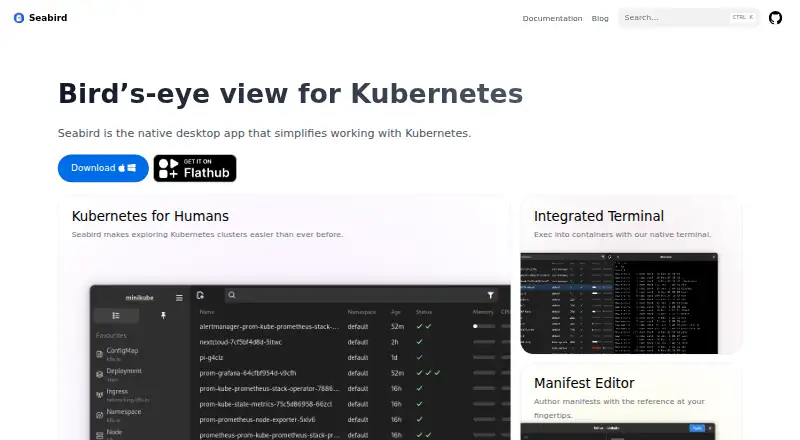
What Seabird is
Seabird is a desktop IDE for exploring and managing Kubernetes clusters, with a graphical interface for Linux, Windows, and macOS. It brings cluster logs and resource metrics into one workspace, showing memory and CPU use for nodes, pods, and containers through Metrics Server integration. A native terminal lets users execute commands in containers, while the manifest editor provides an API reference during authoring. Users can forward container ports to localhost with a button.
The project describes Seabird as designed for the GNOME desktop. Downloads for each platform are available through its releases, and Flatpak is the recommended Linux option. That Flatpak can access files in the home directory; system-directory access requires granting permission with Flatseal. Credential plugins can add authentication protocols not natively supported by the Kubernetes client, and must be installed on the system PATH.
Seabird is released under the Mozilla Public License v2, and its source code is available for audit. Its listed plan is free, described as an unlimited free trial. The project directs users to GitHub issues for problems and discussions for feature suggestions.
Who it suits
Seabird suits people who want a desktop interface for cluster exploration, monitoring, manifest authoring, and container commands. It is aimed at GNOME desktop users and is available across Linux, Windows, and macOS.
What it does well
- Displays CPU and memory metrics for nodes, pods, and containers.
- Includes a native terminal for commands in containers.
- Manifest editor keeps the API reference at hand.
- One-button port forwarding sends container ports to localhost.
- Source code is available for audit under MPL v2.
What to know first
- Flatpak file access is limited to the home directory by default.
- Credential plugins must be installed on the system PATH.
- Designed for the GNOME desktop.
Limits
The listed plan is free and has an unlimited free trial. The Flatpak can access only the home directory unless system-directory access is granted with Flatseal.
Plans
| Plan | Billed and limits | Price |
|---|---|---|
| Seabird | Paid software · unlimited free trial | Free |
As getseabird.github.io lists them, read 4 Oct 2026. The maker's own page has the final word.
Getting started
- Open the Seabird website.
- Choose a download from the project’s releases for Linux, Windows, or macOS.
- On Linux, consider the recommended Flatpak package.
- For Flatpak access to system directories, grant access with Flatseal.
- Install any needed credential plugins on the system PATH.
Verdict
Choose Seabird if you want a desktop Kubernetes IDE with logs, metrics, a terminal, and manifest authoring in one interface. Consider its Flatpak file-access constraint and system-PATH requirement for credential plugins when choosing how to use it.
Questions
Which platforms does Seabird support?
Linux, Windows, and macOS.
Is Seabird free?
The listed plan costs nothing and is described as an unlimited free trial.
What does Seabird do for Kubernetes clusters?
It supports cluster exploration and management, including logs, resource metrics, manifest authoring, container commands, and port forwarding.
Is Seabird open source?
It is released under the Mozilla Public License v2, and its source code is available for audit.
Where can users get downloads or support?
Downloads are available through project releases. The project directs users to GitHub issues for problems and discussions for feature suggestions.
Facts from Seabird's own pages
- Credential plugins
- Credential plugins add authentication protocols not natively supported by the Kubernetes client and must be installed on the system PATH. · getseabird.github.io, 4 Oct 2026
- Downloads
- The project says downloads for all platforms are available through its releases and recommends Flatpak on Linux. · github.com, 4 Oct 2026
- Flatpak limitation
- The Flatpak can access files only in the home directory unless system-directory access is granted with Flatseal. · getseabird.github.io, 4 Oct 2026
- Intended desktop
- The repository describes Seabird as a Kubernetes IDE designed for the GNOME desktop. · github.com, 4 Oct 2026
- License and auditability
- Seabird is released under Mozilla Public License v2 and its source code is available for audit. · getseabird.github.io, 4 Oct 2026
- Manifest editor
- Its manifest editor puts the API reference at hand while authoring manifests. · getseabird.github.io, 4 Oct 2026
- Metrics
- It displays memory and CPU utilization for nodes, pods, and containers through Metrics Server integration. · getseabird.github.io, 4 Oct 2026
- Port forwarding
- Users can forward container ports to localhost with a button. · getseabird.github.io, 4 Oct 2026
- Purpose
- Seabird is a native desktop Kubernetes IDE for exploring and managing clusters. · getseabird.github.io, 4 Oct 2026
- Resource monitoring
- The IDE supports monitoring clusters through logs and metrics. · github.com, 4 Oct 2026
- Support
- The project directs users to open GitHub issues for problems and discussions for feature suggestions. · github.com, 4 Oct 2026
- Terminal
- It includes a native terminal for executing commands in containers. · getseabird.github.io, 4 Oct 2026
Where Seabird stands on Freedom251
- Local Kubernetes Tools#23 of 23