Freedom251 › Synthetic Data Generation Software
SynthEngyne
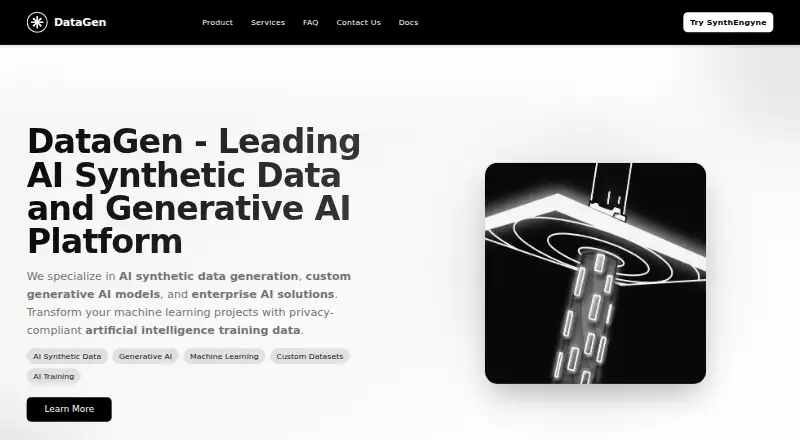
What SynthEngyne is
SynthEngyne generates synthetic datasets for AI training and development, with output types covering text, images, tabular data, and time series. Users can create dataspaces, generate datasets, then view, analyze, and export them for AI models. Custom datasets can be built from proprietary documents using adjustable parameters and generation methods. The listed quality tools include validation, deduplication, and data cleaning; processing options include real-time generation, streaming, batch, and enterprise-scale processing. Text, tabular, and time-series output uses 1 credit per row, while image generation uses 10 credits per image. The free plan provides 1,000 credits each month without a credit card. One-time purchases start at ₹1,500 for 30,000 credits; the pricing page says credits do not expire and dataspaces, datasets, and storage are unlimited. SynthEngyne is currently described as being in closed alpha, with public availability planned by the end of March 2026. DataGen identifies healthcare, finance, automotive, and retail among industries that may use its synthetic data.
Who it suits
It may suit AI development teams that need synthetic text, image, tabular, or time-series data, including teams in healthcare, finance, automotive, or retail. Its closed-alpha status is important for anyone considering access now.
What it does well
- Supports text, image, tabular, and time-series generation.
- Generates domain-specific datasets from proprietary documents.
- Includes validation, deduplication, and data cleaning.
- Free plan offers 1,000 monthly credits without a card.
- Credits do not expire; storage is listed as unlimited.
What to know first
- Currently in closed alpha.
- Public availability was planned for the end of March 2026.
- Image generation costs 10 credits per image.
Limits
The free plan provides 1,000 credits per month. Text, tabular, and time-series generation uses 1 credit per row; image generation uses 10 credits per image. Generated synthetic datasets are retained for 30 days by default and can be deleted sooner from the dashboard.
Plans
| Plan | Billed and limits | Price |
|---|---|---|
| Monthly free credits | 1,000 credits every month · No credit card required · text, tabular and time-series: 1 credit per row · images: 10 credits per image | Free |
| Enterprise | One-time purchase; no subscription · 200,000 credits · 200,000 rows of text/tabular data · 20,000 images · ₹0.05 per credit | ₹10,000, paid once |
| Starter | One-time purchase; no subscription · 30,000 credits · 30,000 rows of text/tabular data · 3,000 images · ₹0.05 per credit | ₹1,500, paid once |
| Popular | One-time purchase; no subscription · 60,000 credits · 60,000 rows of text/tabular data · 6,000 images · ₹0.05 per credit | ₹3,000, paid once |
| Pro | One-time purchase; no subscription · 120,000 credits · 120,000 rows of text/tabular data · 12,000 images · ₹0.05 per credit | ₹6,000, paid once |
As datagen.in lists them, read 8 Oct 2026. The maker's own page has the final word.
Getting started
- Visit the DataGen website.
- Check the try page for availability; SynthEngyne is described as being in closed alpha.
- Choose the monthly free credits plan or a one-time credit bundle.
- Create a dataspace and generate a dataset using the available formats and methods.
- View, analyze, and export the dataset for an AI model.
SynthEngyne is a synthetic-data platform for AI training and development projects that need several data modalities in one workflow. It is most compelling for teams building domain-specific datasets from internal documents and wanting one-time credit purchases rather than a subscription. The principal reservation is that it remains in closed alpha, which makes it a poor choice when dependable public access is essential.
Overview
SynthEngyne structures projects as dataspaces: create a space, generate datasets, inspect and analyze the results, then export them for AI models. It can produce text, images, tabular records, and time-series data, giving mixed-modality projects a broader toolkit than a table-only generator.
The maker describes real-time, streaming, batch, and enterprise-scale processing. Users can also derive domain-specific datasets from proprietary documents, adjusting generation parameters and methods to suit a particular use case. Quality control, validation, deduplication, and data cleaning are built into the described workflow, which should reduce some of the manual preparation normally required before model development.
Availability remains the decisive limitation. SynthEngyne is described as being in closed alpha; public availability was planned by the end of March 2026. That status makes it unsuitable for a production dependency that needs broad, predictable access today.
Key features
- Four data types: Text, image, tabular, and time-series generation covers both structured and unstructured AI workloads. The trade-off is sharply different credit consumption: one row costs one credit, while one image costs 10 credits.
- Proprietary-document datasets: Teams can create domain-specific data from their own documents and tune generation parameters and methods. This is more relevant to specialized healthcare, finance, automotive, and retail projects than to generic sample-data needs.
- Multiple processing modes: Real-time, streaming, batch, and enterprise-scale processing are presented as supported approaches. That range lets teams match generation to interactive development or larger pipeline jobs, although the alpha status tempers how confidently it can be adopted for critical operations.
- Dataset safeguards: Quality control, validation, deduplication, and cleaning address common defects in generated data. These controls are valuable when synthetic output will feed model training, but they do not replace a team's own review of fitness for purpose.
- Workspace workflow: Dataspaces, datasets, and storage are advertised as unlimited. Users can view, analyze, and export generated sets rather than treating generation as a one-off download.
- Security and retention: DataGen says it encrypts data in transit and at rest, uses role-based access controls and multi-factor authentication, performs vulnerability assessments, and maintains an incident-response program. Generated datasets are retained for 30 days by default and can be deleted sooner from the dashboard; backups are destroyed within 180 days. Processing and storage primarily use servers in India, with transfers elsewhere protected by safeguards. The company says it does not sell or rent personal data and uses contractual data-processing agreements with service providers.
Pricing
SynthEngyne uses a freemium model with monthly free credits and one-time paid packs. The free plan provides 1,000 credits every month with no credit card required. Credits do not expire, and dataspaces, datasets, and storage are unlimited. Because rows cost one credit and images cost 10, the free allowance represents 1,000 text, tabular, or time-series rows, or 100 images if spent exclusively on images.
| Plan | Price and billing | Allowance | Best fit |
|---|---|---|---|
| Monthly free credits | ₹0.00 per month | 1,000 credits monthly | Evaluation and small experiments |
| Starter | ₹1,500.00 once | 30,000 credits; 30,000 rows or 3,000 images | Small projects needing more than the free allowance |
| Popular | ₹3,000.00 once | 60,000 credits; 60,000 rows or 6,000 images | Regular development workloads |
| Pro | ₹6,000.00 once | 120,000 credits; 120,000 rows or 12,000 images | Larger model-development batches |
| Enterprise | ₹10,000.00 once | 200,000 credits; 200,000 rows or 20,000 images | High-volume generation without a subscription |
Every paid pack is a one-time purchase with no subscription, priced at ₹0.05 per credit. Custom credit purchases range from ₹100 to ₹1,00,000. The packs are straightforward for row-heavy work, but image-heavy teams will consume their allowance quickly.
Who it's for
SynthEngyne fits AI teams in healthcare, finance, automotive, and retail that need customized synthetic data across multiple formats, especially when proprietary documents are central to the project. Its expiring dataset retention, India-centered processing, and stated security controls may also suit organizations with defined data-governance requirements.
It is not the right choice for teams that require a generally available service immediately, need a recurring subscription with predictable monthly capacity, or expect image-heavy generation to stretch a modest budget.
Pros and cons
- Pros: Four supported data modalities; document-based customization; validation, deduplication, cleaning, and quality controls; unlimited dataspaces, datasets, and storage; credits that never expire; one-time pricing with no subscription; documented encryption, access controls, MFA, and incident response.
- Cons: Closed-alpha availability limits suitability for dependable production use; image generation costs 10 credits per image versus one per row; default 30-day dataset retention requires timely export or deletion; primary data processing and storage are in India, which may matter for residency requirements.
Alternatives
Synth Studio is the better pick for a free, MIT-licensed option with up to 1 million rows per generation and broad API, desktop, web, and self-hosted platform support.
SDV Enterprise suits teams wanting a free community edition with five data types, five basic constraints, nine models, CSV and Excel support, and forum support.
YData SDK is preferable when a free monthly-credit plan, all features, and more than 20 connectors matter, with pay-as-you-go billing also available.
MOSTLY AI offers a free starting plan across API, self-hosted, and web deployments.
NVIDIA ShadowPlay is a free Windows utility rather than a synthetic-data platform.
Simudyne Pulse is aimed at cached simulations with rolling usage limits rather than general dataset generation.
Synthetic AI Data provides a free plan for getting started across API, self-hosted, and web environments.
SynthForge IO offers a free web plan with the first 20,000 rows of each dataset free and stated table, download, and storage limits.
For broader browsing, see Synthetic Data Generation Software and AI Synthetic Data Generators.
Verdict
Choose SynthEngyne if your team needs text, image, tabular, and time-series synthesis, document-driven customization, and non-expiring credits purchased once. Look elsewhere if closed-alpha access or image-credit economics would put a production project at risk.
Verdict
SynthEngyne covers multiple data types and includes dataset quality tools and adjustable generation from proprietary documents. Its stated closed-alpha availability is a key consideration, alongside credit use that varies by output type.
Questions
Is SynthEngyne free?
Yes. The monthly free credits plan costs 0.00 INR and provides 1,000 credits every month without requiring a credit card.
How much do paid credits cost?
The listed one-time bundles are Starter at ₹1,500 per once for 30,000 credits, Popular at ₹3,000 per once for 60,000 credits, Pro at ₹6,000 per once for 120,000 credits, and Enterprise at ₹10,000 per once for 200,000 credits.
How are credits used?
Text, tabular, and time-series generation costs 1 credit per row. Image generation costs 10 credits per image.
Which data formats can it generate?
SynthEngyne supports text, image, tabular, and time-series data.
Is SynthEngyne generally available?
The try page describes it as currently in closed alpha and says public availability was planned by the end of March 2026.
How long are generated datasets retained?
Generated synthetic datasets are retained for 30 days by default and can be deleted earlier from the dashboard. Backups are destroyed within 180 days.
Facts from SynthEngyne's own pages
- Audience
- The maker identifies healthcare, finance, automotive, and retail among industries that may use its synthetic data. · datagen.in, 9 Oct 2026
- Availability
- The Try SynthEngyne page describes the product as in closed alpha and says public availability is planned by the end of March 2026. · datagen.in, 9 Oct 2026
- Credit limits
- Credits never expire; the page also advertises unlimited dataspaces, datasets, and storage, and custom purchases from ₹100 to ₹1,00,000. · datagen.in, 9 Oct 2026
- Credit pricing
- The maker states that text, tabular, and time-series generation costs 1 credit per row, while image generation costs 10 credits per image. · datagen.in, 8 Oct 2026
- Credit usage
- Text, tabular, and time-series data costs 1 credit per row; image generation costs 10 credits per image. · datagen.in, 9 Oct 2026
- Custom datasets
- It can generate domain-specific datasets from proprietary documents with confidentiality and security protocols. · datagen.in, 9 Oct 2026
- Data formats
- It supports text, image, tabular, and time-series data generation. · datagen.in, 9 Oct 2026
- Data location
- The privacy policy says DataGen primarily processes and stores data on servers in India and may transfer it elsewhere with safeguards. · datagen.in, 8 Oct 2026
- Data retention
- The privacy policy says generated synthetic datasets are retained for 30 days by default and can be deleted earlier from the dashboard. · datagen.in, 9 Oct 2026
- Dataset workflow
- The described workflow is to create dataspaces, generate datasets, then view, analyze, and export them for AI models. · datagen.in, 8 Oct 2026
- Founded
- 2024 · datagen.in, 28 Sept 2026
- Free credits
- The maker advertises 1,000 free credits every month and says no credit card is required. · datagen.in, 9 Oct 2026
- Headquarters
- India · datagen.in, 28 Sept 2026
- Privacy policy
- The privacy policy says DataGen does not sell or rent personal data and identifies service providers as recipients under contractual data-processing agreements. · datagen.in, 8 Oct 2026
- Processing
- The product page describes real-time generation, streaming, batch processing, and enterprise-scale processing. · datagen.in, 9 Oct 2026
- Product
- SynthEngyne is a platform for generating custom synthetic datasets for AI training. · datagen.in, 9 Oct 2026
- Quality
- Features include quality control, validation, data cleaning, and deduplication. · datagen.in, 9 Oct 2026
- Quality controls
- The product page lists quality control, validation, deduplication, and data cleaning capabilities. · datagen.in, 8 Oct 2026
- Retention
- The privacy policy says generated synthetic datasets are retained for 30 days by default and can be deleted sooner from the dashboard; backups are destroyed within 180 days. · datagen.in, 8 Oct 2026
- Security
- The privacy policy says the company uses encryption in transit and at rest, role-based access controls, multi-factor authentication, vulnerability assessments, and an incident-response program. · datagen.in, 9 Oct 2026
- Storage and credit limits
- The pricing page says dataspaces, datasets, and storage are unlimited, credits never expire, and custom purchases range from ₹100 to ₹1,00,000. · datagen.in, 8 Oct 2026
- Support
- The site provides a contact form and lists [email protected] for messages and privacy requests. · datagen.in, 9 Oct 2026
- Target industries
- The maker names healthcare, finance, automotive, and retail as industries that can benefit from its synthetic data. · datagen.in, 8 Oct 2026
- Workflow
- Users can create dataspaces, generate datasets, then view, analyze, and export them for AI models. · datagen.in, 9 Oct 2026
Where SynthEngyne stands on Freedom251
- Synthetic Data Generation Software#14 of 29
- AI Synthetic Data Generators#14 of 25