Freedom251 › Synthetic Data Generation Software
Simudyne Pulse
What Simudyne Pulse is
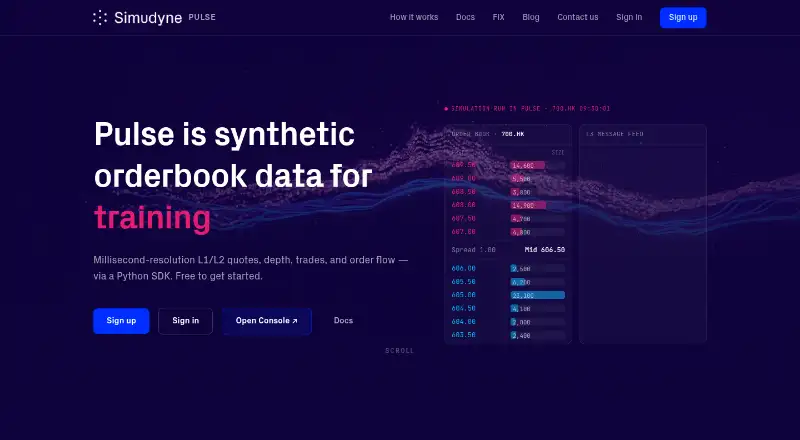
Simudyne Pulse generates synthetic financial market data for research, model training, algorithm development, and backtesting. Its PulseABM simulator models markets with millisecond resolution, producing synthetic order books, L1, L2, and L3 quotes, individual order events, executed trades, and other order-flow data. It supports HKEX and LSE. Listed uses include testing trading algorithms, measuring market impact, estimating transaction costs before a trade, and exploring stress scenarios. The simulated exchange is available over FIX 4.4 and can run at up to 20× speed. Pulse offers API access and a Python SDK, which returns simulation data as Polars DataFrames; outputs are available in Parquet and ZIP formats. Its MCP server makes market-data and backtesting tools available to compatible assistants such as Cursor, Windsurf, VS Code with GitHub Copilot, Cline, and Zed. Pulse is cloud deployed, and the company was founded in London in 2016 by simulation expert Justin Lyon. A Free plan offers cached simulations, with limits on new simulation groups and Monte Carlo runs. Pro adds custom simulation jobs and additional testing options.
Who it suits
Pulse suits researchers, developers, and financial teams building or training trading models and testing algorithms against simulated market data. Its FIX connection and MCP tools may also fit users working with compatible trading or coding environments.
What it does well
- Generates market data at millisecond resolution.
- Supports HKEX and LSE market data.
- Offers FIX 4.4 connectivity at up to 20× speed.
- Python SDK returns data as Polars DataFrames.
- MCP tools connect to several compatible assistants.
What to know first
- Free downloads are limited to 3 new simulation groups per rolling 24 hours.
- Free plan allows up to 10 Monte Carlo runs per group.
- Custom simulation jobs are available on Pro.
Limits
The Free plan includes pre-run cached simulations, up to 10 Monte Carlo runs per group, and a selection of HKEX and LSE symbols, dates, and scenarios. Downloads are limited to 3 new simulation groups per rolling 24-hour period; previously downloaded groups can be fetched again without charge.
Plans
| Plan | Billed and limits | Price |
|---|---|---|
| Free | Pre-run cached simulations · 3 new simulation groups per rolling 24 hours · Up to 10 Monte Carlo runs per group · Selection of HKEX and LSE symbols, dates, and scenarios | Free |
| Pro | Custom simulation jobs · Any available calibration date · All 6 market scenarios with custom parameters · TWAP, VWAP, and CSS testing · Up to 100 Monte Carlo runs per job · Validation results | On request |
As pulse.simudyne.com lists them, read 3 Oct 2026. The maker's own page has the final word.
Getting started
- Visit the Simudyne Pulse website.
- Choose the Free plan or Pro, depending on the simulation features you need.
- Use the API or Python SDK to access simulations.
- Create an API key for API access.
- Connect a compatible assistant through the Pulse MCP server if you want its market-data and backtesting tools.
Simudyne Pulse generates synthetic exchange data through an agent-based market simulator. It suits quantitative researchers and trading developers building or evaluating financial models. Its free tier supports small experiments; custom simulations and broader testing are reserved for Pro.
Overview
PulseABM simulates HKEX and LSE markets, producing market data at millisecond resolution. Unlike general-purpose synthetic-data tools, Pulse is built for trading and market research: its stated uses include algorithm backtesting, market-impact measurement, pre-trade transaction-cost analysis, stress scenarios, and model training. Simudyne, founded in 2016 by simulation expert Justin Lyon, is headquartered in London.
Key features
Market data and simulation
Pulse provides synthetic order books, L1/L2/L3 quotes, depth, individual orders, trades, and order flow. FIX 4.4 connectivity and simulation speeds of up to 20× can suit teams that need to connect exchange-style workflows or accelerate runs. The data is designed for training trading agents and financial models, not as a general substitute for arbitrary business datasets.
Developer access
API access and a Python SDK support research and development workflows; the SDK returns simulation data as Polars DataFrames. Outputs are available in Parquet and ZIP formats, and deployment is cloud-based. The Pulse MCP server exposes market-data and backtesting tools to compatible assistants, including Cursor, Windsurf, VS Code with GitHub Copilot, Cline, and Zed.
API keys are displayed only once when created and can be revoked. Simudyne says it retains the key prefix rather than the full key, a useful security measure for teams managing credentials.
Pricing
| Plan | Price | Includes |
|---|---|---|
| Free | free | Pre-run cached simulations; up to 3 new simulation groups per rolling 24 hours; up to 10 Monte Carlo runs per group; selection of HKEX and LSE symbols, dates, and scenarios. |
| Pro | Custom pricing | Custom simulation jobs, any available calibration date, all 6 market scenarios with custom parameters, TWAP, VWAP, and CSS testing, up to 100 Monte Carlo runs per job, and validation results. |
Free is suited to exploring cached runs and testing a limited workflow. The rolling cap applies to new simulation groups; groups already downloaded can be fetched again at no charge. Pro is the option for custom jobs, wider scenario control, more Monte Carlo runs, and the listed trading-strategy tests. Contact Simudyne for Pro upgrades or requests for symbols and venues.
Platforms
Pulse is available through a web interface and API, with a Python SDK for programmatic work. Its deployment option is cloud.
Who it's for
Pulse is a focused choice for quantitative researchers, trading-system developers, and financial-model teams who need synthetic HKEX or LSE data for training, backtesting, or market analysis. It is less suitable for buyers seeking a broad synthetic-data platform for non-financial datasets, or for work requiring custom simulation jobs without Pro.
Pros and cons
- Market-specific detail: Millisecond-resolution simulations span order books, quotes, orders, and trades across HKEX and LSE, supporting varied trading research workflows.
- Useful development interfaces: API, Python SDK, FIX 4.4, and MCP integrations provide several ways to incorporate simulation into research and testing.
- Clear free-tier boundary: Cached simulations and repeat downloads are free, but only 3 new groups may be downloaded per rolling 24 hours and each group is capped at 10 Monte Carlo runs.
- Pro-dependent flexibility: Custom jobs, all six scenarios with custom parameters, validation results, and up to 100 runs per job require a custom-priced plan.
- Narrow exchange coverage: Pulse supports HKEX and LSE, so teams needing other venues should confirm availability before choosing it.
Alternatives
Browse synthetic data generation software to compare tools across the broader category.
- Synth Studio is a free alternative with up to 1M rows per generation under an MIT License; consider it when those terms and its listed platform coverage fit better than Pulse's exchange-specific simulations.
- SDV Enterprise offers a free SDV Community plan with five data types, five basic constraints, nine models, CSV and Excel support, and forum support. Choose it when those general data options better suit the task than market simulation.
- YData SDK has a free monthly credit, all features, and more than 20 connectors on its free plan. It may suit users who value connector breadth over Pulse's HKEX and LSE market scenarios.
- MOSTLY AI offers a free plan; consider it as another freemium synthetic-data option.
- NVIDIA ShadowPlay is a free Windows app with GeForce GPU and driver requirements, rather than a market-data simulator.
- SynthEngyne offers monthly free credits for text, tabular, time-series, and image generation; consider it when those data types better match your needs.
- Synthetic AI Data offers a free plan and API, self-hosted, and web platforms; consider it as another freemium option.
- SynthForge IO is another freemium API and web option to compare.
Verdict
Choose Simudyne Pulse if your work depends on synthetic HKEX or LSE data for trading-agent training, backtesting, or market analysis. Its market-specific data and developer interfaces are the strongest reasons to choose it; the free-tier caps and custom-priced Pro plan are reasons to look elsewhere if you need frequent new runs or unrestricted simulation flexibility.
Verdict
Choose Simudyne Pulse if you need synthetic HKEX or LSE data for model training, backtesting, or market analysis. The Free plan provides cached simulations, while custom jobs and broader testing options are in Pro.
Questions
Is Simudyne Pulse free?
Yes. Its Free plan costs nothing and includes pre-run cached simulations.
What does the Free plan include?
It allows up to 10 Monte Carlo runs per group and a selection of HKEX and LSE symbols, dates, and scenarios. Downloads are capped at 3 new simulation groups per rolling 24 hours.
What does Pro add?
Pro includes custom simulation jobs, any available calibration date, all six market scenarios with custom parameters, TWAP, VWAP, and CSS testing, up to 100 Monte Carlo runs per job, and validation results.
Which markets does PulseABM support?
PulseABM supports HKEX and LSE and provides synthetic order books, L1/L2/L3 data, order events, and executed trades.
What integrations are available?
The Pulse MCP server exposes market-data and backtesting tools to compatible assistants, including Cursor, Windsurf, VS Code with GitHub Copilot, Cline, and Zed.
Who makes Simudyne Pulse?
Simudyne makes Pulse. The company was founded in London in 2016 by simulation expert Justin Lyon.
Facts from Simudyne Pulse's own pages
- API key security
- API keys are shown only once at creation, can be revoked, and Simudyne says it stores only the key prefix rather than the full key. · pulse.simudyne.com, 3 Oct 2026
- Company history
- Simudyne says it was founded by simulation expert Justin Lyon in 2016. · simudyne.com, 3 Oct 2026
- Data
- PulseABM supports HKEX and LSE and provides synthetic order books, L1/L2/L3 data, individual order events, and executed trades. · pulse.simudyne.com, 3 Oct 2026
- Data format
- The Python SDK returns simulation data as Polars DataFrames. · pulse.simudyne.com, 3 Oct 2026
- FIX connectivity
- Pulse exposes its simulated exchange over FIX 4.4 and can run at up to 20× speed. · pulse.simudyne.com, 3 Oct 2026
- Founded
- 2016 · pulse.simudyne.com, 28 Sept 2026
- Free tier limit
- Free-tier downloads are capped at 3 new simulation groups per rolling 24-hour period, while previously downloaded groups can be fetched again for free. · pulse.simudyne.com, 3 Oct 2026
- Headquarters
- London, United Kingdom · pulse.simudyne.com, 28 Sept 2026
- Integrations
- The Pulse MCP server exposes market-data and backtesting tools to MCP-compatible assistants, including Cursor, Windsurf, VS Code with GitHub Copilot, Cline, and Zed. · pulse.simudyne.com, 3 Oct 2026
- Intended users
- Simudyne says PulseABM data is designed for training trading agents and financial models. · pulse.simudyne.com, 3 Oct 2026
- Product
- Pulse is a platform for synthetic market data generation, with APIs and a Python SDK for research, model training, algorithm development, and backtesting. · pulse.simudyne.com, 3 Oct 2026
- PulseABM
- PulseABM is an agent-based market simulator that generates synthetic market data at millisecond resolution. · pulse.simudyne.com, 3 Oct 2026
- Support
- The site directs users to [email protected] for symbol or venue requests and Pro upgrades. · pulse.simudyne.com, 3 Oct 2026
- Use cases
- The site lists algorithm backtesting, market-impact measurement, pre-trade transaction-cost analysis, stress scenarios, and model training as Pulse use cases. · pulse.simudyne.com, 3 Oct 2026