Freedom251 › Synthetic Data Generation Software

YData SDK
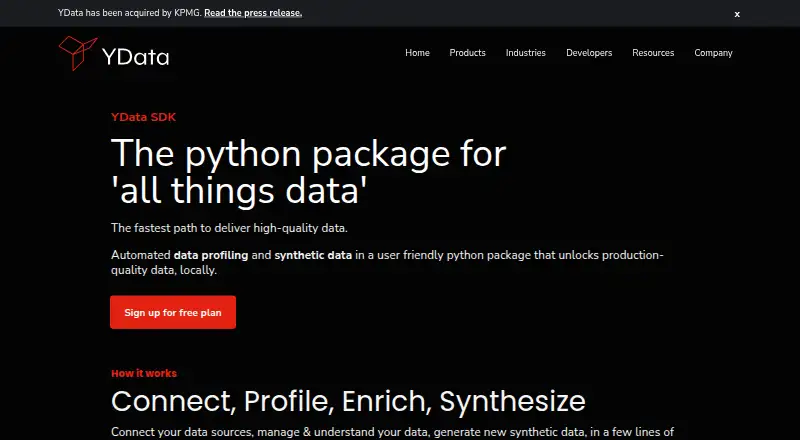
What YData SDK is
YData SDK is a Python toolkit for data profiling, data improvement, and synthetic data generation. It produces automated profiles and comparison reports to help assess data quality and spot issues or drift. It can generate tabular, time-series, relational, text, question-and-answer, and document data. The documentation describes PII detection and anonymization, as well as checks of synthetic data quality, utility, and privacy. Connectors include local files, cloud storage, databases, and Databricks; named LLM backends include Workbench, OpenAI, Anthropic, and Gemini. The SDK supports Python 3.10 and above on Windows, Linux, and macOS. YData says its platform can run on customer cloud or on-premises infrastructure, avoiding data transfer between customer and YData. The free plan lists all features and 20+ connectors. Pay-as-you-go pricing is $1.00 per credit; each credit covers 1 million data points or 10,000 tokens, with a 0.1-credit minimum transaction. Some features require native libraries before installation.
Who it suits
YData describes the SDK for data science, data engineering, analytics, and AI development teams working with Python. It may suit teams needing profiling or synthetic data across several data types.
What it does well
- Generates profiles and data quality comparison reports.
- Supports several synthetic data types, including relational data.
- Offers PII detection and anonymization.
- Free plan lists all features and 20+ connectors.
What to know first
- Requires Python 3.10 or above.
- Some features require native libraries installed beforehand.
- Pay-as-you-go has a 0.1-credit minimum transaction.
Plans
| Plan | Billed and limits | Price |
|---|---|---|
| Free plan | Free monthly credit · Free monthly credit · all features available · 20+ connectors | Free |
| Pay-as-you-go | $1.00/ credit · 1 credit per 1 million data points or 10,000 tokens · minimum transaction of 0.1 credits | $1, paid once |
| Enterprise | Contact us · All features available · predictable pricing | On request |
As ydata.ai lists them, read 30 Sept 2026. The maker's own page has the final word.
Getting started
- Open the YData SDK website.
- Choose the free plan or pay-as-you-go pricing.
- Install the SDK for Windows, Linux, or macOS with Python 3.10 or later.
- Install any native libraries required for the features you plan to use.
- Connect a supported data source or LLM backend.
- Contact YData for support or other inquiries.
Overview
YData SDK is a Python toolkit for profiling data, improving data quality, and generating synthetic datasets. It is best suited to data science, engineering, analytics, and AI teams working in Python. Its range of data types and privacy functions is compelling, but installation prerequisites and connector coverage deserve a check before adoption.
Key features
Automated profiles and comparison reports help teams identify data-quality problems and drift. That gives the SDK a role beyond data generation: teams can use it to assess how datasets change and evaluate generated output. YData says its checks cover quality, utility, and privacy, using divergence and correlation measures, TSTR, and privacy tests such as inference attacks.
Generation covers tabular, time-series, relational, text, question-and-answer, and document data. Built-in PII detection and anonymization add privacy-related functions to the workflow. The SDK also offers API access, relational-data support, and outputs in PDF, DOCX, and HTML, alongside supported data formats including CSV and Parquet.
Documented connectors span local files, Amazon S3, Azure Blob Storage, Google Cloud Storage, BigQuery, Microsoft SQL Server, MySQL, Snowflake, and Databricks. The supported formats and database connectors also include PostgreSQL, Oracle DB, Azure SQL Server, Databricks Unity Catalog, and Databricks Delta Lake. Named LLM backends are Workbench, OpenAI, Anthropic, and Gemini. This breadth suits teams combining varied sources, though teams should confirm that their specific connector and workflow are covered.
YData says its platform can run on customer cloud or on-premises infrastructure, keeping data from transferring between the customer and YData. The company is SOC 2 Type 2 certified. Those are useful considerations for organizations with deployment and security requirements, but they do not remove the need to check a team's own policies and implementation needs. Some SDK features require native libraries installed before the SDK, adding setup work for teams without control over their Python environment.
Pricing
The Free plan costs nothing and includes all features and 20+ connectors, with a Free monthly credit. It is a practical starting point for evaluating the SDK's breadth, but the credit means usage is not unlimited.
Pay-as-you-go costs $1, paid once, billed at $1.00 per credit. One credit covers 1 million data points or 10,000 tokens, with a minimum transaction of 0.1 credits. This makes usage-linked purchasing the defined paid option; teams should map their workload to the credit units before estimating spend.
Enterprise has custom pricing, with all features and predictable pricing. It is the option for organizations seeking predictable costs, while the free and pay-as-you-go plans offer less certainty for sustained or variable workloads.
Platforms
The SDK supports Python 3.10 and above and can be installed on Windows, Linux, or macOS. Its listed platforms also include API access and self-hosted deployment. Teams using older Python versions or unable to install required native libraries may need another approach.
Who it's for
YData SDK is a strong fit for Python teams that need profiling and synthetic generation across several data modalities, especially when privacy checks and customer-controlled deployment matter. It is less suitable for buyers seeking a turnkey tool without Python setup, or for teams whose connectors and native-library requirements do not match their environment.
Pros and cons
- Pro: Profiling, comparison reports, drift detection, generation, and generated-data checks bring multiple parts of data work into one Python toolkit.
- Pro: Generation spans six kinds of data, including relational, text, and document data, with PII detection and anonymization.
- Pro: Customer-cloud and on-premises deployment options can keep data within customer infrastructure.
- Con: Some features require native libraries before installation, which can complicate deployment in managed environments.
- Con: Pay-as-you-go usage is measured in credits tied to data points or tokens, so buyers need to forecast workload against those units.
Alternatives
Benerator is worth considering for a free, open-source core with single-threaded generation and anonymization, though its Community Edition does not include a full graph.
dbForge Studio for PostgreSQL is an alternative for buyers focused on PostgreSQL tooling who want a free limited-feature Express plan or a full-featured Standard subscription at $89.95 a year.
MOSTLY AI is another freemium option with a free plan and API, Linux, self-hosted, and web platforms.
DummyJSON is a free fake REST API for readers seeking a web- or API-based option.
Mockaroo may suit smaller generation needs: its free plan allows 1,000 rows per file, unlimited browser downloads, and 200 API requests per day.
Tonic Fabricate offers a free plan with $5 monthly credits and basic data exports, for buyers considering a credit-based alternative.
Synthetic Data Vault has a free Community plan covering five data types, five basic constraints, nine models, and CSV and Excel support; its narrower stated scope may suit teams prioritizing those options.
Synthesized is another freemium synthetic-data option with pricing available through sales.
For a broader comparison, browse Test Data Generation Tools or Synthetic Data Generation Software.
Verdict
Choose YData SDK if your Python team wants one toolkit for profiling, multi-format synthetic generation, privacy-related functions, and customer-controlled deployment. Its breadth is the main reason to choose it; the main reason to look elsewhere is setup friction or a mismatch between your required connectors and the SDK's supported environment.
Verdict
YData SDK combines data profiling, synthetic data generation, and privacy-related functions for Python workflows. Check connector needs and native-library prerequisites before adopting it.
Questions
Is there a free plan?
Yes. The free plan is listed as free and includes all features and 20+ connectors.
How does pay-as-you-go pricing work?
Pay-as-you-go is $1.00 per credit. One credit covers 1 million data points or 10,000 tokens, and the minimum transaction is 0.1 credits.
Which operating systems and Python versions are supported?
The SDK supports Python 3.10 and above on Windows, Linux, and macOS.
What kinds of synthetic data can it generate?
It can generate tabular, time-series, relational, text, question-and-answer, and document data.
Can it be deployed on customer infrastructure?
YData says its platform can be deployed on customer cloud or on-premises infrastructure.
Which LLM backends are supported?
The documentation names Workbench, OpenAI, Anthropic, and Gemini.
Facts from YData SDK's own pages
- Deployment
- YData says its platform can be deployed on customer cloud or on-premises infrastructure so data does not transfer between the customer and YData. · ydata.ai, 30 Sept 2026
- Headquarters
- Seattle, Washington, USA · ydata.ai, 28 Sept 2026
- Integrations
- Documented connectors include local files, Amazon S3, Azure Blob Storage, Google Cloud Storage, BigQuery, Microsoft SQL Server, MySQL, Snowflake, and Databricks. · docs.sdk.ydata.ai, 30 Sept 2026
- Intended users
- YData describes the SDK as a Python toolkit for data science, data engineering, analytics, and AI development teams. · pypi.org, 30 Sept 2026
- LLM providers
- The SDK documentation names Workbench, OpenAI, Anthropic, and Gemini as supported LLM backends. · docs.sdk.ydata.ai, 30 Sept 2026
- Notable requirement
- The SDK installation guide says some features require native libraries to be installed before the SDK. · docs.sdk.ydata.ai, 30 Sept 2026
- Privacy features
- The SDK documentation describes built-in PII detection and anonymization alongside synthetic data generation. · docs.sdk.ydata.ai, 30 Sept 2026
- Profiling
- It generates automated data profiles and comparison reports to help evaluate data quality and detect issues or drift. · ydata.ai, 30 Sept 2026
- Purpose
- YData SDK is a Python toolkit for data profiling, data improvement, and synthetic data generation. · docs.sdk.ydata.ai, 30 Sept 2026
- Security
- YData states that it is a SOC 2 Type 2 certified company. · ydata.ai, 30 Sept 2026
- Support
- The SDK documentation directs users to contact YData for support and other inquiries. · docs.sdk.ydata.ai, 30 Sept 2026
- Supported platforms
- The SDK supports Python 3.10 and above and can be installed on Windows, Linux, or macOS. · docs.sdk.ydata.ai, 30 Sept 2026
- Synthetic data
- The SDK generates tabular, time-series, relational, text, Q&A, and document data. · docs.sdk.ydata.ai, 30 Sept 2026
- Synthetic data checks
- YData says it evaluates generated data quality, utility, and privacy using divergence and correlation measures, TSTR, and privacy tests such as inference attacks. · ydata.ai, 30 Sept 2026
Where YData SDK stands on Freedom251
- Synthetic Data Generation Software#7 of 29
- Data De-Identification Tools#5 of 12