Freedom251 › Synthetic Data Generation Software
SynthCity
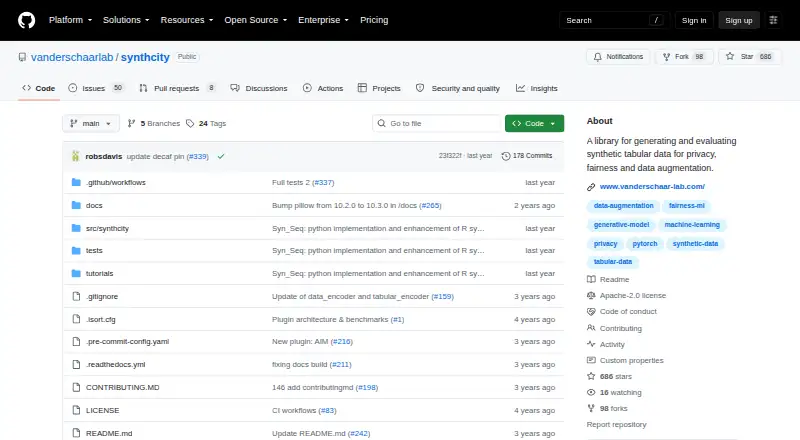
What SynthCity is
SynthCity is a Python library for generating and evaluating synthetic data, with support for tabular data, time series, survival analysis, and images. Its generator options include GANs, VAEs, normalizing flows, Bayesian networks, random forests, and LLM-based models. A plugin architecture is designed to allow extensions. Evaluation metrics cover data correctness, quality, and privacy, and the Benchmarks API can assess generators with selected metrics over repeated runs. Privacy methods include DECAF, DP-GAN, AdsGAN, PATEGAN, and PrivBayes; DECAF also offers inference-time debiasing based on user-defined fairness requirements. The README demonstrates use with scikit-learn and lifelines datasets. The library can be installed from PyPI or from source, and provides utilities for saving and loading models from files or buffers. It is self-hosted and listed for Linux, with API access. SynthCity does not handle missing data, so data must be imputed before use; HyperImpute is suggested for that purpose. The project identifies its license as Apache-2.0.
Who it suits
SynthCity suits teams that need to generate and evaluate synthetic datasets across its supported modalities. It may also fit users who want privacy methods, benchmarking, or a self-hosted Linux library.
What it does well
- Covers tabular, time-series, survival, and image data.
- Offers multiple generator families, including LLM-based models.
- Evaluation metrics address correctness, quality, and privacy.
- Benchmarking supports selected metrics and repeated runs.
- Models can be saved to or loaded from files or buffers.
What to know first
- Missing data must be imputed before use.
- Image architectures are described as not state of the art.
- Listed platform is Linux.
Limits
SynthCity does not handle missing data, so values must be imputed first; the project points to HyperImpute for that purpose. The described image generator architectures are not state of the art.
Plans
| Plan | Billed and limits | Price |
|---|---|---|
| SynthCity | Open-source Python library · install from PyPI or source | Free |
As github.com lists them, read 3 Oct 2026. The maker's own page has the final word.
Getting started
- Install SynthCity from PyPI with pip or install it from source.
- Use it in a Linux environment.
- Start with scikit-learn datasets or lifelines survival datasets, as demonstrated by the project.
- Impute missing data before using it with SynthCity.
Verdict
SynthCity brings several data modalities, generator approaches, and evaluation tools into a self-hosted library. Account for its missing-data requirement and the stated limitation of its image architectures.
Questions
How much does SynthCity cost?
SynthCity is free. The listed SynthCity plan costs nothing.
What data types can it generate?
The project describes generators for tabular data, time series, survival analysis, and images.
Does SynthCity handle missing data?
No. Missing data must be imputed before use, and the project points to HyperImpute for this purpose.
What platforms and deployment options are supported?
Linux is the listed platform, and deployment is self-hosted.
Is SynthCity open source?
Yes. The repository identifies its license as Apache-2.0.
How can users install SynthCity?
It can be installed with pip from PyPI or installed from source.
Facts from SynthCity's own pages
- Benchmarking
- The Benchmarks API can evaluate generators using selected metrics and repeated runs. · github.com, 3 Oct 2026
- Data modalities
- The repository describes generators for tabular data, time series, survival analysis, and images. · github.com, 3 Oct 2026
- Evaluation
- It includes evaluation metrics for data correctness, quality, and privacy. · github.com, 3 Oct 2026
- Extensible architecture
- The library has a plugin architecture designed to be extended. · github.com, 3 Oct 2026
- Fairness and privacy
- Privacy-focused methods include DECAF, DP-GAN, AdsGAN, PATEGAN, and PrivBayes, and DECAF supports inference-time debiasing using user-defined fairness requirements. · github.com, 3 Oct 2026
- Generator types
- The listed models include GANs, VAEs, normalizing flows, Bayesian networks, random forests, and LLM-based generators. · github.com, 3 Oct 2026
- Image model limit
- The README says its image generator architectures are not state of the art and suggests extending the image generator/discriminator architecture method for other architectures. · github.com, 3 Oct 2026
- Installation
- The library can be installed with pip from PyPI or installed from source. · github.com, 3 Oct 2026
- Integration
- The README demonstrates using SynthCity with scikit-learn datasets and lifelines survival datasets. · github.com, 3 Oct 2026
- License
- The repository identifies its license as Apache-2.0. · github.com, 3 Oct 2026
- Missing data limit
- SynthCity does not handle missing data, which must be imputed first; the README points to HyperImpute for this purpose. · github.com, 3 Oct 2026
- Model serialization
- Models can be serialized and loaded from buffers or files using the library's serialization utilities. · github.com, 3 Oct 2026
- Purpose
- SynthCity is a library for generating and evaluating synthetic tabular data. · github.com, 3 Oct 2026
- Support and contributions
- The project tracks public bugs through GitHub Issues and welcomes pull requests. · github.com, 3 Oct 2026
Where SynthCity stands on Freedom251
- Synthetic Data Generation Software#8 of 29
- AI Synthetic Data Generators#10 of 25