Freedom251 › Passkey Authentication Software

Supabase
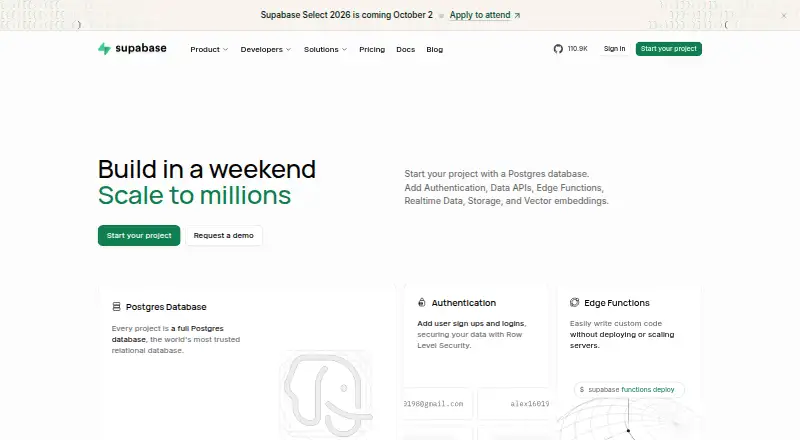
What Supabase is
Supabase is a backend platform built around a Postgres database, with services for authentication, file storage, realtime data, and server-side functions. Every project includes a Postgres database, and the platform supports Postgres extensions; paid plans add database branching and backups. Supabase Auth handles email and password, passwordless, OAuth, and mobile logins through identity providers and APIs. Realtime can listen for database changes, sync user states, and broadcast data to subscribed clients. Edge Functions run server-side code close to users. Official client libraries are available for JavaScript/TypeScript, Dart/Flutter, Swift, and Python, and documentation covers self-hosting. Supabase says customer data is encrypted at rest with AES-256 and in transit via TLS, and states that it is SOC 2 Type 2 compliant and ISO 27001 certified. EU-hosted projects keep primary database data in-region; HIPAA use of the hosted platform requires a Business Associate Agreement. The Free plan costs nothing and allows two active projects, which pause after one week of inactivity. Pro starts at $25 a month and includes email support.
Who it suits
Supabase suits developers building applications that need a hosted or self-hosted Postgres backend with authentication, storage, realtime features, and server-side functions. Its client libraries cover several common programming languages, while the free plan has project and inactivity limits.
What it does well
- Every project includes a Postgres database.
- Auth supports passwordless, OAuth, and mobile logins.
- Realtime can broadcast data to subscribed clients.
- Official libraries cover JavaScript/TypeScript, Dart/Flutter, Swift, and Python.
- Self-hosting documentation is available.
What to know first
- Free plan allows only two active projects.
- Free projects pause after one week of inactivity.
- Pro starts at $25 a month.
Limits
The Free plan permits two active projects, each with up to 500 MB of database storage, 5 GB egress, and 1 GB file storage. Free projects pause after one week of inactivity. The plan includes community support; Pro starts at $25 / month and includes email support.
Plans
| Plan | Billed and limits | Price |
|---|---|---|
| Free | $0 / month · 50,000 monthly active users · 500 MB database per project · 5 GB egress · 1 GB file storage · 2 active projects · pauses after 1 week of inactivity · community support | Free |
| Pro | From $25 / month · 100,000 monthly active users · 8 GB disk per project · 250 GB egress · 100 GB file storage · daily backups stored for 7 days · email support | $25 a month |
| Team | From $599 / month · SOC 2 and ISO 27001 · SSO for Supabase Dashboard · HIPAA available as paid add-on · daily backups stored for 14 days · priority email support and SLAs | $599 a month |
| Enterprise | Custom · Designated support manager · uptime SLAs · AWS PrivateLink · 24×7×365 premium enterprise support · private Slack channel | On request |
As supabase.com lists them, read 3 Oct 2026. The maker's own page has the final word.
Getting started
- Visit the Supabase website.
- Choose the Free plan or review the paid plans, which start at $25/mo.
- Create a project to get its included Postgres database.
- Use an official client library for JavaScript/TypeScript, Dart/Flutter, Swift, or Python.
- Follow the documentation if you want to self-host the platform.
Supabase is a backend platform built around PostgreSQL, bundling authentication, file storage, realtime data and server-side functions. It best suits developers whose applications need a relational database alongside several coordinated backend services. Its broad toolkit is a strong reason to consolidate infrastructure, while free-tier constraints and manual scaling matter for production planning.
Overview
Each project includes a relational Postgres database, with support for Postgres extensions, backups and, on paid plans, database branching. Point-in-time recovery and read replicas are available, which helps with recovery and read-heavy workloads. Scaling is manual, however, so teams must decide when and how to add capacity instead of relying on automatic growth.
The platform combines database, Auth, Storage, Realtime and Edge Functions in one service. That is efficient for applications needing most of those pieces; a project requiring only sign-in or a standalone database may find the wider platform unnecessary.
Key features
Application backend
Supabase Auth handles email-and-password, passwordless, OAuth and mobile logins through identity providers and APIs. Realtime can stream database changes, synchronize user state and broadcast information to subscribed clients, making it useful for collaborative or live interfaces. Globally distributed Edge Functions run server-side code near users, providing a place for request processing without a separate functions service.
Development and operations
Official client libraries cover JavaScript and TypeScript, Dart and Flutter, Swift, and Python. Documented integrations include Vercel Marketplace project management and project provisioning through Stripe CLI. Supabase also documents self-hosting, giving teams an option beyond its hosted service.
Security and compliance
Supabase states that data is encrypted at rest with AES-256 and in transit using TLS. It reports SOC 2 Type 2 compliance and ISO 27001 certification. HIPAA use of the hosted platform requires a Business Associate Agreement; EU-hosted projects keep primary database data in-region, and a GDPR Data Processing Agreement is provided.
Pricing
Supabase uses a freemium model. The Free plan costs nothing, with 50,000 monthly active users, 500 MB of database capacity per project, 5 GB of egress, 1 GB of file storage and two active projects. Projects pause after one week without activity, and support is community-based. That combination suits prototypes, learning projects and low-traffic applications, but the pause and two-project ceiling are meaningful barriers to continuously running products.
Pro costs $25 a month, billed from $25 / month. It raises capacity to 100,000 monthly active users, 8 GB of disk per project, 250 GB of egress and 100 GB of file storage. Daily backups are retained for seven days and support moves to email. Pro is the practical starting point for an active small application, though its listed backup retention and manual scaling still require planning.
Team costs $599 a month, billed from $599 / month. It adds SOC 2 and ISO 27001 provisions, Supabase Dashboard SSO, 14-day daily-backup retention, priority email support and SLAs. HIPAA is available as a paid add-on. This tier targets organizations with compliance and service-level obligations rather than individual developers.
Enterprise has custom pricing and includes a designated support manager, uptime SLAs, AWS PrivateLink, premium 24×7×365 support and a private Slack channel. It is intended for large organizations needing dedicated operational assistance and private connectivity.
Platforms
Supabase supports Android, iOS, macOS, Windows and web development, along with API access and self-hosted deployments. The range fits teams shipping across mobile and browser clients while retaining control over hosting when required.
Who it's for
Choose Supabase when a product is centered on relational data and benefits from authentication, storage, realtime messaging and edge functions in one backend. It is especially suitable for teams comfortable managing PostgreSQL and making their own scaling decisions. It is less suitable when automatic scaling, a continuously active no-cost environment or a narrowly focused identity service is the main requirement.
Pros and cons
- Pro: A full Postgres database sits alongside Auth, Storage, Realtime and Edge Functions, reducing the need to assemble separate backend services.
- Pro: Client libraries for four major language or framework families and self-hosting documentation support varied development and deployment preferences.
- Pro: Published encryption, SOC 2 Type 2, ISO 27001 and regional-data provisions address common security and compliance needs.
- Con: Free projects pause after one week of inactivity and are limited to two active projects, making the free tier unsuitable for many always-on applications.
- Con: Scaling is manual, so growing workloads demand explicit capacity and operational decisions.
- Con: The Team price of $599 a month is a substantial jump from Pro for organizations that need SLAs or priority support.
Alternatives
Azure SQL Database is a better fit when you want a Microsoft-managed relational service with a free offer, free trial and stated vCore, storage and database allowances.
CrateDB suits teams seeking a distributed SQL option with a free shared tier offering 2 vCPUs, 2 GiB of RAM and 8 GiB of storage.
MySQL is the clearer choice when an established open-source database with SQL and NoSQL application support, replication and high-availability components is the priority.
RavenDB is an alternative document database with developer and community plans.
DuckDB UI is preferable for a free, local browser-based SQL notebook rather than a hosted application backend.
GeoDesk is a free option focused on geospatial and cartographic work.
Microsoft SQL Server fits organizations standardizing on Microsoft's SQL Server editions and licensing model.
OpenSearch is the alternative when an Apache 2.0, open-source search and analytics platform is the goal.
For specialist discovery, compare Spatial Databases or Passkey Authentication Software.
Verdict
Supabase is a strong choice for developers building relational-data applications that need authentication, storage, realtime behavior and server-side functions together. The main reason to choose it is the cohesive Postgres-centered backend, backed by broad client-library and self-hosting options. Look elsewhere if free projects must remain continuously active, if scaling should be automatic, or if you need only one narrowly defined backend capability.
Verdict
Supabase brings a Postgres database and several backend services together, with client libraries and self-hosting documentation. Review the Free plan's project and inactivity limits, or consider Pro at $25 a month for more capacity and email support.
Questions
Is there a free plan?
Yes. Free costs $0 per month and includes 50,000 monthly active users, 500 MB database per project, 5 GB egress, 1 GB file storage, and two active projects.
What does Pro cost?
Pro is listed from $25 / month. It includes 100,000 monthly active users, 8 GB disk per project, 250 GB egress, 100 GB file storage, daily backups stored for seven days, and email support.
Which platforms and libraries are supported?
Platforms listed include Android, iOS, macOS, Windows, web, APIs, and self-hosted use. Official client libraries are available for JavaScript/TypeScript, Dart/Flutter, Swift, and Python.
Can Supabase be self-hosted?
Yes. Supabase provides documentation to get started with self-hosting its platform.
What support comes with each plan?
Free includes community support, Pro includes email support, Team includes priority email support and SLAs, and Enterprise offers premium 24×7×365 support.
What limits apply to Free projects?
The Free plan allows two active projects, and projects pause after one week of inactivity. Each project has a 500 MB database allowance, 5 GB egress, and 1 GB file storage.
Facts from Supabase's own pages
- Authentication
- Supabase Auth provides email and password, passwordless, OAuth, and mobile logins through identity providers and APIs. · supabase.com, 3 Oct 2026
- Client libraries
- Official client libraries are available for JavaScript/TypeScript, Dart/Flutter, Swift, and Python. · supabase.com, 3 Oct 2026
- Database
- Every Supabase project includes a Postgres database, and the platform supports Postgres extensions, backups, and database branching on paid plans. · supabase.com, 3 Oct 2026
- Free plan limits
- Free projects are paused after one week of inactivity and are limited to two active projects. · supabase.com, 3 Oct 2026
- Functions
- Edge Functions are globally distributed server-side functions for running code close to users. · supabase.com, 3 Oct 2026
- HIPAA and GDPR
- Supabase says HIPAA use of its hosted platform requires a Business Associate Agreement and that EU-hosted projects keep primary database data in-region; it also makes a GDPR Data Processing Agreement available. · supabase.com, 3 Oct 2026
- Integrations
- Supabase documents integrations including Vercel Marketplace project management and project provisioning through Stripe CLI. · supabase.com, 3 Oct 2026
- Product
- Supabase describes itself as a backend platform with a full Postgres database and services for Auth, Storage, Realtime, and Edge Functions. · supabase.com, 3 Oct 2026
- Realtime
- Realtime can listen for database changes, sync user states, and broadcast data to subscribed clients. · supabase.com, 3 Oct 2026
- Security
- Supabase says customer data is encrypted at rest with AES-256 and in transit via TLS, and that it is SOC 2 Type 2 compliant and ISO 27001 certified. · supabase.com, 3 Oct 2026
- Self-hosting
- Supabase provides documentation to get started with self-hosting its platform. · supabase.com, 3 Oct 2026
- Support
- The Free plan includes community support, Pro includes email support, Team includes priority email support and SLAs, and Enterprise offers premium 24×7×365 support. · supabase.com, 3 Oct 2026
Where Supabase stands on Freedom251
- Passkey Authentication Software#23 of 55
- API Generation Software#11 of 25
- Ai Databases#19 of 40
- Databases And Backend#18 of 33
- Authentication Software#17 of 31
- Spatial Databases#24 of 40
- Backend as a Service (BaaS) Software#12 of 20
- Cli Tools#20 of 32