Freedom251 › Database Software
Microsoft SQL Server
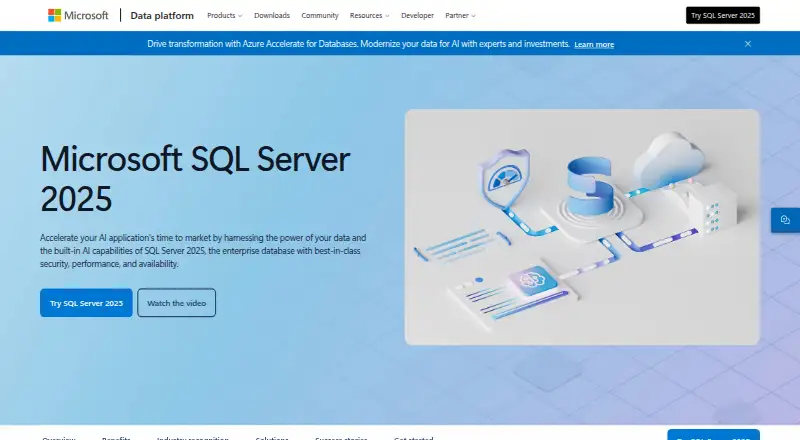
What Microsoft SQL Server is
Microsoft SQL Server is a database platform for storing, processing, and securing data. Its Database Engine includes replication, full-text search, relational data, XML and JSON management, and Python and R machine learning services. Integration Services offers graphical and programmable tools for moving and transforming data, while PolyBase can query sources such as Azure Storage, S3, and ODBC data sources. SQL Server 2025 adds vector search, embedding generation, text chunking, and DiskANN vector indexing, and integrates with LangChain, Semantic Kernel, Entity Framework Core, Microsoft Azure, and Microsoft Fabric. It supports Windows and Linux, with a Docker container image also available; SQL Server 2025 does not support SUSE Linux Enterprise Server. Express is free for learning and desktop or small server applications, with a 50 GB database size and an instance limit of the lesser of one socket or four cores. Developer editions offer Enterprise or Standard functionality but are licensed only for development and testing, not production. Enterprise and Standard editions address organizational and business workloads.
Who it suits
SQL Server may suit organizations with complex workloads or businesses seeking the performance and security balance described for Standard. Express is for learning or desktop and small server applications; Developer editions are for non-production development and testing.
What it does well
- Free Express edition is available.
- Includes replication and full-text search.
- Supports XML and JSON management.
- High availability and read replicas are listed.
- Windows, Linux, and Docker options are listed.
What to know first
- Express instances are limited to one socket or four cores.
- Express database size is 50 GB.
- Developer editions are not licensed for production.
- SQL Server 2025 does not support SUSE Linux Enterprise Server.
Limits
Developer editions are licensed for development and testing, not production use. Express has a 50 GB database size limit, and each single Database Engine instance is limited to the lesser of one socket or four cores.
Plans
| Plan | Billed and limits | Price |
|---|---|---|
| Standard per core | Standard edition · 2-core pack · Volume licensing and hosting | On request |
| Standard per core | Standard edition · 2-core pack · Volume licensing and hosting | On request |
| Standard server | Standard edition · Server license · Volume licensing and hosting | On request |
| Standard server | Standard edition · Server license · Volume licensing and hosting | On request |
| Standard CAL | Client access license · Volume licensing and hosting | On request |
| Standard CAL | Client access license · Volume licensing and hosting | On request |
| Enterprise pay-as-you-go | Monthly rate; Azure Arc enabled · Cloud billing for on-premises and cloud | $274 a month |
| Express | Free download; desktop, web, and small server applications | Free |
The first 8 of 20 plans, as microsoft.com lists them, read 22 Sept 2026. The maker's own page has the final word. Every plan
Getting started
- Visit Microsoft's SQL Server website.
- Choose an edition and licensing option for your intended use.
- Download SQL Server for Windows or Linux, or use the SQL Server container image for Docker.
- Use Developer only for non-production development and testing, or Express for learning and desktop or small server applications.
Overview
Microsoft SQL Server is a database platform for storing and processing data, with separate tools for data integration and virtualization. It is best suited to organizations that need a broad database stack across Windows, Linux, or self-hosted deployments. Its free editions lower the barrier to learning and development, but production use calls for careful edition and licensing choices.
Key features
The SQL Server Database Engine stores, processes, and secures data, supporting relational, XML, and JSON data, replication, and full-text search, as well as Python and R machine-learning services. High availability and read replicas suit organizations planning for resilient or read-heavy deployments; the stated ceiling of 32,767 connections is substantial, but does not by itself determine how a particular edition will fit a workload.
Integration Services combines graphical tools and programmable objects for moving, copying, and transforming data. PolyBase can query Azure Storage, S3, and ODBC data sources, making SQL Server useful when data is spread beyond the database engine. SQL Server 2025 adds vector search, embedding generation, text chunking, and DiskANN vector indexing. Its integrations with LangChain, Semantic Kernel, Entity Framework Core, Azure, and Microsoft Fabric are relevant to teams already building around those technologies.
Microsoft's security guidance covers platform and network security, permissions, encryption, and secure connections. These are important areas for deployment planning, but the guidance does not remove the need to configure and operate a secure environment.
Pricing
SQL Server has a freemium model. Enterprise, Standard per core, Standard server, and Standard CAL use volume licensing and hosting, with prices set by custom pricing rather than a published amount. Enterprise is intended for organizations with complex workloads. Standard is positioned as a balance of performance, security, and affordability for businesses; the per-core, server-license, and client-access-license options provide different licensing bases, so buyers should match the option to their deployment and access requirements.
Developer – Standard & Enterprise is a free download with Standard or Enterprise functionality, but its license is limited to non-production development and testing. It is a strong fit for building and validating applications, not a way to run production workloads without a production license.
Express is free and includes a 50 GB database-size limit. It is aimed at learning and desktop or small server applications. A single Database Engine instance is also limited to the lesser of one socket or four cores, so teams should treat it as an entry point rather than assume it will scale into a production deployment unchanged.
Platforms
SQL Server supports Windows, Linux, API access, and self-hosted deployment, with both self-managed and other deployment models represented. Microsoft provides Windows and Linux downloads and a Docker container image. SQL Server 2025 does not support SUSE Linux Enterprise Server, a meaningful constraint for organizations standardizing on that distribution.
Who it's for
SQL Server is a strong candidate for businesses and organizations that want database, integration, and virtualization capabilities in one product family, particularly those using Microsoft's ecosystem or needing Windows and Linux deployment options. Developers can use the free Developer edition for non-production work, while learners and small applications can start with Express. It is less suitable when a team needs a free edition for production or cannot align its workload with the available licensing terms and edition limits.
Pros and cons
- Pros: The Database Engine combines relational, XML, and JSON support with replication, full-text search, and Python and R services, giving teams a broad set of data capabilities.
- Pros: Integration Services and PolyBase cover data movement and queries across external sources, reducing the need to treat SQL Server as an isolated store.
- Pros: Free Developer and Express editions support development, testing, learning, and small applications without a paid license.
- Cons: Developer edition is expressly barred from production, and Express has both a 50 GB database cap and an instance CPU/socket limit.
- Cons: Production editions use volume licensing and hosting, and the listed plans have custom pricing, so buyers need to resolve licensing costs before committing.
- Cons: SQL Server 2025's Linux support excludes SUSE Linux Enterprise Server.
Alternatives
Choose MySQL if its free Community Edition and support for SQL and NoSQL applications, replication, and high-availability components better fit your needs. Azure SQL Database is worth considering for its free offer, which includes 100,000 vCore seconds, 32 GB of data storage, 32 GB of backup storage, and 10 databases per subscription. Choose SQLite when an embedded SQL engine with no separate server and no license requirement is the better fit. PostgreSQL is a free and open-source option whose use, copying, modification, and distribution carry no fee. Amazon DynamoDB offers a free tier with per-region capacity and storage allowances. Amazon Aurora is another option, with a free plan and usage-based paid pricing. Amazon RDS provides a free-tier option with conditions that vary by account. MariaDB Server is a free, self-hosted community server for non-production applications. Browse Database Software, Relational Databases, and Spatial Databases for more options.
Verdict
Choose Microsoft SQL Server if your organization needs a broad database platform with integration and virtualization tools, and can select an edition and license suited to its production workload. Its free editions make development and smaller applications accessible, but production licensing and Express limits are the main reasons to compare alternatives before choosing.
Verdict
SQL Server offers database, integration, and virtualization capabilities, with editions for production, development, and learning uses. Check the edition limits and licensing terms against your intended deployment.
Questions
Is Microsoft SQL Server free?
Yes. The pricing model is freemium, with a free plan. Developer is a free download for non-production development and test use; Express is also a free entry-level edition.
What does Express include and what is its limit?
Express is for learning and desktop or small server applications. It has a 50 GB database size limit, and a single Database Engine instance is limited to the lesser of one socket or four cores.
Can Developer edition be used in production?
No. Developer editions include Enterprise or Standard functionality but are licensed for development and testing, not production use.
Which platforms are supported?
Microsoft provides SQL Server downloads for Windows and Linux, as well as a SQL Server container image for Docker. SQL Server 2025 does not support SUSE Linux Enterprise Server.
Which integrations are listed for SQL Server 2025?
It integrates with LangChain, Semantic Kernel, Entity Framework Core, Microsoft Azure, and Microsoft Fabric.
Are prices listed for the paid licensing options?
Enterprise, Standard per core, Standard server, and Standard CAL are listed with volume licensing and hosting, but no prices are included in their plan descriptions.
Facts from Microsoft SQL Server's own pages
- AI features
- SQL Server 2025 includes vector search, vector embedding generation, text chunking, and DiskANN vector indexing. · microsoft.com, 11 Oct 2026
- Database engine
- SQL Server Database Engine stores, processes, and secures data and includes replication, full-text search, relational, XML and JSON management, and Python and R machine learning services. · learn.microsoft.com, 11 Oct 2026
- Data integration
- Integration Services provides graphical tools and programmable objects for moving, copying, and transforming data. · learn.microsoft.com, 11 Oct 2026
- Data virtualization
- PolyBase can query storage sources such as Azure Storage and S3, as well as ODBC data sources. · learn.microsoft.com, 11 Oct 2026
- Developer edition limits
- Developer editions include Enterprise or Standard edition functionality but are licensed for development and testing, not production use. · learn.microsoft.com, 11 Oct 2026
- Express edition limits
- Express is a free entry-level edition for learning and desktop or small server applications; a single Database Engine instance is limited to the lesser of one socket or four cores. · learn.microsoft.com, 11 Oct 2026
- Free plan
- Yes · cdn-dynmedia-1.microsoft.com, 22 Sept 2026
- Integrations
- SQL Server 2025 integrates with LangChain, Semantic Kernel, Entity Framework Core, Microsoft Azure, and Microsoft Fabric. · microsoft.com, 11 Oct 2026
- Linux support limit
- SQL Server 2025 does not support SUSE Linux Enterprise Server. · learn.microsoft.com, 11 Oct 2026
- Security
- Microsoft's SQL Server security guidance covers platform and network security, permissions, encryption, and secure connections. · learn.microsoft.com, 11 Oct 2026
- Who it serves
- Microsoft describes Enterprise as intended for organizations with complex workloads and Standard as a balance of performance, security, and affordability for businesses. · learn.microsoft.com, 11 Oct 2026
- Windows and Linux
- Microsoft provides SQL Server downloads for Windows and Linux, as well as a SQL Server container image for Docker. · microsoft.com, 11 Oct 2026
Where Microsoft SQL Server stands on Freedom251
- Database Software#15 of 74
- Relational Databases#14 of 38
- Spatial Databases#15 of 40
- Transaction Data Store Software#15 of 29
- Sql Databases#12 of 23