Freedom251 › Natural Language Processing Software
spaCy
What spaCy is
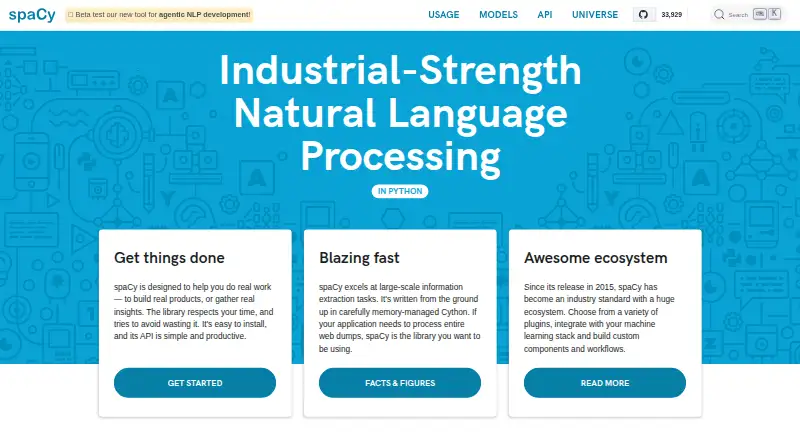
spaCy is a free, open-source Python library for building natural language processing applications, aimed at production workloads that handle large volumes of text. Its components cover named entity recognition, part-of-speech tagging, dependency parsing, sentence segmentation, text classification, lemmatization, morphology and entity linking. The maker lists support for 75+ languages and 84 trained pipelines for 25 languages, though trained pipelines are not available for every language. Developers can configure and train custom pipelines, describe training runs with configuration files, and package pipelines for installation as Python packages. spaCy Projects helps manage workflows that include downloads, commands, checksum checks and caching, with integrations for tracking, demos, serving models, distributed training and uploading to Hugging Face Hub. It can load pretrained transformers through spacy-transformers and work with custom models in PyTorch, TensorFlow and other frameworks. Installation is available through pip, conda or source on Linux, macOS and Windows, with CPU and GPU options. It is a library, not a hosted web application; transformer models require a GPU to run effectively, while word vectors are computationally efficient.
Who it suits
spaCy suits developers building NLP applications, especially production workflows that process large volumes of text. It is designed for users who can install and manage a Python library on their own systems.
What it does well
- Free, open-source library with a free plan.
- Components cover multiple NLP tasks, including entity recognition.
- Supports 75+ languages and 84 trained pipelines for 25.
- Custom pipelines can be trained and packaged as Python packages.
- Can run without data leaving the user's servers.
What to know first
- It is a library, not a hosted web application.
- Trained pipelines are not available for every supported language.
- Transformer models require a GPU to run effectively.
- Commercial consulting fees are quoted, with no price list published.
Limits
The free plan is an open-source library available under AGPL or a commercial license. Trained pipelines do not cover every supported language, and transformer models require a GPU to run effectively.
Plans
| Plan | Billed and limits | Price |
|---|---|---|
| spaCy | Free, open-source library; available under AGPL or a commercial license | Free |
As spacy.io lists them, read 7 Oct 2026. The maker's own page has the final word.
Getting started
- Open https://spacy.io/.
- Install spaCy through pip, conda or from source.
- Choose CPU or GPU installation options.
- Configure or train a pipeline, then package it for installation if needed.
spaCy is a Python library for building natural language processing into production software. It best suits developers who need to process substantial volumes of text and want to train and deploy their own pipelines. Its broad task coverage and flexible deployment are compelling; it is the wrong fit if you want a ready-to-use web app or hosted service.
Overview
Made by AI and NLP developer-tools company Explosion, spaCy supports tasks including entity extraction and linking, text classification, part-of-speech tagging, dependency parsing, sentence segmentation, lemmatization and morphological analysis. It supports 75+ languages and offers 84 trained pipelines across 25 languages. Tokenization support extends beyond those pipelines, so users may need to train their own for some languages.
Trained pipelines can be installed as Python packages, with data stored anywhere on the file system. spaCy can run on a user's servers without data leaving them, which suits deployments where data location matters. But this is a library for building applications, not a hosted service or finished web application.
Key features
Custom pipelines and projects
Developers can configure and train pipelines, package them for installation, and coordinate end-to-end workflows with spaCy Projects. Projects handle source downloads, command execution, checksum checks and caching across different backends. Configuration-file-based training makes runs reproducible, a useful foundation for teams iterating on models and workflows.
Model and framework support
spaCy loads pretrained transformers through spacy-transformers and can share transformer embeddings across pipeline components. It also supports custom models in PyTorch, TensorFlow and other frameworks. This flexibility is valuable for teams with existing models, but transformer models require a GPU to run effectively; word vectors are the more computationally efficient option.
Projects also describe integrations for data and experiment tracking, demos, model serving, distributed training and uploading pipelines to Hugging Face Hub. Installation is available through pip, conda or source, with CPU and GPU options. The library runs on Linux, macOS and Windows and is compatible with 64-bit CPython 3.7+.
Support and services
Community help is available through GitHub Discussions, the issue tracker and Stack Overflow. Explosion also offers custom NLP consulting and implementation, with fees quoted up front. That is a separate service rather than a packaged support plan.
Pricing
spaCy — free. The free, open-source library is available under AGPL or a commercial license. There are no stated seat or usage caps. The license choice matters for organizations deciding how to use and distribute software built with spaCy; teams that need different licensing terms can consider Explosion's consulting and implementation services, which use custom pricing.
Platforms
spaCy supports Linux, macOS and Windows, and can be self-hosted. It is a Python library rather than a browser-based product, so users need to install it and manage their own application and deployment. GPU hardware is important for effective transformer use, while word vectors offer a more efficient alternative.
Who it's for
spaCy is a strong fit for developers and organizations building production NLP applications, especially when they need custom pipelines, broad language coverage, control over deployment or the ability to keep data on their own servers. It is less suitable for people seeking qualitative research software, a hosted analysis interface or a turnkey text-analytics app.
Pros and cons
- Broad NLP coverage: Built-in components span entity extraction, parsing, classification and other common tasks, reducing the need to assemble each capability separately.
- Customizable and deployable: Pipelines can be trained, packaged and installed as Python packages, with data stored where the user chooses.
- Workflow support: Projects provide reproducible training configurations and tools for managing assets and commands.
- Language coverage has a gap: More languages have tokenization support than trained pipelines, so coverage may require custom training.
- Requires engineering ownership: Users must build and operate the application themselves; spaCy is not a hosted service.
- Transformer hardware cost: Effective transformer operation requires a GPU, which may be a constraint for some deployments.
Alternatives
For qualitative and text-analysis workflows rather than a Python NLP library, CATMA is free and has no listed project or collaboration count limit, though it is not designed for massive quantitative or statistical text analysis. Taguette is another free option for computer, server or hosted use. Voyant Tools offers an open-source text analysis environment as a hosted web app or downloadable local server.
KH Coder may suit users who want a desktop analysis application, with a free Windows edition limited to analysis data and features and an older beta version. MAXQDA is a paid macOS and Windows alternative with a free trial. QualCoder is free, open-source qualitative analysis software; optional AI features may require a separate provider account or paid usage.
Dovetail is a web-based option with a free plan covering one channel and one project, basic chat and AI summaries. TextAnalyzer is a free web-based set of NLP tools for researchers with CSV or XLSX support. Browse more options in Text Analytics Software.
Verdict
Choose spaCy if you have Python development resources and want broad NLP capabilities with custom training, package-based deployment and control over where data runs. Its strongest advantage is the combination of production-oriented pipelines and workflow tooling at no library cost. Look elsewhere if you need a hosted interface, a finished analysis product or a solution that avoids operating your own application.
Verdict
spaCy offers a broad set of NLP components and tools for training, packaging and deploying custom pipelines. It requires developers to manage the library themselves, and transformer use has a GPU requirement for effective operation.
Questions
Is spaCy free?
Yes. The plan is free, and spaCy is an open-source library available under AGPL or a commercial license.
What platforms does spaCy support?
It runs on Linux, macOS and Windows, including self-hosted deployments. The installation documentation lists compatibility with 64-bit CPython 3.7+.
What can spaCy do?
Its components cover tasks including named entity recognition, part-of-speech tagging, dependency parsing, sentence segmentation, text classification, lemmatization, morphology and entity linking.
Who makes spaCy?
Explosion identifies itself as spaCy's maker and describes its work as software for developer tools and AI and natural language processing services.
Does spaCy offer a web application?
No. spaCy is a library for building NLP applications, not a software-as-a-service product or web application.
Can spaCy keep data on my servers?
Yes. Explosion says spaCy can run without data leaving the user's servers.
Facts from spaCy's own pages
- Custom pipelines
- Users can configure and train custom pipelines, package them as Python packages, and manage end-to-end workflows with spaCy Projects. · spacy.io, 7 Oct 2026
- Data privacy
- Explosion says spaCy can run without data leaving the user's servers. · explosion.ai, 7 Oct 2026
- Deployment
- Trained pipelines can be installed as Python packages, and their data can be stored anywhere on the file system. · spacy.io, 7 Oct 2026
- Founded
- 2015 · spacy.io, 28 Sept 2026
- Framework integration
- The homepage says spaCy supports custom models in PyTorch, TensorFlow and other frameworks. · spacy.io, 7 Oct 2026
- Hardware limit
- The documentation says transformer models require a GPU to run effectively, while word vectors are computationally efficient. · spacy.io, 7 Oct 2026
- Headquarters
- Berlin, Germany · spacy.io, 28 Sept 2026
- Installation
- The documentation lists installation through pip, conda or source, with CPU and GPU options. · spacy.io, 7 Oct 2026
- Integrations
- The documentation describes integrations with transformer pipelines, CuPy for GPU support and an extension for Visual Studio Code configuration files. · spacy.io, 7 Oct 2026
- Languages
- The site lists support for 75+ languages and 84 trained pipelines for 25 languages. · spacy.io, 7 Oct 2026
- Language support
- The maker’s homepage states that spaCy supports 75+ languages and offers 84 trained pipelines for 25 languages. · spacy.io, 7 Oct 2026
- Maker
- Explosion identifies itself as the maker of spaCy and describes itself as a software company specializing in developer tools and services for AI and natural language processing. · explosion.ai, 7 Oct 2026
- Model availability
- The documentation notes that although spaCy supports tokenization for many languages, trained pipelines are not available for every language. · spacy.io, 7 Oct 2026
- NLP features
- Its components include named entity recognition, part-of-speech tagging, dependency parsing, sentence segmentation, text classification, lemmatization and morphological analysis. · spacy.io, 7 Oct 2026
- NLP tasks
- Its components cover named entity recognition, part-of-speech tagging, dependency parsing, sentence segmentation, text classification, lemmatization, morphology and entity linking. · spacy.io, 7 Oct 2026
- Operating systems
- The installation documentation says spaCy runs on Unix/Linux, macOS/OS X and Windows and is compatible with 64-bit CPython 3.7+. · spacy.io, 7 Oct 2026
- Paid services
- Explosion offers custom NLP consulting and implementation, with fees quoted up front; the page does not publish a price list. · explosion.ai, 7 Oct 2026
- Product boundary
- spaCy is a library for building NLP applications; it does not provide a software-as-a-service product or web application. · spacy.io, 7 Oct 2026
- Project integrations
- spaCy Projects describes integrations for data and experiment tracking, demos, model serving, distributed training and uploading pipelines to Hugging Face Hub. · spacy.io, 7 Oct 2026
- Purpose
- spaCy is a Python library for advanced natural language processing, designed for production use and processing large volumes of text. · explosion.ai, 7 Oct 2026
- Security
- The official pages opened for this research did not state a security certification or compliance standard. · spacy.io, 7 Oct 2026
- Support
- The site links to GitHub Discussions, an issue tracker and Stack Overflow for community help. · spacy.io, 7 Oct 2026
- Training
- Its training system uses configuration files to describe training runs and make experiments reproducible. · spacy.io, 7 Oct 2026
- Transformer integration
- spaCy can load pretrained transformer models through spacy-transformers and supports sharing transformer embeddings across pipeline components. · spacy.io, 7 Oct 2026
Where spaCy stands on Freedom251
- Natural Language Processing Software#2 of 28
- Text Analytics Software#7 of 37