Freedom251 › Payment Reconciliation Software
SettleFlow
What SettleFlow is
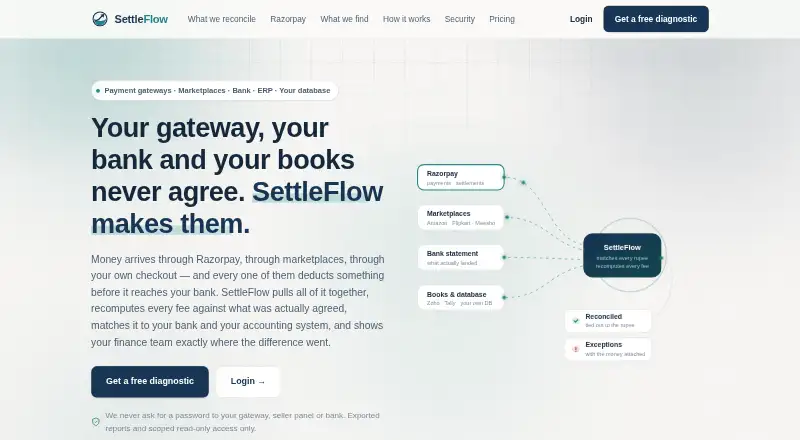
SettleFlow reconciles payment gateway, marketplace, bank, and accounting data to identify settlement and fee differences. It recalculates fees against the applicable rate card and flags commission variances, shipping or weight errors, duplicate deductions, and unsettled orders. For GST reconciliation, it ties settlement data to GSTR-1 and GSTR-3B and checks marketplace TCS reported in GSTR-8. Users can upload settlement, order, and returns reports as CSV or Excel, or use scoped read-only API access where available. Listed sources include payment services such as Razorpay and Cashfree, marketplaces such as Amazon.in and Flipkart, accounting tools, databases, bank statements, and the GST portal. Findings include claim expiry dates, filing routes, and evidence requirements; users can track claims and recoveries. Tables can be downloaded as CSV, and each run creates a workbook with a summary and order-level detail. An audit trail records uploads, runs, rule changes, exports, and claim actions. Workspaces support four roles and multiple entities; agencies and CA firms can manage clients under one login. Plans start at ₹9,999/mo, with monthly row counts measured across all sources.
Who it suits
SettleFlow is described for Indian sellers, agencies, and CA firms that need to reconcile settlements, fees, and GST data. Its multi-entity workspaces and client management may suit service providers handling several organizations.
What it does well
- Recomputes fees and flags several deduction and order issues.
- Ties settlement data to GSTR-1 and GSTR-3B.
- Tracks claim deadlines, filing routes, and recoveries.
- Workspaces offer owner, admin, analyst, and read-only roles.
- Free diagnostic covers 90 days of one source.
What to know first
- Starter is limited to one entity and two users.
- Monthly row counts span transactions across every source.
- Backlog recovery is quoted separately as a fixed-price sprint.
- Paid plans start at ₹9,999/mo.
Limits
The free diagnostic covers one source and 90 days of data. Starter costs ₹9,999 a month and allows 2,50,000 rows across all sources, one entity and two users; backlog recovery is a separately quoted fixed-price sprint.
Plans
| Plan | Billed and limits | Price |
|---|---|---|
| Free Diagnostic | 1 source · 90 days of data · full leakage report · order-level detail · claim deadlines · ongoing monitoring · auto-fetch | Free |
| Growth | monthly · 1,000,000 rows/month · 1 entity · 3 users · auto-fetch on 3 accounts · three-way GST tie-out · claim pack · scheduled reports | ₹19,999 a month |
| Scale | monthly · 3,500,000 rows/month · 2 entities · 5 users · auto-fetch on 6 accounts · three-way GST tie-out · priority support | ₹35,000 a month |
| CA firms, agencies & custom | monthly · 5,000,000 rows/month · multiple client entities · 10 users · white-label · revenue share | ₹60,000 a month |
| Starter | monthly · 250,000 rows/month · 1 entity · 2 users · auto-fetch · claim-window tracker · GST tie-out | ₹9,999 a month |
As settleflow.in lists them, read 15 Oct 2026. The maker's own page has the final word.
Getting started
- Open the SettleFlow website.
- Request the no-cost diagnostic for one source covering 90 days of data.
- Upload settlement, order or returns reports as CSV or Excel, or use scoped read-only API access where available.
- Choose a plan based on monthly rows, entities and users.
- Invite workspace users and assign owner, admin, analyst or read-only roles.
Overview
SettleFlow is a web service for Indian sellers, agencies and CA firms that need to reconcile marketplace and payment settlements with bank and accounting data. It is most compelling for teams that want discrepancies carried through into GST checks and claims, rather than stopping at matching totals. Its cross-source row caps and separately quoted backlog work make volume an important part of the buying decision.
Key features
SettleFlow recomputes fees against the applicable rate card and flags commission differences, shipping or weight errors, duplicate deductions and unsettled orders. That makes it useful for finding potential leakage as well as reconciling deposits; the value is greatest where teams have enough transaction volume to justify systematic review.
GST checks connect settlement data with GSTR-1 and GSTR-3B and check marketplace TCS reported in GSTR-8. The product also supports invoice reconciliation and automatic matching. CSV and Excel uploads cover settlement, order and returns reports, while scoped, read-only API access can be used where available. Sources span Razorpay, Cashfree, PayU, Paytm, PhonePe, major Indian marketplaces, Shopify, Zoho Books, Tally, QuickBooks, PostgreSQL, MySQL, bank statements and the GST portal. This is a broad fit for multi-channel operations, but every source contributes to the same monthly row allowance.
Findings carry claim expiry dates, filing routes and evidence requirements, with tracking for claims and recoveries. Downloadable CSV tables and a workbook per reconciliation run provide summary and order-level views; an audit trail records uploads, runs, rule changes, exports and claim actions. These records are practical strengths for finance teams that need to follow a discrepancy from detection through follow-up.
Workspaces provide owner, admin, analyst and read-only roles, can contain multiple entities, and let agencies or CA firms manage clients under one login. SettleFlow says it uses PostgreSQL row-level security to separate workspaces and encrypts stored API credentials before they reach the database. It says it does not request gateway, seller-panel or bank passwords; automatic retrieval uses scoped read-only API keys. The company also says it does not sell, share, pool, benchmark or train on customer figures, and will delete a workspace and its data on request.
A no-cost diagnostic covers 90 days of data from one source and includes a full leakage report, order-level detail and identified claim deadlines, with results promised within three working days. It is a focused way to assess one source, not a substitute for evaluating ongoing multi-source capacity.
Pricing
The Free Diagnostic costs ₹0.00 per free and covers one source and 90 days of data. It includes the leakage report, order detail and claim-deadline identification, but not a continuing multi-source workflow.
Starter costs ₹9,999 a month for 2,50,000 rows a month, one entity and two users. Auto-fetch, claim-window tracking and GST tie-out make it the entry plan for a small operation that needs an ongoing process. The single-entity and two-user limits leave little room for a larger finance team or client portfolio.
Growth costs ₹19,999 a month and raises the monthly allowance to 10,00,000 rows, with one entity and three users. It adds auto-fetch on three accounts, three-way GST tie-out, claim packs and scheduled reports. This is the more capable choice for a higher-volume single entity; it still does not expand entity capacity.
Scale costs ₹35,000 a month for 35,00,000 rows, two entities and five users. Six auto-fetch accounts, three-way GST tie-out and priority support suit larger operations that need more throughput or a second entity. CA firms, agencies and custom costs ₹60,000 a month, with 50,00,000 rows, multiple client entities, ten users, white-label and revenue share. That tier is tailored to service providers, though its row cap remains relevant across clients.
Monthly row counts measure transactions processed across every source, so adding systems can use capacity faster than a single-source workflow. Backlog recovery is quoted separately as a fixed-price sprint. Check both the row allowance and entity and user limits against the intended workload before choosing a tier.
Platforms
SettleFlow runs on the web. API access and scoped read-only retrieval support data workflows, but the product does not list a mobile platform.
Who it's for
SettleFlow is best suited to Indian sellers reconciling several payment and marketplace channels, or agencies and CA firms that need client workspaces, audit records and claim follow-through. It is less suitable for a small operation that only needs a simple bank-statement match, or for teams that cannot estimate transaction volume across all connected sources.
Pros and cons
- Pros: Fee, settlement and GST checks sit alongside claim tracking, giving finance teams a path from a discrepancy to recovery.
- Pros: Multi-source input, role-based access, entity workspaces and an audit trail suit complex seller or client operations.
- Pros: The free diagnostic provides a defined, one-source starting point with order-level findings and claim deadlines.
- Cons: All sources count toward the monthly row cap, which can make broad data coverage consume a plan's capacity quickly.
- Cons: Starter and Growth each cover only one entity, while the larger multi-client tier costs ₹60,000 a month.
- Cons: Recovering historical backlog is a separate fixed-price sprint, adding cost beyond the recurring plan.
Alternatives
For a broader shortlist, see Payment Reconciliation Software. Choose UnPay Loan Management System instead if you want a loan-management product with a free sandbox spanning 15 products and 480 API endpoints. Fihary is an alternative with Android, web and Windows platforms and a free tier limited to one mobile-money operator and one user. BankStatementMatcher offers a free web/API tier for statement and receipt matching, with daily usage and upload-row caps. ReconcileIQ has a free starting tier with 1,000 one-off credits and one IQ Books organisation for cash accounting, making it an option for that narrower workflow. SettlePair is a free web reconciliation alternative. Invoiced is an API/web alternative with custom pricing. Loopfour Payment Reconciliation is a paid API/web alternative. Serrala Alevate AR Cash Application is a paid web alternative with custom pricing.
Verdict
Choose SettleFlow if your Indian business or client practice needs fee-level settlement checks, GST tie-outs and claim follow-through in one web workflow. Its combination of audit records, multiple data sources and entity-aware access is the reason to choose it; the main reason to look elsewhere is that cross-source volume, entity needs and separately priced backlog recovery can push a seemingly simple reconciliation workflow into a larger commitment.
Verdict
SettleFlow brings settlement reconciliation, GST checks, claim tracking, and audit records into one web service. Check row and entity limits against your data volume and workflow before selecting a plan.
Questions
Is there a free option?
Yes. Free Diagnostic costs nothing and covers one source and 90 days of data, with a leakage report, order-level detail and identified claim deadlines.
What does a paid plan cost?
Starter is ₹9,999 a month. Growth is ₹19,999 a month, Scale is ₹35,000 a month, and CA firms, agencies & custom is ₹60,000 a month.
Which platforms and data sources does it support?
SettleFlow is web-based. Listed sources include payment providers, marketplaces, Shopify, accounting tools, PostgreSQL, MySQL, bank statements and the GST portal.
Can I connect accounting and payment services?
Listed payment processors are Razorpay, Cashfree, PayU, Paytm and PhonePe. Accounting integrations are Zoho Books, Tally and QuickBooks.
How can I provide data?
Upload settlement, order and returns reports as CSV or Excel, or use scoped read-only API access where available. The service says it does not request gateway, seller-panel or bank passwords.
What are the row limits?
Starter includes 2,50,000 rows a month, Growth 10,00,000, Scale 35,00,000, and CA firms, agencies & custom 50,00,000. Monthly rows count transactions processed across every source.
Facts from SettleFlow's own pages
- Accounting reconciliation
- It compares recorded revenue and fees with settled revenue and supports GST tie-outs involving GSTR-1, GSTR-3B and GSTR-8. · settleflow.in, 15 Oct 2026
- API access
- Direct connections use scoped read-only API keys that customers create and can revoke. · settleflow.in, 15 Oct 2026
- Audit trail
- Logins, uploads, reconciliation runs, rule changes, exports and claim actions are recorded with user and timestamp. · settleflow.in, 15 Oct 2026
- Authentication
- Sign-in uses a one-time code sent to a work email instead of a password. · settleflow.in, 15 Oct 2026
- Automated mapping
- Uploaded CSV or Excel columns are matched automatically and the confirmed format is reused on later files. · settleflow.in, 15 Oct 2026
- Automation capabilities
- A LinkedIn post describes automated journal entries, Zoho Books and ERP integration, real-time MIS dashboards, Power BI and Tableau reporting, and Python automation. · linkedin.com, 15 Oct 2026
- Claim tracking
- Users can manage exception queues, record claims and recoveries, and track filing windows and evidence requirements. · settleflow.in, 15 Oct 2026
- Commerce integration
- Shopify or other D2C order data can be reconciled. · settleflow.in, 15 Oct 2026
- Company positioning
- The LinkedIn company page says it serves D2C brands, marketplace sellers and finance teams with reconciliation and audit-ready reporting. · in.linkedin.com, 15 Oct 2026
- Company profile
- LinkedIn describes SettleFlow as a privately held financial-services company with 2–10 employees in Noida and a 2023 founding year. · in.linkedin.com, 15 Oct 2026
- Credential handling
- Optional API credentials are encrypted before storage and are not written to logs. · settleflow.in, 15 Oct 2026
- Database connectivity
- The product supports read-only PostgreSQL and MySQL connections, scheduled exports or CSV uploads. · settleflow.in, 15 Oct 2026
- Data deletion
- The maker says a workspace and its data can be deleted in full on request. · settleflow.in, 15 Oct 2026
- Data input
- Users can upload settlement, order and returns reports as CSV or Excel, or use scoped read-only API access where available. · settleflow.in, 8 Oct 2026
- Data use and deletion
- The company says it does not sell, share, pool, benchmark or train on customers’ figures, and will delete a workspace and its data on request. · settleflow.in, 8 Oct 2026
- Documentation
- The public site provides feature, FAQ, pricing, privacy and terms pages but no separate public developer documentation was identified. · settleflow.in, 15 Oct 2026
- ERP integrations
- The listed accounting systems are Zoho Books, Tally and QuickBooks. · settleflow.in, 15 Oct 2026
- Exception checks
- The workflow runs sixteen checks against the applicable rate card and assigns an expiry date to each finding. · settleflow.in, 15 Oct 2026
- Exports
- Every table exports to CSV and each reconciliation produces a workbook with summary and order-level detail. · settleflow.in, 15 Oct 2026
- Fee checks
- It recomputes fees against the applicable rate card and flags issues such as commission variances, shipping and weight errors, duplicate deductions, and unsettled orders. · settleflow.in, 8 Oct 2026
- Gateway matching
- It matches captured payments, gateway settlements and bank credits transaction by transaction using UTRs. · settleflow.in, 15 Oct 2026
- GST reconciliation
- The product ties settlement data to GSTR-1 and GSTR-3B and checks marketplace TCS reported in GSTR-8. · settleflow.in, 8 Oct 2026
- Headquarters
- Sector 10, Noida, Uttar Pradesh, India · settleflow.in, 28 Sept 2026
- Integration breadth
- The same post names Razorpay, Cashfree, PayU, Paytm, PhonePe, CCAvenue, Juspay, HDFC PG, Shiprocket, Delhivery, Bluedart, Xpressbees, DTDC, Amazon, Flipkart, Meesho, Shopify and WooCommerce. · linkedin.com, 15 Oct 2026
Where SettleFlow stands on Freedom251
- Payment Reconciliation Software#4 of 29