Freedom251 › Minecraft Seed Finders

SeedFinder
What SeedFinder is
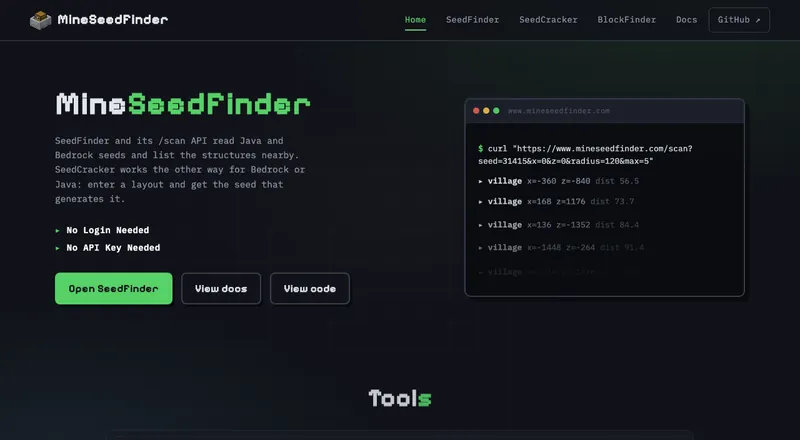
SeedFinder helps Minecraft players locate nearby structures from a world seed and player position, and SeedCracker searches for Bedrock seeds matching structures near supplied coordinates. The listed structures include villages, temples, ocean structures, ancient cities, mansions, portals, buried treasure, mineshafts, trail ruins, and trial chambers. SeedFinder’s browser console runs scans locally through WebAssembly without an account, key, or download. Its REST API accepts GET or POST requests and returns JSON, with examples for Python, Lua, and Node.js. The hosted API is limited to 60 requests per IP per minute; scans are capped at a 1,000-chunk radius and 200 results. An integration can show nearby structures in an in-game overlay using Flarial Client. SeedCracker needs coordinates for at least four structures. It runs in the browser, but its hosted HTTP API is offline; the documented HTTP API runs on a local server. The site says browser scans run locally and do not need a connection to a Minecraft world or third-party seed map. The Free plan costs nothing.
Who it suits
SeedFinder suits Minecraft players seeking structures near a world seed and player position, or a Bedrock seed matching a chosen structure layout. Developers can also use its REST API or documented language examples.
What it does well
- Browser scans run through WebAssembly without an account or download.
- REST API returns JSON for GET or POST requests.
- Structure list includes ancient cities and trial chambers.
- Flarial Client integration can show nearby structures in-game.
What to know first
- Hosted API allows 60 requests per IP per minute.
- Scans cap the radius at 1,000 chunks.
- Results are capped at 200.
- SeedCracker needs coordinates for at least four structures.
Limits
The free hosted API allows 60 requests per IP per minute, with a scan radius capped at 1,000 chunks and results capped at 200. SeedCracker needs coordinates for at least four structures; its hosted HTTP API is offline, and the documented HTTP API runs on a local server.
Plans
| Plan | Billed and limits | Price |
|---|---|---|
| Free | Hosted browser tools and API · 60 requests per IP per minute | Free |
As mineseedfinder.com lists them, read 15 Oct 2026. The maker's own page has the final word.
Getting started
- Open https://mineseedfinder.vercel.app/ in a browser to use the console without an account, key, or download.
- Run a SeedFinder scan using a world seed and player position.
- For API use, send a GET or POST request to the REST API and read the JSON results.
- For the in-game overlay, use the SeedFinder module with Flarial Client.
- For SeedCracker, provide coordinates for at least four structures in its browser tool.
SeedFinder is a Minecraft structure-finding toolkit for Java and Bedrock players, with a browser console, REST API and an in-game overlay integration. It is best for players who want to scan a known world or search for a Bedrock seed from several structure locations; the missing map preview is a meaningful drawback for anyone who wants a visual way to explore results.
Overview
SeedFinder locates structures near a player position when the world seed is known. Its companion SeedCracker works in reverse, searching for Bedrock seeds that place selected structures near supplied coordinates. Together, they cover both finding points of interest in a world and narrowing down an unknown seed, but SeedCracker needs coordinates for at least four structures, so one landmark is not enough.
Key features
- Structure and terrain search: SeedFinder covers villages, temples, ocean structures, ancient cities, mansions, portals, buried treasure, mineshafts, trail ruins and trial chambers. Terrain analysis adds another way to assess a seed, but there is no map preview; players who prefer visual map browsing should choose a map-oriented alternative.
- Browser console: Scans run locally in the browser through WebAssembly without an account, key or download. The site says the console needs no connection to the Minecraft world or a third-party seed map, which suits players who want to keep the scan on their device.
- REST API: GET and POST requests return JSON, and documentation examples for Python, Lua and Node.js make the API approachable for developers using those languages. The hosted service allows 60 requests per IP per minute, with a maximum radius of 1,000 chunks and 200 results per scan; that is a clear ceiling for automated or especially broad searches.
- Flarial Client overlay: The SeedFinder module can display nearby structures in an in-game overlay, a practical fit for players who want results while playing rather than switching between the game and a browser.
- SeedCracker access: SeedCracker runs in the browser via WebAssembly. Its hosted HTTP API is offline, though its documented HTTP API can run on a local server, so developers seeking a hosted reverse-search endpoint will need another approach.
Pricing
SeedFinder is free, with a Free plan at no cost. Browser tools and the hosted API are included, and there is no free-trial period. The browser console avoids API quotas, while API users must work within the 60-requests-per-IP-per-minute limit, 1,000-chunk scan radius and 200-result cap. The plan is a strong fit for personal scans and modest API use; those limits make it less suitable for sustained high-volume requests.
Platforms
SeedFinder supports web, API, Linux, Windows and self-hosted use, and supports Bedrock edition. Its browser console needs no download, while the self-hosted option is relevant to users who want to run the documented HTTP API locally. The Flarial Client overlay adds an in-game option for nearby-structure results.
Who it's for
Choose SeedFinder if you play Java or Bedrock and want to locate nearby structures from a known seed, or if you have several structure coordinates and want to find a matching Bedrock seed. It also suits developers who want JSON responses and examples in Python, Lua or Node.js, plus Flarial Client users who value an overlay. Look elsewhere if a map preview is central to how you search, or if your project depends on SeedCracker’s hosted HTTP API.
Pros and cons
- Pros: Local browser scans require no account, key or download, and the site says they do not connect to the Minecraft world or a third-party seed map.
- Pros: Broad structure coverage, terrain analysis, an API and a Flarial Client overlay give players and developers several ways to use the tools.
- Cons: There is no map preview, so results are less suited to players who want to inspect a seed visually.
- Cons: Hosted API quotas cap both request frequency and scan size, which may constrain frequent or wide searches.
- Cons: SeedCracker’s hosted HTTP API is offline, limiting convenient remote access to reverse searches.
Alternatives
For a broader comparison, browse Minecraft Seed Finders.
- MC Seed View is a free alternative on Android, iOS and web, with an independently maintained project that began in 2025.
- ChunkSeeds Seed Finder is a free web tool for Java Edition reverse searches, with standard scans of up to 350,000 seeds per pass.
- Crafty Seed Map is a free in-browser Java Edition seed viewer for versions 1.18.2, 1.19.4, 1.20.6, 1.21.1 and 1.21.3; choose it for visual viewing on those releases.
- Ezseed Minecraft Seed Finder is a browser-based, no-download, no-account option for Java 1.20–26.2 and Bedrock up to 26.30.
- Feed the Mods Minecraft Seed Map is another free browser seed-map tool.
- KLIMATA offers a free web plan with unlimited core features, saves for up to three seeds and five exports per day, with more exports after watching an ad.
- MC Seed Map Seed Finder is a free Java Edition seed-search option.
- Minecraft Search Seed Finder keeps website content and core features free, with an optional Emerald Monthly plan at $2.99 a month that renews every month and adds supporter perks.
Verdict
SeedFinder is a good choice for Java and Bedrock players who want local browser scans, broad structure coverage, or an API and overlay around a known world. Its free access and range of entry points are compelling, but the absent map preview, hosted API caps and offline SeedCracker endpoint are solid reasons to choose another tool for visual exploration or hosted reverse-search workflows.
Verdict
SeedFinder offers browser-based structure scans, an API, and a Flarial Client overlay integration. Note the hosted API limits and that SeedCracker’s hosted HTTP API is offline.
Questions
How much does SeedFinder cost?
The Free plan costs nothing.
Which Minecraft editions does it support?
The listed edition support is Bedrock. SeedFinder's purpose also describes finding structures in Bedrock and Java contexts.
Can I use SeedFinder without installing anything?
Yes. Its browser console runs scans through WebAssembly without an account, key, or download.
What limits apply to the hosted API?
It allows 60 requests per IP per minute. Scans are capped at a 1,000-chunk radius and 200 results.
How does SeedCracker work, and what does it require?
It searches for Bedrock seeds with selected structures at or near supplied coordinates. A search requires at least four structures with coordinates.
Does SeedCracker have a hosted API?
Its hosted HTTP API is offline. The documented HTTP API runs on a local server.
Facts from SeedFinder's own pages
- Accuracy limitation
- The project warns that coordinates are predictions and can differ when Minecraft world-generation versions change. · mineseedfinder.com, 15 Oct 2026
- API
- The REST API accepts GET or POST requests and returns JSON results. · mineseedfinder.com, 9 Oct 2026
- API limits
- Hosted API documentation caps radius at 1,000 and results at 200, while the hosted service limits each IP to 60 requests per minute. · mineseedfinder.com, 15 Oct 2026
- API parameters
- Scan requests accept seed, x, z, radius, max and structure-type parameters, with an edition selector on the general route. · mineseedfinder.com, 15 Oct 2026
- Architecture
- The implementation combines a C engine based on cubiomes, a Python Flask HTTP layer and a Lua Flarial module. · github.com, 15 Oct 2026
- Browser execution
- SeedCracker runs in the browser through WebAssembly, with calculations performed on the user's machine. · mineseedfinder.com, 15 Oct 2026
- Browser operation
- The SeedFinder console runs scans in the browser via WebAssembly without an account, key or download. · mineseedfinder.com, 9 Oct 2026
- Developer support
- API documentation includes examples for Python, Lua and Node.js. · mineseedfinder.com, 9 Oct 2026
- Flarial integration
- A Lua module for Flarial Client renders nearby structures in an in-game ImGui overlay. · github.com, 15 Oct 2026
- Integrations
- The SeedFinder module can show nearby structures in an in-game overlay using Flarial Client. · mineseedfinder.com, 9 Oct 2026
- Intended users
- The tools are for Minecraft players who want to locate structures in a world or find a Bedrock seed matching a chosen structure layout. · mineseedfinder.com, 9 Oct 2026
- Java cracker scope
- The Java cracker searches 48-bit seeds using exact structure positions. · mineseedfinder.com, 15 Oct 2026
- Java implementation
- Java scans use cubiomes placement and target the latest Java release. · github.com, 15 Oct 2026
- Licence
- The repository uses a permissive Zlib-style licence allowing commercial use, modification and redistribution with origin attribution and altered-source marking. · github.com, 15 Oct 2026
- Limit: client naming
- A technicalminecraft commenter said the SeedCrackerX name could confuse users because another tool with that name is Java-only. · reddit.com, 15 Oct 2026
- Limit: mineshaft cracking
- The Reddit update says mineshafts cannot be used as SeedCracker input because their random generation works per chunk rather than per region. · reddit.com, 15 Oct 2026
- Local API
- A self-hosted server listens on 127.0.0.1:7890 by default and does not impose the hosted per-IP limit. · mineseedfinder.com, 15 Oct 2026
- Local executable
- The packaged Windows executable bundles the server so players do not need Python or pip installed. · github.com, 15 Oct 2026
- Maker
- The project identifies itself as a personal project by the GitHub user @zebedelu rather than a company or studio. · mineseedfinder.com, 15 Oct 2026
- Maker identity
- The linked GitHub profile identifies @zebedelu as Pedro Vinicius, an information-technology student in Concórdia, Santa Catarina, Brazil. · github.com, 15 Oct 2026
- Multi-type scans
- A single request can ask for several structure types by passing multiple type IDs. · github.com, 15 Oct 2026
- No account
- The hosted tools require no login, account or sign-up. · mineseedfinder.com, 15 Oct 2026
- No API key
- The public REST API can be called without an API key. · mineseedfinder.com, 15 Oct 2026
- Performance report
- The Reddit update reports approximately 900,000 seeds per second on one CPU core, with additional cores used in parallel. · reddit.com, 15 Oct 2026
Where SeedFinder stands on Freedom251
- Minecraft Seed Finders#1 of 36