Freedom251 › Application Lifecycle & Release Management

SAP Cloud ALM
What SAP Cloud ALM is
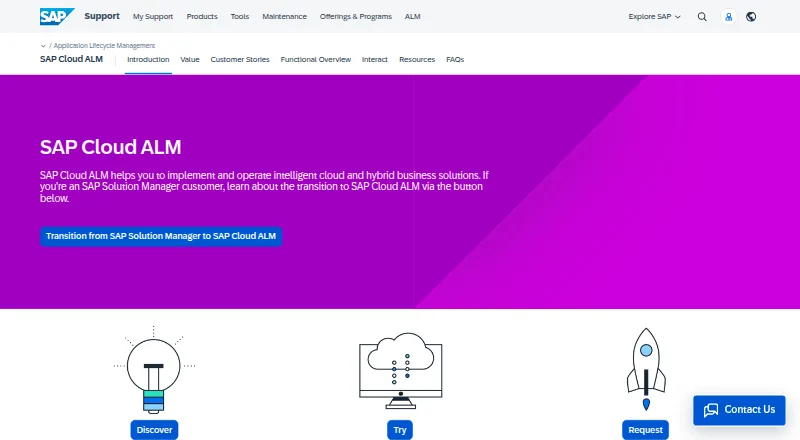
SAP Cloud ALM is a cloud service for managing SAP landscapes through guided implementation and automated operations. Its implementation tools support SAP Activate project work, fit-to-standard workshops, task management, documentation, testing, deployment planning and reporting. Test management handles manual and automated testing, including integrations with SAP S/4HANA Test Automation Tool and Tricentis Test Automation, plus an open API for other providers. Operations monitoring covers business processes, integrations and exceptions, user performance, jobs and automation, configuration and security, system health, and business services. It can connect third-party tools through open APIs and monitor custom SAP BTP and non-SAP applications. Configuration and Security Analysis can check system settings daily against SAP product security recommendations. SAP describes the service as SaaS, with a preferred data center location selected when requesting a tenant. Eligible customers receive one tenant and 24 GB SAP HANA Memory with 24 GB monthly outbound API data transfer at no charge. Usage is limited to internal application lifecycle management, and on-premise SAP solutions must be covered by the customer's SAP Support agreement.
Who it suits
It suits eligible SAP Cloud Service customers who need tools for internal SAP implementation and operations management. Its monitoring and integration features may also suit teams working with custom SAP BTP or non-SAP applications.
What it does well
- Free plan for eligible support customers.
- Guided implementation includes testing and deployment planning.
- Manual and automated test management.
- Daily checks against SAP security recommendations.
- Open APIs support third-party integrations.
What to know first
- Usage rights require qualifying support subscriptions.
- Use is limited to internal lifecycle management.
- On-premise SAP solutions need support agreement coverage.
Limits
Eligible customers receive one tenant per customer number, with 24 GB SAP HANA Memory and 24 GB monthly outbound API data transfer. Usage is limited to internal application lifecycle management, and on-premise SAP solutions must be covered by the customer's SAP Support agreement. Demo data may be cleaned at any time; unchanged implementation projects are archived after two months and deleted if not restored within 30 days.
Plans
| Plan | Billed and limits | Price |
|---|---|---|
| SAP Cloud ALM | One tenant per customer number for eligible support customers · 24 GB SAP HANA Memory · 24 GB monthly outbound API data transfer | Free |
As support.sap.com lists them, read 29 Sept 2026. The maker's own page has the final word.
Getting started
- Visit SAP's Cloud ALM page and confirm that your SAP Cloud Service subscription includes qualifying support.
- Request a tenant and select a preferred data center location.
- Use the public demo tenant at no cost to explore the service.
- Connect testing or third-party tools through the supported integrations and open APIs.
SAP Cloud ALM is a cloud service for managing SAP implementation work and monitoring systems in operation. It suits organizations with qualifying SAP support subscriptions that need lifecycle tools for internal use. Its breadth is useful within that boundary, but it is not a general-purpose standalone ALM service.
Overview
The service connects guided SAP project work with oversight of SAP landscapes after deployment. That gives eligible teams a way to carry implementation planning, testing and reporting into operational monitoring. The trade-off is material: usage rights depend on qualifying SAP support subscriptions, use is restricted to internal application lifecycle processes, and on-premises SAP solutions must be covered by the customer’s SAP Support agreement.
SAP was founded in 1972 and is headquartered in Walldorf, Germany. Cloud ALM is delivered as SaaS, with customers able to select a preferred data center location when requesting a tenant.
Key features
Implementation and testing
SAP Activate guidance, fit-to-standard workshops, task management, documentation, testing, deployment planning and reporting give implementation teams a structured set of workflows. Test management supports both manual and automated testing, including SAP S/4HANA Test Automation Tool and Tricentis Test Automation, with an open API for other providers. This is a strong fit for teams coordinating SAP delivery; the published delivery methodology is agile, so teams using other approaches should confirm that the workflows match their needs.
Operations monitoring and integrations
Monitoring spans business processes, integrations and exceptions, user performance, jobs and automation, configuration and security, system health, and business services. The range connects technical signals with business service oversight rather than focusing on a single monitoring category. Open APIs support third-party tools, and the operations overview includes custom SAP BTP and non-SAP applications alongside third-party monitoring and analytics integrations.
Configuration and security
Configuration and Security Analysis can check system configurations daily against SAP product security recommendations. That gives teams a recurring way to identify configuration gaps against SAP guidance, though the stated scope is those recommendations rather than a general security assessment.
Support and demo access
SAP provides support requests, expert portals, a learning portal, community discussions and virtual and on-site events. Its data may be cleaned at any time; unchanged implementation projects are archived after two months and deleted if not restored within 30 days, so it is better for exploration than preserving ongoing work.
Pricing
SAP Cloud ALM is free for eligible support customers. The SAP Cloud ALM plan costs nothing and includes one tenant per customer number, 24 GB of SAP HANA memory and 24 GB of monthly outbound API data transfer. For an eligible customer, this avoids a per-seat charge in the stated plan, but the tenant and resource allowances are finite. Teams should consider whether one tenant and the memory and transfer limits suit their landscape before relying on it at scale.
The free offer is not open to every organization: usage rights are included only for customers with qualifying SAP Cloud Service subscriptions containing Enterprise Support, SAP Enterprise Support or Product Support for Large Enterprises. The internal-use restriction also rules out using it as a service for external customers. No paid Cloud ALM plan is described, so it is not a pricing route for organizations that do not meet the eligibility conditions.
Platforms
SAP Cloud ALM lists API and web platforms. Its API and third-party integration support can suit teams connecting other tools, while the web platform provides access to the cloud service. The deployment option is described as on-premises, but that does not remove the requirement that on-premises SAP solutions be covered by the customer’s SAP Support agreement.
Who it's for
Cloud ALM is most appropriate for qualifying SAP support customers managing internal SAP implementation and operations work. It is particularly relevant when the same organization wants guided project workflows, manual and automated testing, and monitoring across business processes and technical services. Teams relying on third-party tooling can extend integrations through open APIs.
It is a poor fit for organizations without the required support subscription, teams that need to manage application lifecycles for external customers, or customers whose on-premises SAP solutions lack the required support coverage. The one-tenant allowance and monthly API transfer cap also matter for customers with multiple environments or substantial outbound integration traffic.
Pros and cons
- Pros: Implementation planning, testing and operational monitoring sit in one service, linking project delivery with ongoing oversight.
- Pros: Manual and automated test management, named SAP and Tricentis integrations, and an open API offer options for testing workflows.
- Pros: Monitoring covers business and technical areas, with APIs for third-party tools and non-SAP applications.
- Pros: Eligible customers pay free for the stated plan, with a public demo tenant also available at no cost.
- Cons: Access depends on qualifying SAP support subscriptions, which excludes organizations outside that customer base.
- Cons: Internal-use limits and on-premises support requirements restrict where and how it can be used.
- Cons: The free plan provides one tenant per customer number and caps memory at 24 GB and monthly outbound API transfer at 24 GB.
- Cons: Demo data may be cleaned at any time, and unchanged projects are archived and may later be deleted, making the tenant unsuitable as a durable workspace.
Alternatives
For teams comparing lifecycle and software-asset tools, Application Lifecycle Management Software and Software Asset Management Software provide broader category starting points.
LICENSEWARE may suit readers who want a freemium option with a free tier capped at 10 rows per table and a consumption-based PAYG plan at $1 a month billed one-off. Choose Eracent Software License Management if an enterprise software license management product is the priority. K2 KeyServer is another paid option, with KeySight billed per year, concurrent-use licensing and sales in 10-client increments.
License Dashboard is a paid alternative for readers comparing software license management products. Open iT LicenseAnalyzer offers three functionality levels: Runtime Usage, True Active Usage and Managed Usage. Flexera One IT Asset Management is worth considering for readers comparing IT asset management options; it offers a free plan, while its paid pricing is custom.
Matrix42 FastViewer may suit organizations seeking concurrent-session licensing, at €540 a year per concurrent session, plus 19% VAT. AWS License Manager is a free alternative for readers evaluating another no-cost option.
Verdict
Choose SAP Cloud ALM if your organization has the qualifying SAP support subscription and wants implementation workflows, testing and operations monitoring for internal SAP work without a separate plan charge. Its integrated scope is the main reason to choose it; the support eligibility, internal-use boundary and finite tenant and resource allowances are the reasons to look elsewhere if your needs fall outside that model.
Verdict
SAP Cloud ALM combines implementation workflows, testing and operations monitoring in one cloud service. Eligibility and internal-use restrictions are important to confirm before choosing it.
Questions
Is SAP Cloud ALM free?
The plan is listed as free. Usage rights are included for customers with qualifying SAP Cloud Service subscriptions containing specified support.
What does an eligible customer receive?
One tenant per customer number, 24 GB SAP HANA Memory, and 24 GB monthly outbound API data transfer.
What platforms does SAP Cloud ALM support?
The listed platforms are API and web. SAP describes Cloud ALM as a SaaS service.
Can it work with third-party testing and monitoring tools?
Yes. Test management supports Tricentis Test Automation and an open API for other testing providers. Third-party tools can connect through open APIs, including monitoring and analytics tools.
Can I use it for on-premise SAP solutions?
On-premise SAP solutions must be covered by the customer's SAP Support agreement. The service may be used only for the customer's internal application lifecycle management processes.
Does SAP offer a demo?
SAP provides a public demo tenant at no cost. Demo data may be cleaned at any time, and unchanged implementation projects are archived after two months and deleted if not restored within 30 days.
Facts from SAP Cloud ALM's own pages
- Company
- SAP was founded in 1972 and established its headquarters in Weinheim, Germany. · sap.com, 29 Sept 2026
- Demo
- SAP offers a public demo tenant at no cost for hands-on use; its data may be cleaned at any time and unchanged implementation projects are archived after two months and deleted if not restored within 30 days. · support.sap.com, 29 Sept 2026
- Eligibility
- Usage rights are included for customers with qualifying SAP Cloud Service subscriptions containing Enterprise Support, SAP Enterprise Support, or Product Support for Large Enterprises. · support.sap.com, 29 Sept 2026
- Founded
- 1972 · support.sap.com, 28 Sept 2026
- Headquarters
- Walldorf, Germany · support.sap.com, 28 Sept 2026
- Hosting
- SAP describes Cloud ALM as SaaS and says customers can select a preferred data center location when requesting a tenant. · support.sap.com, 29 Sept 2026
- Implementation
- Implementation capabilities include SAP Activate guided project work, fit-to-standard workshops, task management, documentation, testing, deployment planning, and reporting. · support.sap.com, 29 Sept 2026
- Operations monitoring
- Operations capabilities include business process, integration and exception, user performance, job and automation, configuration and security, health, and business service monitoring. · support.sap.com, 29 Sept 2026
- Purpose
- SAP Cloud ALM is a cloud solution for managing SAP landscapes, with guided implementation and automated operations. · support.sap.com, 29 Sept 2026
- Security analysis
- Configuration and Security Analysis can check system configurations daily against SAP product security recommendations. · support.sap.com, 29 Sept 2026
- Support and learning
- SAP provides product support requests, expert portals, a learning portal, community discussions, and virtual and on-site events for Cloud ALM users. · support.sap.com, 29 Sept 2026
- Testing integration
- Test management supports manual and automated testing, including SAP S/4HANA Test Automation Tool, Tricentis Test Automation, and an open API for other providers. · support.sap.com, 29 Sept 2026
- Third-party integrations
- SAP Cloud ALM can integrate third-party tools through open APIs, and the operations overview describes monitoring custom SAP BTP and non-SAP applications and integrating third-party monitoring and analytics tools. · support.sap.com, 29 Sept 2026
- Usage scope
- SAP Cloud ALM may be used only for the customer's internal application lifecycle management processes, and on-premise SAP solutions must be covered by the customer's SAP Support agreement. · support.sap.com, 29 Sept 2026