Freedom251 › Software Asset Management Software

AWS License Manager
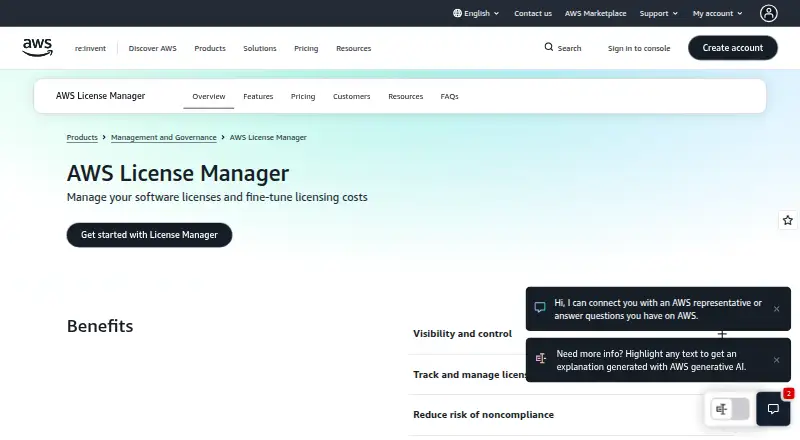
What AWS License Manager is
AWS License Manager helps organizations track software licenses across AWS accounts and Regions, with visibility and reporting for compliance. Administrators can set hard or soft consumption limits and track licenses measured by virtual cores, physical cores, sockets, or machine count. With AWS Systems Manager, the service can discover applications on servers outside AWS and track them alongside AWS resources. Its listed integrations include Amazon EC2, Amazon RDS, AWS Marketplace, AWS Organizations, IAM, CloudFormation, and AWS X-Ray. Software vendors can use managed entitlements to create, distribute, and track licenses under perpetual, floating, subscription, or usage-based models. AWS describes security as a shared responsibility, and says License Manager stores its data in an S3 bucket in the management account with S3 managed encryption keys. AWS lists an example quota of 25 self-managed licenses total in a Region and up to 10 per resource. License Manager has no additional charge, but AWS resources used with it are billed separately; supported user-based subscriptions also have per-user fees and charges for associated users and vCPUs.
Who it suits
The service suits enterprises managing licenses across AWS and on-premises infrastructure, and software vendors distributing licenses to customers. It is relevant to teams that need license limits, tracking, or compliance reporting.
What it does well
- Tracks licenses across AWS accounts and Regions.
- Can discover applications on servers outside AWS.
- Administrators can set hard or soft limits.
- Managed entitlements support four license models.
What to know first
- AWS resources used with it may incur charges.
- Example quota is 25 self-managed licenses per Region.
- User-based subscriptions include fees and associated resource charges.
Limits
License Manager has no additional charge, but AWS resources used with it are billed separately. AWS documentation gives an example quota of 25 self-managed licenses total in a Region and up to 10 per resource.
Plans
| Plan | Billed and limits | Price |
|---|---|---|
| AWS License Manager | No additional charge; related AWS resources are billed at normal AWS rates · No minimum fees · No upfront commitments · Free-tier instances may be free | Free |
As aws.amazon.com lists them, read 15 Oct 2026. The maker's own page has the final word.
Getting started
- Visit the AWS License Manager website.
- Use the web interface or API.
- Connect relevant AWS services, such as Amazon EC2, AWS Organizations, or AWS Systems Manager.
- Set license consumption limits and track license types across your resources.
Overview
AWS License Manager brings software-license tracking and compliance controls into AWS environments, with a route to include on-premises servers. It best fits enterprises already managing AWS infrastructure and vendors distributing software licenses to customers. Its advantage is AWS-connected oversight; it is less suited to buyers looking for a standalone asset-management system spanning unrelated platforms.
Key features
Administrators can set hard or soft consumption limits. Hard limits help guard against exceeding an entitlement, while soft limits allow a less restrictive control. Tracking by virtual core, physical core, socket, or machine count covers several common licensing bases, but teams still need to align those controls with each vendor's terms.
With AWS Systems Manager, the service can discover applications on servers outside AWS and track them alongside AWS resources. That makes it relevant to hybrid estates, though on-premises discovery depends on Systems Manager. Integrations also include Amazon EC2, Amazon RDS, AWS Marketplace, AWS Organizations, AWS Data Exchange, IAM, Service Quotas, CloudFormation, resource tagging, and AWS X-Ray. For AWS-heavy teams, this breadth can tie license work to infrastructure and governance services already in use.
Software vendors can use managed entitlements to create, distribute, and track licenses for end users. Supported models include perpetual, floating, subscription, and usage-based licensing, making this the more relevant side of the service for vendors serving customers with different entitlement structures.
AWS describes security as shared responsibility: customer duties depend on the services and data involved. License Manager stores data in an S3 bucket in the management account, using Amazon S3 managed encryption keys (SSE-S3). Teams should account for those responsibilities and the management-account storage arrangement when deciding how the service fits their security practices.
Pricing
AWS License Manager: free. AWS License Manager has no additional charge, no minimum fees, and no upfront commitments; AWS resources used with it are billed separately, and resource charges may apply. There is no free-trial period to weigh against a paid plan.
The free service is a practical fit for AWS customers who want license controls without a separate License Manager fee. It is not a blanket waiver of infrastructure costs: usage of AWS resources remains chargeable. For supported software, user-based subscriptions use Amazon-provided licenses with per-user subscription fees, and associated users and vCPUs incur charges.
A quota example in AWS documentation is 25 self-managed licenses total in a Region and up to 10 self-managed licenses per resource. These limits matter when modeling larger inventories; the service's no-additional-charge price does not mean every deployment scale is unconstrained.
Platforms
AWS License Manager is available through API and web interfaces and supports hybrid deployment. Its mixed-infrastructure value is strongest when on-premises application discovery through AWS Systems Manager is part of the approach.
Who it's for
Enterprises managing licenses across AWS and on-premises infrastructure get the clearest fit, especially when they need compliance visibility and controls tied to AWS resources. Software vendors can also use managed entitlements to distribute and track licenses across perpetual, floating, subscription, or usage-based models. Buyers seeking a general-purpose asset-management product beyond this AWS-centered context should compare alternatives.
Pros and cons
Pros
- No additional License Manager charge: Customers can use its license controls without a separate service fee, though AWS resource charges remain.
- Hybrid inventory support: Systems Manager discovery can bring applications on outside servers into the AWS license view.
- Multiple licensing bases and controls: Core, socket, and machine-count tracking plus hard or soft limits support different compliance approaches.
- Vendor entitlements: Software makers can manage several common licensing models for end users.
Cons
- AWS resource costs still apply: The free service does not make the infrastructure used with it free.
- Hybrid discovery relies on Systems Manager: On-premises inventory is tied to another AWS service rather than being a standalone discovery path.
- Quotas can constrain larger inventories: The example limits of 25 self-managed licenses per Region and 10 per resource are relevant when planning scale.
- Customer security responsibilities remain: AWS places some security duties on customers, depending on the services and data involved.
Alternatives
For a broader selection, browse Software Asset Management Software.
- LICENSEWARE is worth considering for teams wanting a freemium option with API, Linux, macOS, web, and Windows support; its free plan allows 10 rows per table, while PAYG costs $1 a month on a one-off, consumption-based basis.
- LAMUM (License Asset Manager with Usage Monitoring) may suit teams needing a small free allocation across Linux, macOS, web, and Windows: Parser Lite covers up to 3 licenses, 50 parser users, 10,000 parse lines, 30-day data retention, and 1 admin user.
- SAP Cloud ALM is another free API and web option for eligible support customers, with one tenant per customer number, 24 GB SAP HANA Memory, and 24 GB monthly outbound API data transfer.
- Eracent Software License Management is a paid alternative with a free trial and support for mobile, API, desktop, self-hosted, and web platforms.
- Open iT LicenseAnalyzer is a paid alternative with a free trial and three functionality levels: Runtime Usage, True Active Usage, and Managed Usage.
- K2 KeyServer offers a paid alternative with a free trial; its KeySight plan uses concurrent licensing and is sold in 10-client increments.
- License Dashboard is a paid option supporting API, Linux, web, and Windows.
- Flexera One IT Asset Management is a paid option with a free plan and web or self-hosted platforms; its Flexera One ITAM plan uses custom pricing.
Verdict
AWS License Manager is a strong choice for enterprises that already operate in AWS and need license visibility, compliance controls, or hybrid inventory alongside AWS resources; vendors can also benefit from its managed entitlements. Choose it for that AWS-connected coverage and lack of an additional service fee. Look elsewhere if your priority is a standalone, broader asset-management system or if the stated self-managed-license quotas do not fit your scale.
Verdict
AWS License Manager offers license tracking and controls for AWS and mixed infrastructure, with managed entitlements for vendors. The service itself has no additional charge, but AWS resource charges may apply.
Questions
How much does AWS License Manager cost?
The plan is free, with no additional charge for AWS License Manager. AWS resources used with it are billed separately, and resource charges may apply.
Is there a free plan or trial?
There is a free plan. There is no free trial.
What platforms does it support?
AWS License Manager is available through web and API.
Can it track on-premises software?
With AWS Systems Manager, it can discover applications on servers outside AWS and track them alongside AWS resources.
What license models do managed entitlements support?
They support perpetual, floating, subscription, and usage-based licensing.
Who makes AWS License Manager?
AWS License Manager is an AWS service.
Facts from AWS License Manager's own pages
- API and SDKs
- AWS publishes an API reference, CLI reference and SDK links for License Manager, including Linux-subscription and user-subscription APIs. · docs.aws.amazon.com, 15 Oct 2026
- Automated discovery
- AWS Systems Manager can discover software on EC2 instances, while AWS Organizations supports multi-account discovery and control. · aws.amazon.com, 15 Oct 2026
- Company facts
- LinkedIn lists AWS headquarters in Seattle, company size above 10,001 employees and founding year 2006. · am.linkedin.com, 15 Oct 2026
- Company legal name
- Crunchbase lists the maker as Amazon Web Services, Inc., a subsidiary of Amazon. · crunchbase.com, 15 Oct 2026
- Company ownership and funding
- Crunchbase lists Amazon Web Services as a sub-organization of Amazon and shows one funding round classified as a grant, with the amount obfuscated. · crunchbase.com, 15 Oct 2026
- Data encryption
- License Manager stores data in an S3 bucket in the management account configured with Amazon S3 managed encryption keys (SSE-S3). · docs.aws.amazon.com, 7 Oct 2026
- Dedicated Hosts
- Host resource groups automate Dedicated Host allocation, release and capacity management for licensing scenarios requiring dedicated hardware. · aws.amazon.com, 15 Oct 2026
- Documentation depth
- Documentation includes a user guide, API references, CLI references, security guidance, quotas, endpoints and release history. · docs.aws.amazon.com, 15 Oct 2026
- EC2 lifecycle tracking
- Rules attach to EC2 launches through the console, CLI or API, and usage is tracked through the instance lifecycle with licenses released when instances stop. · aws.amazon.com, 15 Oct 2026
- Encryption at rest
- License Manager stores data in an S3 bucket in the management account using S3-managed SSE-S3 keys. · docs.aws.amazon.com, 15 Oct 2026
- Hard and soft limits
- Administrators can configure hard limits that block non-compliant launches or soft limits that allow launches while sending alerts. · aws.amazon.com, 15 Oct 2026
- Integrations
- Documented integrations include Amazon EC2, Amazon RDS, AWS Marketplace, AWS Systems Manager, AWS Organizations, IAM, Service Catalog, CloudFormation, Service Quotas, resource tagging, X-Ray and Data Exchange. · docs.aws.amazon.com, 15 Oct 2026
- Intended users
- AWS describes License Manager use for enterprises managing licenses across mixed AWS and on-premises infrastructure, and for software vendors distributing licenses to customers. · docs.aws.amazon.com, 7 Oct 2026
- License controls
- Administrators can set hard or soft limits on license consumption to help prevent non-compliant usage. · docs.aws.amazon.com, 7 Oct 2026
- License metrics
- License Manager can track licenses measured by virtual cores, physical cores, sockets or machine count. · docs.aws.amazon.com, 15 Oct 2026
- License models
- Managed entitlements support perpetual, floating, subscription, usage-based and node-locked licensing patterns. · docs.aws.amazon.com, 15 Oct 2026
- License switching
- Windows Server and SQL Server EC2 workloads can switch between AWS-provided licensing and BYOL without redeploying the workload. · aws.amazon.com, 15 Oct 2026
- License types
- The service supports tracking software licensed by virtual cores, physical cores, sockets, or number of machines. · docs.aws.amazon.com, 7 Oct 2026
- Limit: cost and learning curve
- G2 reviewers repeatedly describe the service as expensive and initially difficult to understand or configure. · g2.com, 15 Oct 2026
- Limit: mobile coverage
- The Google Play AWS Console listing describes selected-resource management and browser-based access to some services; it does not list License Manager as a native supported service. · play.google.com, 15 Oct 2026
- Managed entitlements
- Managed entitlements distribute, activate and track seller-issued software rights across AWS accounts and organizations. · docs.aws.amazon.com, 15 Oct 2026
- On-premises inventory
- Systems Manager inventory lets License Manager discover applications on physical or virtual servers outside AWS and track them with cloud resources. · docs.aws.amazon.com, 15 Oct 2026
- Praise: centralization
- G2 reviewers repeatedly praise centralized license management across accounts and environments, dashboards and license-usage visibility. · g2.com, 15 Oct 2026
- Purpose
- AWS License Manager helps manage software vendor licenses across AWS Regions and accounts, with visibility and reporting for software license compliance. · docs.aws.amazon.com, 7 Oct 2026