Freedom251 › Portfolio Management Software
rotki
by rotki
What rotki is
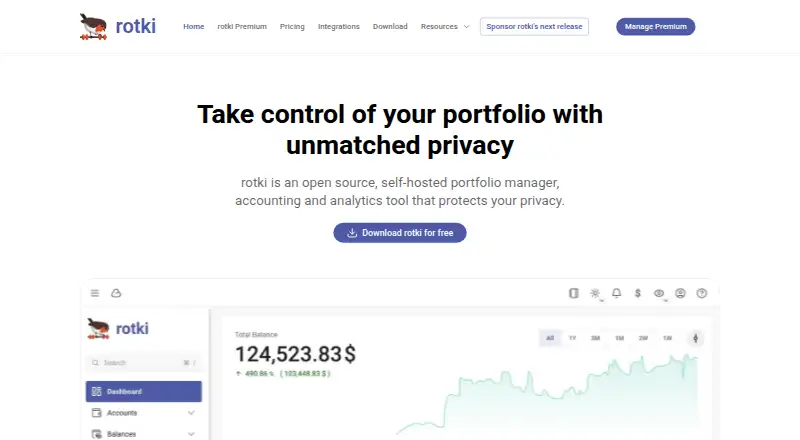
rotki is an open-source, self-hosted portfolio manager, accounting, and analytics tool focused on privacy. It runs locally on Linux, macOS, and Windows, or can be self-hosted, and stores its database on the user's device with SQLCipher encryption using 256-bit AES. Exchange connections use read-only API keys processed locally, while blockchain connections use RPC endpoints chosen by the user. Its dashboard tracks assets, liabilities, exposure percentages, and changes in net worth over time. rotki turns on-chain activity into readable events and produces profit-and-loss and tax reports. The integrations page lists numerous blockchains, including Ethereum, Bitcoin, Avalanche, Polygon PoS, Arbitrum One, and Base, plus early Solana support; the tool also says it detects and decodes more than 140 DeFi protocols. The free plan includes up to 1,000 recent events and 10 notes. Paid plans add features such as graphs, advanced staking, higher event limits, and DeFi historical profit-and-loss reporting. Prices include €9 a month for Supporter, €25 a month for Basic, and €45 a month for Advanced.
Who it suits
rotki suits people who want to track portfolios and account for crypto activity while keeping data locally. Users preparing tax reports should review them with qualified advisors, as rotki does not provide tax or legal advice.
What it does well
- Encrypted local database uses 256-bit AES.
- Exchange API keys are processed locally.
- Tracks assets, liabilities, exposure, and net-worth changes.
- Decodes more than 140 DeFi protocols.
What to know first
- Free plan is limited to 1,000 recent events.
- Free plan includes up to 10 notes.
- Users are responsible for reviewing tax reports.
Limits
The Free plan and Starter plan allow up to 1,000 recent events and up to 10 notes; Starter also excludes ETH staking. Paid plans list higher limits, with exact limits depending on the plan. Premium features include graphs, advanced staking, higher event limits, decentralized-exchange accounting and DeFi historical profit-and-loss reporting.
Plans
| Plan | Billed and limits | Price |
|---|---|---|
| Free | 1,000 recent events · 10 user notes | Free |
| Starter | 1K historical events | Free |
| Basic | Billed monthly · 30K historical events · up to 2 devices · standard support | €25 a month |
| Advanced | Billed monthly · 100K historical events · up to 4 devices · standard support | €45 a month |
| Supporter | Billed monthly · 3K historical events · 1 device | €9 a month |
| Custom | Negotiable event and device limits · bespoke customization assistance | On request |
As rotki.com lists them, read 20 Sept 2026. The maker's own page has the final word.
Getting started
- Visit rotki’s website.
- Choose Linux, macOS or Windows, or use the self-hosted option.
- Connect exchanges with read-only API keys and choose RPC endpoints for blockchain connections.
- Start with the Free plan or select a paid plan for additional features and limits.
- Review generated tax reports with a qualified advisor.
rotki is a local-first crypto portfolio and accounting tool for people who want to keep financial data on their own device. It suits privacy-minded investors who can manage local software and exchange keys. The free core covers tracking and reports, while richer analytics and some accounting features sit behind paid plans.
Overview
Unlike a hosted portfolio service, rotki runs locally, reads exchange data through read-only API keys, and accesses blockchains through RPC endpoints the user chooses. Its database is encrypted with SQLCipher and 256-bit AES. That gives users control over where their records are stored, but also makes device security and setup their responsibility.
The dashboard brings assets, liabilities, exposure percentages, and net-worth changes into one view. Rotki also decodes on-chain activity into readable events and produces profit-and-loss and tax reports. These are useful accounting outputs, not professional advice: users are responsible for reviewing them with qualified advisors.
Key features
Blockchain integrations include Ethereum, Bitcoin, Bitcoin Cash, Kusama, Avalanche, Polkadot, Optimism, Polygon PoS, Arbitrum One, Base, Hyperliquid, Gnosis, Scroll, Binance Smart Chain, Monad, and ZKSync Lite, with early Solana support. Centralized exchanges can import balances, trades, deposits, and withdrawals; API keys are processed locally. That makes rotki a practical choice for combining wallet and exchange activity without handing exchange credentials to a hosted service.
More than 140 DeFi protocols are automatically detected and decoded, and rotki supports NFTs. Premium adds decentralized-exchange accounting, DeFi historical profit-and-loss reporting, advanced staking, graphs and analytics, and higher event limits. These additions matter most to active DeFi users; those who mainly need a record of holdings can stay with the core features, subject to event and note caps.
Premium also enables encrypted database backup and synchronization across devices, with decryption controlled by the user's password. CSV is the supported tax form format, so readers who need another output format should look elsewhere.
Pricing
Rotki is freemium. Its two free options provide core features, but neither is a full substitute for paid analytics and accounting additions.
- Free: free; up to 1,000 recent events and 10 user notes. Best for trying the portfolio and accounting workflow or tracking a modest activity history.
- Starter: free; core features, up to 1,000 recent events, up to 10 notes, and no ETH staking. This is the clearest fit for users content with a capped free setup and without ETH staking needs.
- Supporter: €9 a month, billed monthly in EUR. It raises limits above Free, but exact limits depend on plan; a reader who needs a known event allowance should confirm it before subscribing.
- Basic: €25 a month, billed monthly in EUR. It likewise offers higher limits than Free, with exact limits dependent on plan.
- Advanced: €45 a month, billed monthly in EUR. It offers higher limits than Free; exact limits depend on plan.
- Custom: custom pricing for a plan suited to your needs.
Supporter, Basic, and Advanced are progressively priced options, but the plan descriptions do not establish a specific limit or feature difference between those tiers. Choose based on confirmed requirements rather than assuming the higher fee buys a particular quota.
Platforms
Rotki is available for Linux, macOS, Windows, and self-hosted use. Its local-first design will appeal to people who prefer control of their data, but is less suited to anyone seeking a purely hosted workflow.
Who it's for
Rotki is best for crypto holders who want privacy-oriented portfolio tracking, readable blockchain activity, and accounting reports in one local tool. Its broad chain and DeFi coverage can serve users with activity across wallets, exchanges, and protocols. It is a weaker fit for people who want tax advice, a non-CSV tax format, or advanced analytics without paying for Premium.
Pros and cons
- Pro: Local storage, locally processed exchange keys, and encrypted data give privacy-conscious users meaningful control over their portfolio records.
- Pro: Portfolio tracking, exchange imports, chain activity decoding, and DeFi protocol detection bring several parts of crypto accounting together.
- Con: Free plans cap recent events at 1,000 and notes at 10, which may constrain users with longer or more detailed histories.
- Con: Graphs, advanced staking, higher event limits, DEX accounting, and DeFi historical P&L require Premium, limiting the free tier for active users.
- Con: Users must review tax reports with qualified advisors, and CSV is the only supported tax form format.
Alternatives
For a different crypto accounting or tax workflow, compare Crypto Accounting Software, Crypto Tax Software, and Portfolio Management Software.
- Kryptos is worth considering if mobile or web access matters more than rotki's local-first approach; it has Android, iOS, and web platforms, a free tier capped at 100 transactions per tax year, and a $6.99 a month Pro Membership.
- Pacioli may suit readers seeking a free, open-source alternative across Linux, macOS, Windows, web, or self-hosted use, but it is pre-launch and packaged installers are not yet available.
- CoinTracking is an option for readers who prefer Android, iOS, or web access; its free plan is portfolio-view only, with a 7-day unlimited-import trial and no credit card required.
- CryptaCount may fit a web-based B2B workflow; its free tier is limited to one user, workspace, wallet, 1,000 transactions per month, and one blockchain.
- HQ Wealth offers a web-based free tier with one portfolio and a watermarked tax extract, making it worth comparing for a hosted portfolio workflow.
- Tokenbooks is a web and API alternative whose free tier permits one portfolio, five wallets, and 1,000 total transactions.
- Wag3s is a web alternative with a Starter plan free during Alpha; its stated features include wallet tracking, one-click tax reports, AI categorization, multi-chain support, and portfolio analytics.
- Reckonry is another free option for Linux, Windows, or self-hosted use.
Verdict
Choose rotki if you want a privacy-oriented, local crypto portfolio and accounting tool, especially for activity across chains, exchanges, and DeFi. Its local storage and broad decoding coverage are the strongest reasons to choose it; look elsewhere if you need professional tax advice, another tax output format, or advanced analytics without a paid plan.
Verdict
rotki brings local portfolio tracking, blockchain activity decoding, and tax reporting together, with a free plan and paid additions. Its tax reports are not tax or legal advice and require user review with qualified advisors.
Questions
Is rotki free?
Yes. The Free plan is listed as free, and Starter is listed as free. Both include up to 1,000 recent events and up to 10 notes.
What do the paid plans cost?
Supporter costs €9 a month, Basic costs €25 a month and Advanced costs €45 a month. A Custom plan is also available, with price not listed.
Which platforms does rotki support?
It is available for Linux, macOS and Windows, and can also be self-hosted.
Is rotki open source?
Yes. rotki is described as an open-source tool.
Does rotki provide tax advice?
No. rotki says it does not provide tax or legal advice and that users are responsible for reviewing reports with qualified advisors.
What does Premium add?
Premium adds graphs and analytics, advanced staking, higher event limits, decentralized-exchange accounting and DeFi historical profit-and-loss reporting. It also allows encrypted database backup and synchronization across devices.
Facts from rotki's own pages
- Accounting and tax
- rotki decodes on-chain activity into readable events and produces profit-and-loss and tax reports. · rotki.com, 1 Oct 2026
- Blockchain integrations
- The integrations page lists Ethereum, Bitcoin, Bitcoin Cash, Kusama, Avalanche, Polkadot, Optimism, Polygon PoS, Arbitrum One, Base, Hyperliquid, Gnosis, Scroll, Binance Smart Chain, Monad, ZKSync Lite, and early Solana support. · rotki.com, 1 Oct 2026
- Company
- Rotki Solutions GmbH lists Matthiasstr. 11, 10249 Berlin, Germany, and names Eleftherios Karapetsas as its representative. · rotki.com, 1 Oct 2026
- Company facts
- LinkedIn lists Rotki Solutions GmbH as privately held, headquartered in Berlin, founded in 2020 and employing 2–10 people. · linkedin.com, 21 Oct 2026
- CSV import
- CSV files can be imported for exchanges without an API integration, including generic custom formats. · docs.rotki.com, 21 Oct 2026
- Data synchronization
- Premium users can back up and synchronize an encrypted database across devices, with decryption controlled by their password. · rotki.com, 1 Oct 2026
- DeFi decoding
- The application converts raw blockchain activity and DeFi positions into readable accounting events. · rotki.com, 21 Oct 2026
- DeFi integrations
- rotki says more than 140 DeFi protocols are automatically detected and decoded. · rotki.com, 1 Oct 2026
- Developer extensibility
- Developers can build from source, run Python and Vue/TypeScript workflows, use Docker publishing guidance and contribute through GitHub issues and pull requests. · docs.rotki.com, 21 Oct 2026
- Documentation depth
- Documentation includes installation, usage, accounting, integrations, settings, troubleshooting, mobile/Docker, premium APIs, contribution guides and LLM-friendly files. · docs.rotki.com, 21 Oct 2026
- Download options
- Prebuilt packages are available as Linux AppImage or tarball, macOS Intel or Apple Silicon DMG, and Windows installer, with checksum or attestation verification guidance. · docs.rotki.com, 21 Oct 2026
- Encryption
- rotki stores its local database encrypted with SQLCipher using 256-bit AES. · rotki.com, 1 Oct 2026
- Exchange integrations
- Centralized exchanges connect through API keys to import balances, trades, deposits, and withdrawals, with API keys processed locally. · rotki.com, 1 Oct 2026
- External data services
- Supported external services include Etherscan, Blockscout, Helius, CryptoCompare, Beaconchain, OpenSea, Alchemy, Moralis, The Graph, DefiLlama and CoinGecko. · docs.rotki.com, 21 Oct 2026
- Founded
- 2017 · rotki.com, 28 Sept 2026
- Free plan
- Yes · rotki.com, 20 Sept 2026
- Funding news
- Octant reported on January 22, 2024 that rotki was participating in its funding round and seeking funds for salaries and additional developers. · octant.build, 21 Oct 2026
- Independent listing
- GoodFirms lists rotki as open-source and self-hosted, with a starting price of €9 per month and a free version. · goodfirms.co, 21 Oct 2026
- Indexer cost limitation
- The 1.44.1 release notes say Base requires a paid Etherscan or Blockscout key, while Polygon’s free Blockscout tier ended. · github.com, 21 Oct 2026
- Integration limitation
- Loopring tracking was removed in version 1.44 because the Loopring API shut down; historical data remains but new balances are not queried. · docs.rotki.com, 21 Oct 2026
- Integrations
- The product advertises support for more than 190 exchanges, blockchains and DeFi protocols, including Ethereum, Bitcoin, Solana, Kraken, Coinbase and Binance. · rotki.com, 21 Oct 2026
- Licence
- The public rotki repository is licensed under AGPL-3.0. · github.com, 21 Oct 2026
- Limit: coverage
- A Reddit discussion describes rotki as having potential but says users may need to become more involved with the community. · reddit.com, 21 Oct 2026
- Local-first
- rotki runs locally, reads exchanges through read-only API keys and chains through chosen RPC endpoints, and stores data on the user's device. · rotki.com, 1 Oct 2026
Where rotki stands on Freedom251
- Portfolio Management Software#1 of 81
- Crypto Tax Software#1 of 21
- Cryptocurrency Tax Calculator#1 of 18
- Crypto Portfolio Management software#1 of 13
- Crypto Accounting Software#2 of 25
- Nft Portfolio Management#1 of 5