Freedom251 › Crypto Accounting Software
Tokenbooks
What Tokenbooks is
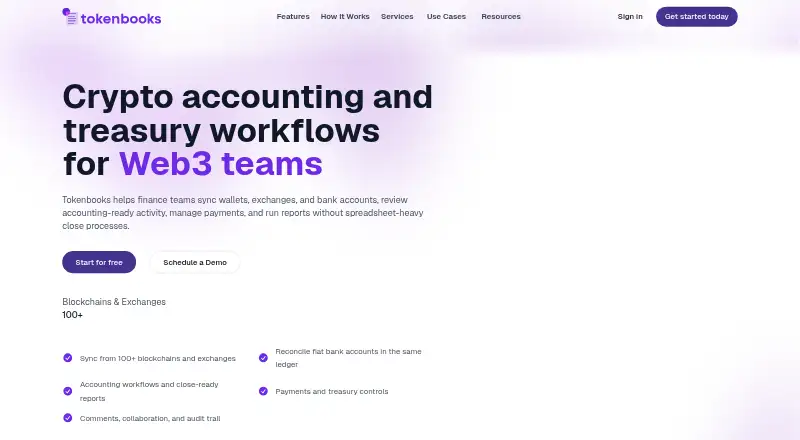
Tokenbooks provides crypto accounting and treasury workflows for Web3 finance teams and crypto-native businesses. It syncs wallet, exchange, and bank activity, with support listed for more than 100 blockchains and exchanges. Accounting features include reviewable transactions and journals, ledgers, cost basis, financial reports, and exports. Teams can request and approve payments, execute through Safe, and handle fiat payouts linked to accounting. Comments, collaboration tools, and an audit trail give reviewers context. Named integrations include EVM chains, Coinbase, Kraken, Ledger, Solana, and NEAR; the Growth plan adds QuickBooks Online and Xero connections. Its public API can embed multi-chain accounting in portfolio apps, wallets, or trading platforms, and also powers its MCP server. Tokenbooks describes workflows through Claude, ChatGPT, or a user's own agent with audit trails and sign-off gates. The Free plan costs nothing and includes one portfolio, five wallets, and 1,000 total transactions. Solo is $99 a year; Growth is $399 a year; and Treasury is $999 a year. Enterprise pricing is custom. The site also lists paid services from $2,000/mo.
Who it suits
Tokenbooks suits Web3 finance teams and crypto-native businesses handling multi-chain accounting and treasury workflows. Its API may also suit products embedding accounting, and bookkeeping services are available for monthly crypto and fiat reconciliation.
What it does well
- Syncs from 100+ blockchains and exchanges.
- Includes journals, ledgers, cost basis, and reports.
- Free plan includes one portfolio and five wallets.
- Public API supports embedded multi-chain accounting.
- Says it never stores users' private keys.
What to know first
- Free plan is limited to 1,000 total transactions.
- QuickBooks Online and Xero connections require Growth.
- Enterprise pricing is custom.
Limits
The Free plan allows one portfolio, five wallets, and 1,000 total transactions. Solo allows two portfolios, 25 wallets, and 10,000 transactions; Growth allows three portfolios, 50 wallets, and 50,000 transactions.
Plans
| Plan | Billed and limits | Price |
|---|---|---|
| Free | No charge · 1 portfolio · 5 wallets · 1,000 total transactions | Free |
| Starter bookkeeping | monthly · 250 close credits · workspace included · monthly crypto and fiat reconciliation · close by 10th business day · Slack or Telegram accountant access | $2,000 a month |
| Books Diagnostic | Refunded if Tokenbooks cannot scope the work; credited against first paid month · 3 business days · source inventory · volume estimate · coverage check · written unsupported-items list · recommended plan | $250, paid once |
| Catch-up | From $2,500 quoted after diagnostic · Historical rebuild · transfer matching · statement reconciliation · journal posting | $2,500, paid once |
| Growth bookkeeping | monthly · 400 close credits · everything in Starter · cost-center and project reporting · payout runs prepared for approval | $3,000 a month |
| Growth | billed annually · 3 portfolios · 50 wallets · 50,000 total transactions · QuickBooks Online and Xero · classification rules · general ledger and cost-basis ledger | $399 a month |
| Treasury bookkeeping | monthly · 1,000 close credits · everything in Growth · multi-entity reporting · advanced DeFi review | $6,000 a month |
| Solo | billed annually · 2 portfolios · 25 wallets · 10,000 total transactions · daily wallet/exchange refresh · financial statements and exports | $99 a month |
The first 8 of 10 plans, as tokenbooks.io lists them, read 15 Oct 2026. The maker's own page has the final word. Every plan
Getting started
- Visit the Tokenbooks website.
- Choose a plan: Free, Solo, Growth, Treasury, or Enterprise.
- Use the web platform or API, depending on your workflow.
- Connect supported wallets, exchanges, banks, or named integrations.
- For bookkeeping services, explore the offering that includes monthly crypto and fiat reconciliation.
Tokenbooks is built for Web3 finance teams and crypto-native businesses that need accounting, treasury payments, and review controls in one workflow. It also suits software makers embedding multi-chain accounting through an API. The strongest case is connected accounting and payment approval; smaller teams should weigh the portfolio, wallet, and transaction caps carefully against the annual tiers.
Overview
Tokenbooks brings wallet, exchange, and bank syncing into a crypto accounting and treasury workspace. It supports reviewable transactions and journals, ledgers, cost basis, financial reports, and exports, so finance staff can move from imported activity to records suitable for review and reporting.
Payment workflows cover requests, approvals, Safe execution, and fiat payouts tied to accounting. Comments, collaboration, and an audit trail preserve the context behind reviews and sign-offs. That combination is more relevant to an operating finance team than a portfolio tracker that stops at balances and transactions.
Tokenbooks also offers bookkeeping services with monthly crypto and fiat reconciliation, including the Tokenbooks workspace. Teams wanting software plus recurring operational support may find that model practical.
Key features
- Multi-source accounting: Tokenbooks says it syncs from more than 100 blockchains and exchanges. Named connections include EVM chains, Coinbase, Kraken, Ledger, Solana, and NEAR. Wallet and exchange imports, tax-lot tracking, accounting exports, and multi-entity support cover the core mechanics of crypto finance.
- Review and close workflows: Reviewable transactions, journals, ledgers, cost basis, reports, and exports provide a path from raw activity to accounting output. Growth adds QuickBooks Online and Xero connections for close-ready journal entries, making that tier more suitable when an existing accounting system is part of the close process.
- Payments with controls: Requests and approvals, Safe execution, and fiat payout workflows keep treasury actions linked to accounting records. Comments, collaboration, and an audit trail help distributed teams explain and approve decisions.
- Embedded accounting: The public API is intended for portfolio apps, wallets, and trading platforms that need multi-chain accounting features. Tokenbooks says the same API powers its MCP server. AI workflows can be driven through Claude, ChatGPT, or a user's own agent, with audit trails and sign-off gates rather than an approval-free automation path.
- Key security position: Tokenbooks says it never stores users' private keys and describes its security as industry-leading. That is a meaningful fit for teams that want imports and workflows without handing over custody.
Pricing
The Free plan costs 0.00 USD with no charge and allows 1 portfolio, 5 wallets, and 1,000 total transactions. It is useful for evaluating the workflow or running a small operation, but the caps leave little room for a broad treasury footprint.
Solo costs $99 a year, billed annually, and raises capacity to 2 portfolios, 25 wallets, and 10,000 total transactions. It fits an individual operator or a compact Web3 business that has outgrown the free limits.
Growth costs $399 a year, billed annually, with 3 portfolios, 50 wallets, and 50,000 total transactions. Its QuickBooks Online and Xero connections make it the practical step for teams that need accounting-system close entries as well as larger import capacity.
Treasury costs $999 a year, billed annually, and provides 5 portfolios, 100 wallets, and 150,000 total transactions. This is the clearest fit for a larger treasury operation managing many wallets and sustained transaction volume.
Enterprise uses custom annual pricing with custom capacity, permissions, security controls, and commercial terms. Tokenbooks also states that paid plans start from $2,000/mo, so buyers should confirm how that figure relates to the annual self-serve tiers before committing budget.
Platforms
Tokenbooks is offered through the web and an API. The API matters for products that want to embed accounting in their own portfolio, wallet, or trading experience; the web workspace serves finance teams managing the underlying records and approvals.
Who it's for
Choose Tokenbooks if you run a Web3 finance function that must reconcile activity across wallets, exchanges, and entities while coordinating payment approvals. It also makes sense for crypto-native businesses that want comments, audit history, and sign-off around treasury actions, or for product teams embedding multi-chain accounting.
It is less compelling for a casual investor who only needs a personal portfolio view, or for a very small operation whose activity stays comfortably below the Free plan's 1,000-transaction and five-wallet limits.
Pros and cons
Pros
- Accounting and treasury in one workflow: Payment requests, approvals, Safe execution, and fiat payouts connect directly to accounting records.
- Broad crypto coverage: Syncing across 100+ blockchains and exchanges, with named EVM, Coinbase, Kraken, Ledger, Solana, and NEAR integrations, reduces the need to split source data across tools.
- Review controls: Comments, collaboration, audit trails, and sign-off gates support accountable team processes.
- Integration path: The public API and MCP-powered workflows support embedded accounting and agent-driven operations.
- Non-custodial stance: Tokenbooks says it never stores private keys.
Cons
- Capacity is tightly tiered: The free plan's 1 portfolio, 5 wallets, and 1,000 transactions can be restrictive for an active treasury.
- Accounting-system connections are tier-specific: QuickBooks Online and Xero arrive with Growth, not the lower tiers.
- Budgeting needs clarification: Annual plan prices sit alongside a separate $2,000/mo paid-from figure, which may affect how larger buyers compare tiers.
Alternatives
Kryptos is a better fit when you want Android and iOS apps alongside web and API access, with a free tier capped at 100 transactions per tax year and a paid Pro Membership at $6.99 a month.
Pacioli suits readers seeking free, open-source software that can run on Linux, macOS, Windows, or a self-hosted setup.
CoinTracking is worth choosing for a portfolio-oriented service with mobile apps, API and web access, a free portfolio-view plan, and a 7-day unlimited-import trial.
rotki is the alternative for users who prefer Linux, macOS, Windows, or self-hosting and need a free tier covering 1,000 recent events and 10 user notes.
CryptaCount targets web-based business use, with a B2B Free tier for one user, one workspace, one wallet, and 1,000 transactions per month.
HQ Wealth is aimed at portfolio users who want a free-forever web tier with one portfolio and five on-chain scans per portfolio each month.
Wag3s is a free web option during its Alpha period, combining wallet tracking, tax reports, AI categorization, multi-chain support, and portfolio analytics.
Reckonry is a free alternative available for Linux, Windows, and self-hosted deployments.
For a broader comparison, see Crypto Accounting Software.
Verdict
Tokenbooks is the right choice for Web3 finance teams that need imported crypto activity, accounting records, treasury payments, and review trails to operate together. Its main reason to choose it is that connected workflow, strengthened by API access and multi-entity support. Look elsewhere if your needs are limited to personal portfolio tracking, mobile-first access, or a very small transaction footprint, or if the annual tiers do not align with the separate $2,000/mo starting figure.
Verdict
Tokenbooks combines crypto accounting, payment workflows, and an API for embedding accounting features. Compare the portfolio, wallet, and transaction limits with the listed plan costs before choosing a tier.
Questions
Is there a free plan?
Yes. Free costs $0.00 per free plan and is billed as no charge; it includes one portfolio, five wallets, and 1,000 total transactions.
How much do the paid plans cost?
Solo is $99.00 per year, Growth is $399.00 per year, and Treasury is $999.00 per year, each billed annually. Enterprise uses a custom annual agreement with no listed price.
Which platforms does Tokenbooks support?
The listed platforms are web and API.
Does it connect to QuickBooks Online or Xero?
The Growth plan adds QuickBooks Online and Xero connections for close-ready journal entries.
Does Tokenbooks offer an API?
Yes. Its public API is for embedding multi-chain accounting in portfolio apps, wallets, or trading platforms, and also powers its MCP server.
Who makes Tokenbooks?
The site identifies Pavel Kudinov as Founder & CEO.
Facts from Tokenbooks's own pages
- Accounting
- The product supports reviewable transactions and journals, ledgers, cost basis, financial reports, and exports. · tokenbooks.io, 30 Sept 2026
- Accounting integrations
- The Growth plan adds QuickBooks Online and Xero connections for close-ready journal entries. · tokenbooks.io, 30 Sept 2026
- Accounting workflow
- The product turns synchronized activity into reviewable transactions, journals, ledgers, cost basis and close-ready reports. · tokenbooks.io, 15 Oct 2026
- AI workflows
- Tokenbooks describes driving the product through Claude, ChatGPT, or a user's own agent with audit trail and sign-off gates. · tokenbooks.io, 30 Sept 2026
- API
- Tokenbooks offers a public API for embedding multi-chain accounting in portfolio apps, wallets, or trading platforms, and says the API also powers its MCP server. · tokenbooks.io, 30 Sept 2026
- API capabilities
- The API covers user and workspace onboarding, portfolios, wallets, asynchronous sync jobs, transactions, balances and report exports. · tokenbooks.io, 15 Oct 2026
- API purpose
- The Public API is intended for embedding multi-chain accounting in portfolio apps, wallets and trading products. · tokenbooks.io, 15 Oct 2026
- Breach notification
- The privacy policy says Tokenbooks will notify authorities within 72 hours when required after a breach and will try to notify users. · tokenbooks.io, 15 Oct 2026
- Circle partnership listing
- Circle's partner directory lists Tokenbooks for crypto accounting, controlled payments, treasury management and B2B payouts. · partners.circle.com, 15 Oct 2026
- Collaboration
- Comments, review context and an audit trail are kept with the accounting workflow. · tokenbooks.io, 15 Oct 2026
- Company headquarters
- Crunchbase lists headquarters in North Vancouver, British Columbia, Canada. · crunchbase.com, 15 Oct 2026
- Company legal name
- Crunchbase identifies the legal entity as Ledgertech Inc. · crunchbase.com, 15 Oct 2026
- Company size
- LinkedIn lists Tokenbooks as privately held with 2–10 employees and headquarters in Vancouver. · ca.linkedin.com, 15 Oct 2026
- Cost basis
- The platform provides cost-basis tracking and a dedicated cost-basis ledger. · tokenbooks.io, 15 Oct 2026
- Data-feed limitation
- A LinkedIn company update says live bank feeds through Plaid-like providers are on the roadmap; current bank support is statement-file import. · ca.linkedin.com, 15 Oct 2026
- ERP integrations
- The Growth plan lists QuickBooks Online and Xero connections for journal entries. · tokenbooks.io, 15 Oct 2026
- Fair-market value
- Tokenbooks describes fair-market-value processing for transactions and reporting. · tokenbooks.io, 15 Oct 2026
- Founder
- The official site identifies Pavel Kudinov as founder and CEO. · tokenbooks.io, 15 Oct 2026
- Integrations
- Named integrations include EVM chains, Coinbase, Kraken, Ledger, Solana, and NEAR. · tokenbooks.io, 30 Sept 2026
- Licence
- Terms grant only a limited, non-exclusive, non-transferable and revocable licence to use the software. · tokenbooks.io, 15 Oct 2026
- MCP support
- A first-party MCP server exposes the same accounting surface to agents such as Claude, ChatGPT, Cursor and Codex. · tokenbooks.io, 15 Oct 2026
- Named integrations
- Official pages name EVM chains, Coinbase, Kraken, Ledger, Solana and NEAR integrations. · tokenbooks.io, 15 Oct 2026
- Notable news
- Circle's directory page records Tokenbooks as a listed partner with an entry last updated August 26, 2026. · partners.circle.com, 15 Oct 2026
- Open-source scope
- The Tokenbooks GitHub organization says some core infrastructure remains private, so the accounting product is not presented as open source. · github.com, 15 Oct 2026
Where Tokenbooks stands on Freedom251
- Crypto Accounting Software#9 of 25